Welcome to your next lesson in our course on contemporary Indian politics. In our last session, we explored how V.P. Singh's implementation of the Mandal Commission report acted as a political catalyst, permanently centering OBC identity in national politics and triggering a "silent revolution" in the Hindi heartland. We saw how this decision, validated by the Supreme Court, redrew the map of political competition.
Today, we will analyze the most direct and powerful consequence of that revolution: the rise of regional parties dedicated to the cause of 'social justice'. Our focus will be on Uttar Pradesh and Bihar, the epicenters of this political transformation, and the two leaders who came to personify it: Mulayam Singh Yadav and Lalu Prasad Yadav. We will trace their political origins, examine the social coalitions they built, and analyze their model of governance, which combined profound social empowerment with significant political and economic critiques.
The Ideological Forebears: Lohia and Charan Singh
The rise of Mulayam Singh and Lalu Prasad was not a spontaneous event. They were the inheritors of two distinct, yet converging, streams of non-Congress politics that had been developing in North India for decades. To understand their political DNA, we must first look at their ideological godfathers: Rammanohar Lohia and Charan Singh.
The Rise Of the Other Backward Classes in the Hindi Belt
Christophe Jaffrelot's paper, which we consulted in the last lesson, provides an excellent foundation for understanding these ideological roots. It traces the intellectual lineage that the new OBC leaders would claim.
First, read the initial section on Rammanohar Lohia. Focus on his core argument that in India, caste, not class, was the primary axis of inequality. Note his call for "preferential opportunities" and a 60% quota, which formed the bedrock of what became known as 'quota politics'. Next, read the section on Charan Singh. Understand his alternative approach of 'kisan politics', which sought to unite cultivating castes under a peasant identity, famously encapsulated in the AJGAR coalition (Ahir, Jat, Gujar, Rajput). This strategy focused on agrarian interests rather than caste quotas. Finally, read the section titled "The Janata Dal and the Empowerment of the Lower Castes". This will show you how the V.P. Singh-led Janata Dal of 1989 was an amalgamation of these two legacies. V.P. Singh's decision to implement the Mandal report signaled a decisive victory for Lohia's 'quota politics' over Charan Singh's 'kisan politics', creating the perfect political storm for dedicated OBC leaders to rise.
As the reading makes clear, the political ground was fertile. Lohia had provided the language of caste-based social justice, while Charan Singh had demonstrated the power of mobilizing intermediate and backward cultivating castes. When V.P. Singh implemented the Mandal report, he threw a match on this political kindling. The Janata Dal, a loose coalition, soon fractured. From its fragments, leaders who were more authentically and aggressively rooted in the politics of OBC identity built their own powerful regional outfits.
The Rise of the Yadav Chieftains
The 1990s belonged to Mulayam Singh Yadav in Uttar Pradesh and Lalu Prasad Yadav in Bihar. They were not just politicians; they were symbols of a dramatic power shift from the upper castes to the numerically dominant backward castes, particularly their own Yadav community.
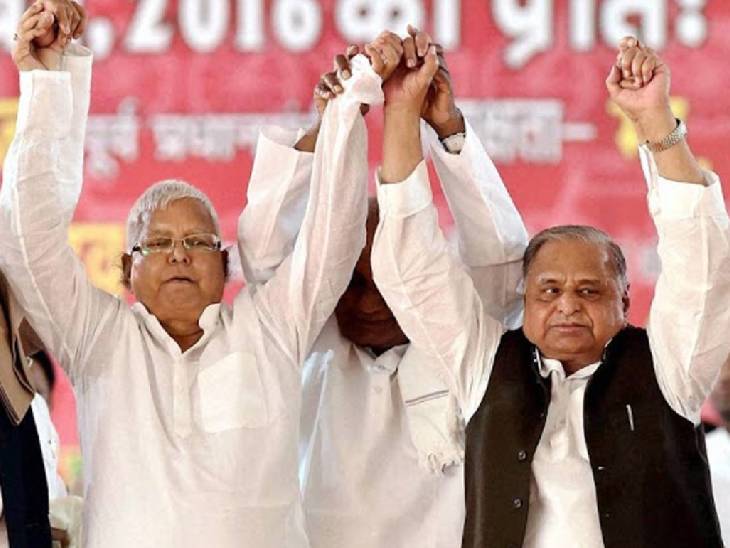
Though they often allied on the national stage, their rise and rule in their respective states followed distinct, yet parallel, tracks.
Bihar: From Social Churn to Lalu's Reign
Bihar, in many ways, was the laboratory for modern caste politics. The demand for a share in power by backward castes had been simmering for decades before Lalu's arrival.
Why Bihar’s OBC politics brought 'half a social justice', left it impoverished, while TN prospered
This video from ThePrint provides an excellent narrative of the political history that culminated in Lalu Yadav's chief ministership.
First, watch the introductory segment that establishes Bihar as the fountainhead of modern caste politics, where backward castes began demanding their share of power. Next, focus on the period after 1967, which saw the emergence of leaders like Karpoori Thakur, a backward caste leader who, as Chief Minister in the 1970s, implemented his own version of reservations, laying the groundwork for Mandal. Finally, watch the crucial section describing the transfer of power in 1990. It highlights how Lalu Yadav's victory marked the end of upper-caste chief ministers and the beginning of an unbroken, 33-year period of rule by backward caste-led combinations.
Lalu Prasad Yadav's rise in 1990 was transformative. Emerging from the JP Movement against the Emergency, he became the undisputed champion of Bihar's backward castes and minorities. His political genius lay in forging an almost invincible electoral coalition known as M-Y (Muslim-Yadav). Yadavs constituted the largest and most assertive OBC group, while Muslims, feeling insecure after the Babri Masjid demolition, saw him as their protector.
His slogan was simple: social dignity. He gave the poor and the downtrodden a political voice (swar) and the confidence to challenge centuries of upper-caste dominance. For his supporters, he was a messiah of social justice. For his detractors, his rule, and that of his wife Rabri Devi who succeeded him, became synonymous with "Jungle Raj"—a period marked by economic stagnation, crumbling infrastructure, and a breakdown of law and order.
Uttar Pradesh: Mulayam Singh's Socialist Politics
In Uttar Pradesh, a state with even more complex caste dynamics, Mulayam Singh Yadav charted a similar path. A wrestler and a teacher by training, he was a disciple of Rammanohar Lohia. After the Janata Dal experiment collapsed, he founded the Samajwadi Party (SP) in 1992.
Like Lalu, Mulayam mastered the art of social engineering. He replicated the M-Y formula in UP, positioning himself as the primary protector of Muslims, especially after the Babri Masjid demolition, while consolidating his base among the Yadavs.
Analyzing the 'Social Justice' Model of Governance
The rise of the SP and the Rashtriya Janata Dal (RJD) represented a new "third space" in Indian politics, challenging the dominance of both the Congress and the BJP in India's most populous states. However, as these parties became entrenched in power, the very model that brought them to prominence began to reveal its internal contradictions.
[PDF] The Backwards Turn Right in the Hindi Belt - Indian Politics & Policy
This paper by Sanjay Kumar and Pranav Kumar provides a sharp analysis of the trajectory of these social justice parties, explaining both their initial success and the reasons for their eventual decline in popularity among the very voters they claimed to represent.
First, read the Introduction and the sections on the "Political Mobilization of OBCs" and "Changing Political Preference". This will reinforce your understanding of how parties like the RJD and SP emerged to fill a "third space" by capturing the OBC vote. Now, focus carefully on the section "Explaining the Drift". This is the core of the analysis. It details the internal factors that weakened these parties. Pay attention to three key criticisms: The phenomenon of "Yadavization": how the perception grew that these parties disproportionately favored their own caste group, alienating other powerful OBCs like the Kurmis and Koeris. The problem of dynastic politics: how the parties became tightly controlled family fiefdoms, stifling internal democracy and causing experienced leaders to leave. The failure to broaden the agenda: once reservations were achieved, the parties struggled to move beyond caste identity and offer a compelling vision for development and governance.
Let's use this framework to analyze the governance model of these parties.
Achievements:
- Political Representation: Their greatest success was the irreversible transfer of political power. They broke the upper-caste stranglehold on politics in the Hindi belt, filling legislatures and ministries with people from backward communities.
- Social Dignity: As noted with Lalu, their rule fostered a sense of empowerment and self-respect among marginalized groups that cannot be measured by economic data alone.
Failures and Criticisms:
- "Yadavisation": The Jaffrelot paper provides stark data on this. Both Lalu and Mulayam were accused of packing the state administration and police force with members of their own caste. This created immense resentment among other backward and most backward castes (MBCs), who felt that the fruits of Mandal had been hijacked by a single community. This internal division would later be expertly exploited by the BJP.
- Dynastic Succession: Both the SP and RJD transformed into family enterprises. Key positions were handed to sons, daughters, and wives, alienating grassroots workers and creating a perception of a new 'dynastic' elite replacing the old upper-caste one.
- Economic Underperformance: Particularly in Bihar, Lalu's tenure is often cited as a period of severe economic decline, where the pursuit of social justice allegedly came at the expense of development, investment, and law and order.

In essence, the parties born out of the Mandal movement successfully captured power but struggled to govern inclusively or effectively. Their focus on empowering one section of the OBC coalition ultimately fractured that very coalition, creating a political vacuum that their rivals were eager to fill.
Conclusion
The Mandal revolution found its most potent expression in the rise of Mulayam Singh Yadav's Samajwadi Party and Lalu Prasad Yadav's Rashtriya Janata Dal. These leaders translated the new OBC political consciousness into formidable state-level power, permanently ending the era of upper-caste political dominance in the Hindi heartland.
Key Takeaways:
- Inheritors of a Legacy: The 'social justice' parties built upon the ideological foundations laid by socialist thinkers like Rammanohar Lohia and peasant leaders like Charan Singh.
- A New Power Axis: They constructed powerful electoral coalitions, typically a Muslim-Yadav (M-Y) alliance, which allowed them to govern Uttar Pradesh and Bihar for extended periods.
- Empowerment and Its Limits: Their rule brought undeniable political representation and social dignity to millions. However, it was marred by accusations of favoring a single dominant caste ("Yadavisation"), entrenching dynastic politics, and neglecting economic governance.
- Sowing the Seeds of Decline: The internal contradictions of their governance model alienated other backward castes and created a political opening for opponents to challenge their dominance by appealing to these disaffected groups.
In our next lesson, we will analyze precisely how the BJP adapted to this new political reality. We will explore the strategies it developed under Narendra Modi to co-opt a large section of the non-Yadav OBC vote, effectively turning the Mandal playbook against its original champions and engineering a major political realignment in the Hindi belt.