Welcome to the next lesson in our exploration of Hindutva's ideological foundations. In our previous session, we examined how Dr. K.B. Hedgewar built the organizational "body" of the Hindutva movement, the Rashtriya Swayamsevak Sangh (RSS), through the disciplined structure of the shakha. He created the vehicle. Today, we turn to the man who filled that vehicle with its most potent and enduring ideological fuel: Madhav Sadashiv Golwalkar.
Known reverentially within the RSS as "Guruji," Golwalkar was the second Sarsanghchalak (Supreme Chief) and, serving from 1940 to 1973, its longest-reigning leader. If Hedgewar built the RSS's structure, Golwalkar chiselled its soul. He took the foundational ideas of Savarkar and the organizational framework of Hedgewar and synthesized them into a comprehensive vision for India as a Hindu Rashtra, or a Hindu civilisational state.
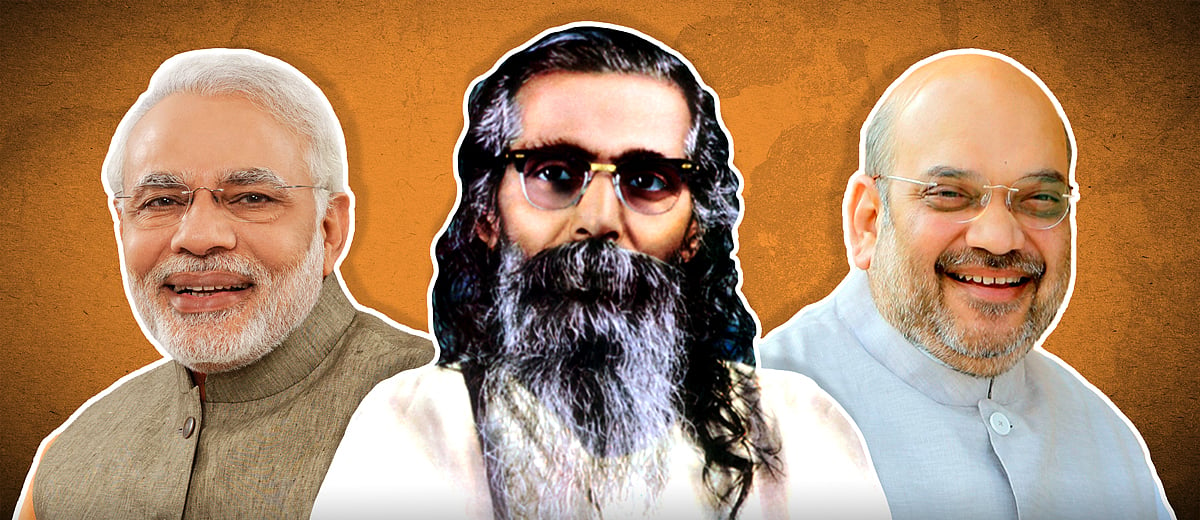
Understanding Golwalkar is not merely a historical exercise; it is essential for decoding the ideological underpinnings of modern Indian politics. This lesson will summarize his vision of India as a Hindu civilisational state and explore its profound and deeply controversial implications.
From Guru to "Guruji"
M.S. Golwalkar (1906-1973) was an unlikely successor to Hedgewar. A zoology professor at Banaras Hindu University, he was more inclined towards spiritual asceticism than political organization. However, his intellectual rigor and deep commitment impressed Hedgewar, who appointed him as his successor shortly before his death in 1940.
Golwalkar's leadership transformed the RSS. He systematized its ideology and oversaw its expansion into a nationwide organization. His ideas were primarily articulated in two key texts: the highly controversial We, or Our Nationhood Defined (1939) and a later, more moderate collection of speeches and writings, Bunch of Thoughts (1966).
A Nation Defined by Culture, Not Territory
Golwalkar's central thesis was a radical rejection of the then-dominant idea of Indian nationalism, which was based on territory. For the Indian National Congress and other mainstream anti-colonial movements, anyone born within the geographical borders of India was an Indian. Golwalkar found this "territorial nationalism" to be a superficial, unscientific, and weak concept imported from the West.
He argued that a true nation is an organic entity bound by a common culture, spirit, and heritage. For him, India was not just a piece of land; it was fundamentally a Hindu civilisational entity.
The following resource provides an excellent overview of his core philosophy.
M. S. Golwalkar's Interpretation of Hindu Nationalism
This article from the PolSci Institute clearly outlines Golwalkar's ideological framework, contrasting it with both Western nationalism and Savarkar's earlier formulation.
Please read the following sections to grasp his foundational arguments: Start with the spiritual foundation of his nationalism. Continue to the concept of cultural nationalism, where he equates Indian culture with Hindu dharma. Read his rejection of territorial nationalism, which he saw as "unscientific." Finally, read about his critique of Western values and institutions, including democracy and secularism, which he believed were materialistic and inferior to India's spiritual values rooted in dharma.
As you've read, Golwalkar's model is built on the idea of cultural nationalism. He believed that what united India for millennia was not a political state but a shared spiritual and cultural ethos, which he defined as Hindu. Western concepts like democracy, individual rights, and secularism were, in his view, foreign impositions that created social fragmentation and moral decay. The nation's strength lay in its unique and superior spiritual values, encapsulated in the concept of Dharma.
The Five "Unities" of a Nation
In We, or Our Nationhood Defined, Golwalkar systematically laid out five components he deemed essential for a nation to exist. The following video explains these five "unities" from a perspective sympathetic to his framework.
Hindu Rashtra Explained: Savarkar & Golwalkar's Vision | What Would It Actually Look Like?
In this excerpt from a talk on Hindu Rashtra by Sangam Talks, the speaker breaks down the five criteria for nationhood as articulated by Golwalkar. This will help you understand the internal logic of his definition.
Watch the segment from "definition of a Rashtra". Focus on how the speaker explains Golwalkar's five pillars of a nation: Country (Desh): A specific, identifiable geography. Race (Jati): A hereditary society with common culture and memories. Religion (Dharma): A common religious worldview and sense of right and wrong. Culture (Sanskriti): Shared traditions, values, and social practices. Language (Bhasha): A common language. Pay attention to how these five elements are presented as an indivisible whole, forming the basis of the Hindu Nation.
By these five criteria, Golwalkar concluded that India was axiomatically a Hindu nation. The "country" was not just land but Punyabhumi (Holy Land); the "race" was not genetic but cultural; and "religion" and "culture" were fused into the all-encompassing way of life known as Sanatana Dharma.
Implications: The Assimilation Model for Minorities
If India is defined as a Hindu civilisational state based on these five unities, a critical question immediately arises: what is the place of those who do not fit this definition, particularly India's large Muslim and Christian populations?
This is where the most severe implications of Golwalkar's vision become clear. He proposed a model of cultural assimilation.
M. S. Golwalkar's Views on Hindu Nationalism and Minorities
This second article from the PolSci Institute focuses specifically on the implications of Golwalkar's theory for religious minorities, detailing his proposed framework for their integration.
First, read the section on the foundation of his beliefs. Next, carefully study the assimilation model, which outlines the specific expectations placed upon minorities. Then, understand his distinction between religious practice and cultural identity. This is key to his argument. Finally, read about his deep concern regarding "extra-territorial loyalties," which he saw as a sign of divided allegiance.
Golwalkar's solution was not physical expulsion or forced conversion. Instead, he argued that minorities could live in India, but only if they subordinate their distinct cultural identities to the dominant Hindu culture. In his view, they could continue their private religious worship (e.g., attending a mosque or church) but must, in their public and national life:
- Adopt Hindu cultural norms, festivals, and symbols.
- Revere Hindu historical figures and heroes as their own.
- Sever all "extra-territorial loyalties"—any cultural or political affinity with co-religionists outside India.
For Golwalkar, to be a true member of the Indian nation, one had to embrace not just the Fatherland (Pitribhumi) but also the Holyland (Punyabhumi), a condition that, by definition, excluded those whose holy sites were outside India.
The Nazi Controversy and Enduring Critique
Golwalkar's ideas have always been fiercely contested. Critics argue that his assimilation model is a blueprint for reducing minorities to second-class citizens, forcing them to erase their heritage to prove their loyalty. The most explosive criticism stems from his early work, We, or Our Nationhood Defined, where he expressed admiration for Nazi Germany's methods of dealing with its Jewish minority.
In that book, he wrote:
"To keep up the purity of the Race and its culture, Germany shocked the world by her purging the country of the Semitic Races—the Jews. Race pride at its highest has been manifested here... a good lesson for us in Hindustan to learn and profit by."
This passage has become the cornerstone of the critique that Golwalkar's vision was directly inspired by European fascism. The following video features Dhirendra K. Jha, a journalist and biographer of Golwalkar, who makes this argument forcefully.
RSS is a Security Threat to Indian Democracy, Says Dhirendra K Jha, biographer of M.S. Golwalkar
This interview with Dhirendra K. Jha on Force Magazine presents a sharp, critical analysis of Golwalkar's ideology and its contemporary relevance. It provides the crucial counter-perspective requested in your learning goals.
Please watch these three short clips: First, from the beginning of the discussion, where Jha argues that We, or Our Nationhood Defined is the true ideological roadmap for the RSS, aimed at creating second-class citizenship for Muslims. Next, from "is it fair to say", he explains how Golwalkar, drawing inspiration from Nazi Germany, gave the RSS its core ideological mission. Finally, from "the organization that we're talking about", Jha delivers his stark conclusion that Golwalkar was a "Nazi" who provided a "Nazi model for India" that is being implemented today.
The RSS has since tried to distance itself from We, or Our Nationhood Defined, sometimes claiming it was merely a translation of another text and not reflective of Golwalkar's mature thought. However, critics like Jha maintain that it remains the foundational, unrepudiated blueprint for the RSS's vision of a Hindu Rashtra. This debate underscores the deep and irreconcilable chasm between Golwalkar's proponents and his detractors.
Conclusion
Today, we have delved into the complex and controversial ideology of M.S. Golwalkar, the architect who defined the RSS's vision of a Hindu civilisational state.
Here are the key takeaways from our discussion:
- Golwalkar defined the Indian nation not by territory but as an organic cultural and spiritual entity, synonymous with the Hindu way of life (Dharma).
- He rejected Western political concepts like secularism and territorial nationalism, viewing them as inferior to India's ancient spiritual heritage.
- His vision demanded that religious minorities integrate by adopting Hindu culture and severing all "extra-territorial loyalties," effectively a model of cultural assimilation.
- This framework is intensely controversial, with critics arguing it is inherently exclusionary and was influenced by 1930s European fascism, a charge rooted in Golwalkar's own early writings praising Nazi Germany.
We have now covered the three foundational pillars of Hindutva ideology: Savarkar's definition of the Hindu, Hedgewar's creation of the RSS organization, and Golwalkar's articulation of the Hindu civilisational state. In our next lesson, we will see how these ideas were put into action by mapping the broader ecosystem of organizations known as the Sangh Parivar. We will explore the distinct roles of its key affiliates, such as the VHP, Bajrang Dal, and ABVP, and understand how they work in concert to advance the ideological project of the RSS.