Welcome to our fifth lesson in the "Foundations of Hindutva Ideology" module. So far, we have explored the intellectual and organizational origins of the Hindutva movement. We've examined V.D. Savarkar's definition of the Hindu, K.B. Hedgewar's creation of the RSS as a disciplined cadre-based organization, and M.S. Golwalkar's articulation of India as a Hindu civilisational state. These lessons focused on the core ideology and the central organization.
Today, we zoom out to see how this core has spawned a vast and complex ecosystem of affiliated bodies. This network is known as the Sangh Parivar, or the "Sangh Family." This lesson aims to map this ecosystem, explaining the distinct roles of its most significant affiliates, including the Vishva Hindu Parishad (VHP), the Bajrang Dal, and the Akhil Bharatiya Vidyarthi Parishad (ABVP). Understanding this structure is crucial because it reveals the mechanism through which the RSS projects its influence across every sphere of Indian society—from religion and education to politics and social work.
The Sangh Parivar: A Network of Networks
The term "Sangh Parivar" refers to a multitude of organizations that are connected to the RSS through ideology, leadership, and personnel. Publicly, the RSS often maintains a strategic distance, describing these affiliates as independent bodies that are merely "inspired" by its ideals. This creates a degree of plausible deniability and operational flexibility. However, internal publications and investigative research reveal a much more integrated and coordinated structure.
The following in-depth article from The Caravan magazine, based on a six-year investigation, unveils the material connections that bind this network together. It argues that the Sangh is not a loose "family" but a single, tightly networked entity.
Exposing the largest far-right network in history
This piece by researcher and writer Christophe Jaffrelot and his team provides the most comprehensive mapping of the Sangh Parivar to date. It moves beyond ideology to trace concrete links of personnel, funding, and property.
Please read the introduction and the section on methodology. Begin with the first few paragraphs, starting from the discussion on strategic ambiguity, which explains why the RSS publicly disavows control over its affiliates. Continue by reading about how this opacity has shaped our understanding of the Hindu Right. Finally, focus on the methodology of the investigation, which traced concrete material ties rather than just shared ideology. This will help you appreciate the evidence-based approach to mapping the network.
As the article explains, the Sangh operates as a vast bureaucratic network, deliberately cultivated and centrally coordinated. This structure allows it to penetrate diverse sectors of society, manage internal tensions, and tailor its messaging for different audiences. The image below provides a simplified, though useful, snapshot of some of the key players in this "Parivar."
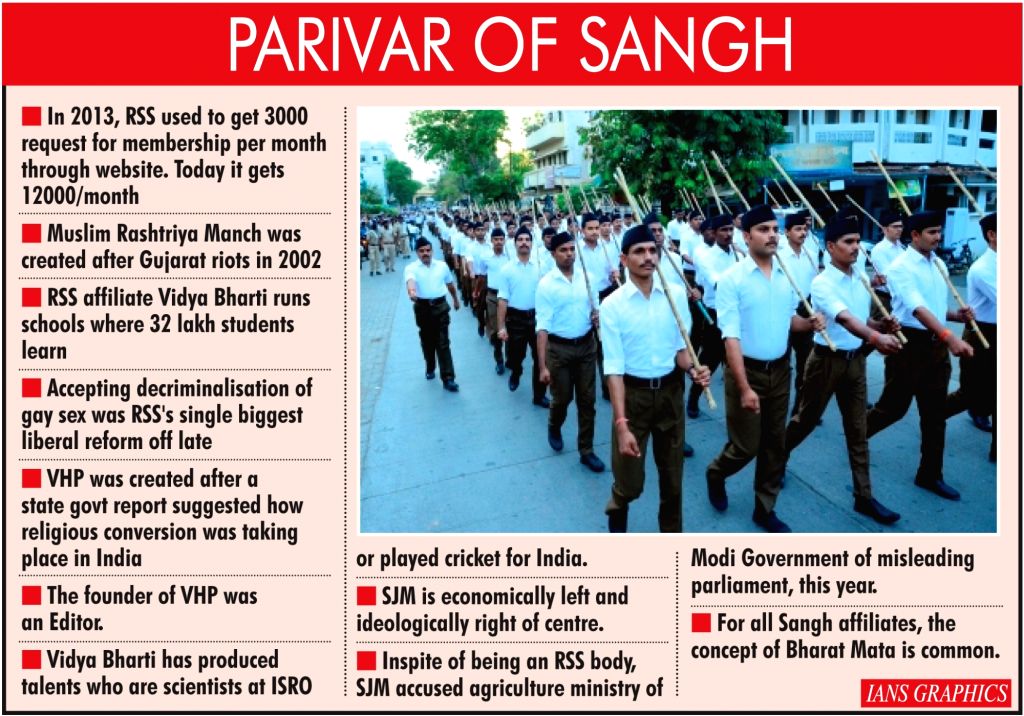
A Functional Division of Labour: Typology of Affiliates
To make sense of this sprawling network, it is helpful to categorize the affiliates based on their primary function. The research from The Caravan provides an excellent analytical framework for this. The Sangh Parivar is not just a collection of random groups; it is a system with a sophisticated division of labor.
The following reading explains this typology, breaking down the network into distinct categories such as "cadre organizations," "co-ordinating organizations," "showpiece organizations," and more. This is the key to understanding the specific role each affiliate plays.
Exposing the largest far-right network in history
This section of the article is crucial as it lays out a clear typology for understanding the different components of the Sangh ecosystem.
Please read the entire section that begins after the photo of the VHP/Bajrang Dal procession. Start with the introduction to the typology, which begins with the text "It is the layers". Carefully study the descriptions for each category: Cadre organisations: For mass mobilisation (e.g., ABVP, VHP, Bajrang Dal). Co-ordinating organisations: The bureaucratic mediators (e.g., Vidya Bharati, Sewa Bharati). Campaign organisations: Single-use groups for specific issues. Front organisations: Duplicates of parent bodies operating under a different name. Covert organisations: For illicit or reputationally damaging activities. Showpiece organisations: For reputation management (e.g., Muslim Rashtriya Manch). Training organisations: For "man-making" and leadership development. Knowledge production organisations: Think tanks and research institutes. Last-mile organisations: Small, local service providers. Focus on understanding the purpose of each category within the broader strategy.
Key Affiliates: Roles and Functions
Now that we have a framework, let's take a closer look at the three affiliates mentioned in our learning outcome: the VHP, Bajrang Dal, and ABVP. These all fall primarily under the category of cadre organizations, designed for mass mobilization and ideological propagation.
1. Vishva Hindu Parishad (VHP) – The Religious Mobilizer
Founded in 1964, the VHP's primary objective was to bridge the gap between the RSS and the traditional Hindu religious establishment (temples, monasteries, and holy men or sadhus). It aims to unite various Hindu denominations under a single, assertive umbrella.
Hindutva and the Sangh Parivar in Britain - International Socialism
This article from International Socialism provides a concise history of the key Sangh affiliates.
In the section titled "The Sangh Parivar," read the subsection that begins with the discussion on the VHP's formation. Focus on the VHP's stated objectives of forging national and international unity among Hindus and providing an "ecclesiastical body" for Hinduism.
The VHP was the principal architect of the Ram Janmabhoomi movement in the 1980s and 90s, successfully mobilizing religious sentiment for a political cause. Its role is to act as the religious and cultural face of the Sangh, lending traditional legitimacy to the Hindutva project.
2. Bajrang Dal – The Militant Youth Wing
Formed in 1984 during the Ayodhya campaign, the Bajrang Dal functions as the youth wing of the VHP. It is known for its aggressive and often militant street-level activism.

The Bajrang Dal attracts young, aggressive men and is frequently involved in activities such as cow protection vigilantism, protests against inter-faith relationships ("love jihad"), and confronting political opponents. It represents the "tough" or militant edge of the Parivar.
Hindutva and the Sangh Parivar in Britain - International Socialism
We return to the same article to understand the Bajrang Dal's specific role.
Read the paragraph that details the group's origins and character. Pay attention to the distinction made between its formation by non-RSS figures within the VHP and its subsequent role in sectarian violence. The name itself, "the tough lads," gives a clear sense of its intended character.
The relationship between the RSS/BJP and the Bajrang Dal illustrates the network's strategic division of labor. The Bajrang Dal can undertake actions that the more mainstream political wing, the BJP, might find reputationally damaging, while still serving the broader ideological goal.
3. Akhil Bharatiya Vidyarthi Parishad (ABVP) – The Student Cadre Factory
The ABVP is one of the oldest and largest affiliates, operating in universities and colleges across India. Its primary role is to recruit and train students, creating a steady stream of ideologically committed cadres who will go on to staff other Sangh organizations, including the BJP.
Hindutva and the Sangh Parivar in Britain - International Socialism
Finally, let's examine the role of the ABVP from the same article.
Read the paragraph describing the ABVP's function. Note its dual role: providing both muscle and cadres. The long-term aim of diffusing Hindutva ideas into professional ranks is a key strategic function.
The ABVP's presence on campuses makes it the Sangh's frontline force in the "battle of ideas" within academia, often leading to clashes with left-wing and other rival student groups. Its alumni network is a powerful asset, embedding Sangh sympathizers throughout India's administrative, corporate, and political structures.
Conclusion
In this lesson, we have moved from the ideological core of the RSS to its vast organizational periphery, the Sangh Parivar. We've seen that this is not a random assortment of groups but a highly structured and coordinated network with a sophisticated division of labor.
Here are the key takeaways:
- The Sangh Parivar is a complex ecosystem of organizations linked to the RSS, which maintains strategic ambiguity about its control over them.
- The network is built on a principle of functional specialization, with different affiliates performing distinct roles—from mass mobilization and service delivery to reputation management and intellectual production.
- Key cadre organizations like the VHP focus on religious mobilization, the Bajrang Dal serves as a militant youth wing for street-level action, and the ABVP recruits and trains future leaders from the student population.
- This structure allows the Sangh to project power across all sections of society, creating a deep and resilient organizational base for the Hindutva movement.
We have now completed our survey of the foundational ideology and structure of the RSS and its affiliates. In our final lesson of this module, we will focus on the most visible and powerful member of this family: the Bharatiya Janata Party (BJP). We will analyze the unique and often tense relationship between the RSS as a cultural organization and the BJP as its political, electoral wing, exploring the strategic push-and-pull between ideological purity and the compromises of democratic politics.