In our last lesson, we performed a close reading of V.D. Savarkar's Hindutva: Who is a Hindu?, unpacking the specific ideological criteria he used to define a Hindu for his political project. We saw how his formula of pitribhumi (fatherland) and punyabhumi (holyland) was designed to forge a broad, unified identity while simultaneously marking certain communities as external to the nation's core. An ideology, however, is inert without an organization to carry it forward.
This lesson bridges that gap by introducing the Rashtriya Swayamsevak Sangh (RSS), the organization founded to translate the philosophy of Hindutva into a tangible social and political force. We will focus on its founder, Dr. Keshav Baliram Hedgewar, and his vision for creating a new kind of Hindu man. Our goal is to understand the founding of the RSS in 1925, its unique organizational structure, and its foundational unit: the shakha (branch). This is not just a historical overview; understanding the RSS's structure is essential to comprehending its enduring influence as the ideological mothership of the entire Sangh Parivar and its political affiliate, the BJP.
The Founder's Diagnosis: Dr. K.B. Hedgewar
While Savarkar provided the ideological scripture for Hindutva, it was Keshav Baliram Hedgewar (1889-1940) who became its chief organizer. A medical doctor from Nagpur, Hedgewar was initially an active participant in anti-colonial revolutionary movements and later, the Indian National Congress.
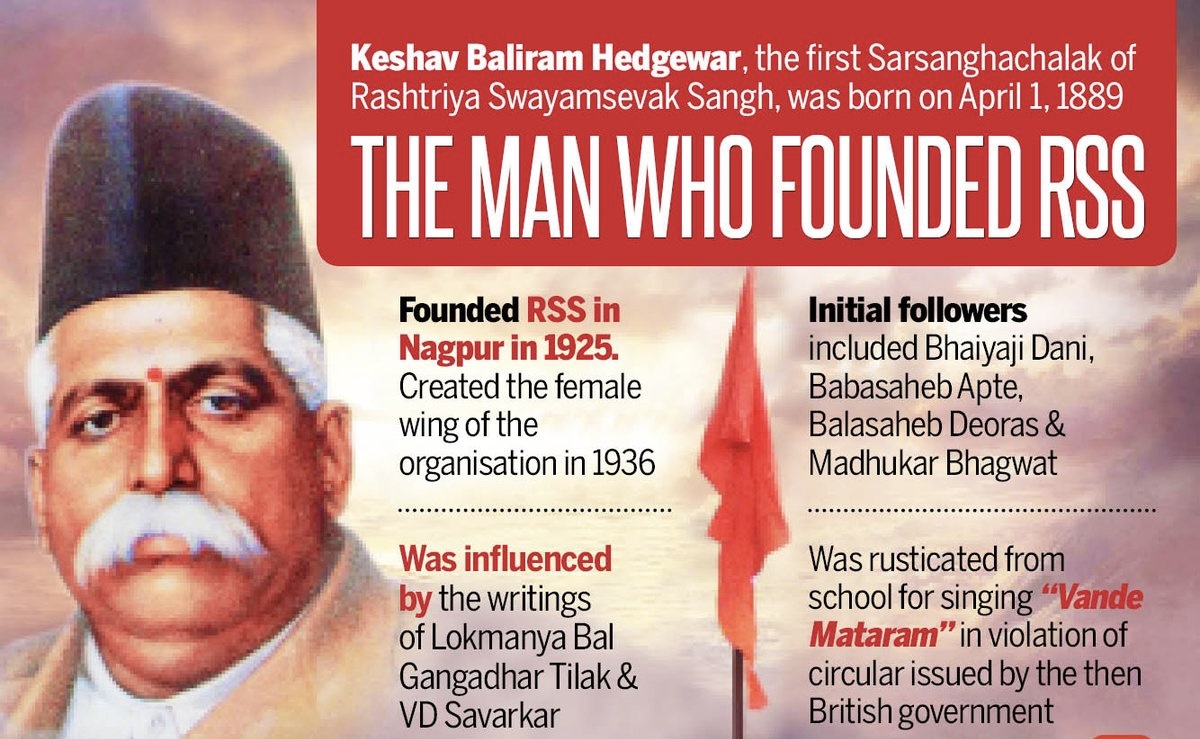
However, the wave of Hindu-Muslim riots in the early 1920s led him to a profound disillusionment. He concluded that existing nationalist platforms, like the Congress, were failing to address what he saw as the fundamental problem: the internal weakness, fragmentation, and lack of unity within Hindu society. In his view, a foreign power could only rule India because the people themselves were divided by caste, language, and sect, and had lost their sense of collective identity and discipline.
To understand Hedgewar's motivation, it is useful to think in terms of a concept from modern sociology: social capital. Social capital refers to the networks of relationships among people who live and work in a particular society, enabling that society to function effectively. It is built on trust, cooperation, and a shared sense of identity. Hedgewar's diagnosis was that centuries of division had eroded India's social capital to a critical low.
The following podcast discussion offers a compelling analysis of Hedgewar's mindset, framing his project as an attempt to rebuild this lost social capital.
Dr. Hedgewar: The Man Who Built the RSS | Sachin Nandha on Abhijit Chavda Podcast 96
In this excerpt from the Abhijit Chavda Podcast, author Sachin Nandha explains Hedgewar's crucial intellectual shift. He moved from blaming external forces (like the British) to identifying the internal disunity of Indian society as the root cause of its subjugation.
Please listen from this segment. Pay close attention to how the speaker describes Hedgewar's diagnosis that Indian society was fragmented by "caste, class and creed" and that "social capital had evaporated." This perspective is key to understanding why he founded the RSS.
Driven by this diagnosis, Hedgewar established the Rashtriya Swayamsevak Sangh on the festival of Vijayadashami in 1925, in his hometown of Nagpur. His initial group consisted of just a handful of teenage boys. His goal was not immediate political action, but a long-term project of "man-making" — to forge a new generation of disciplined, patriotic, and united Hindus who could form the backbone of a revitalized nation, or Hindu Rashtra.
The Shakha: A "Man-Making Machine"
Hedgewar's solution to the lack of social capital was an innovative social experiment: the shakha. A shakha (literally "branch") is the most basic unit of the RSS. It is a daily or weekly meeting of members, called swayamsevaks (self-reliant volunteers), typically held for an hour in a public park or open ground.
The primary resource for this section is a research paper that details the RSS's structure and methodology. It will give you a clear picture of the organization's founding principles and the function of the shakha.
[PDF] Ideology, social movement and organization of Rashtriya ...
This paper provides a sociological overview of the RSS. We will focus on the reasons for its founding and the mechanics of its core unit, the shakha.
First, please read the section describing the organization's founding. This part explains Hedgewar's disillusionment with Congress and his focus on character-building. Next, find the section titled "The Shakha Sangh Unique Methodology" and read the description of the typical shakha. This outlines the activities, age groups, and key roles within a branch.
As you've just read, the shakha is a highly structured environment. The daily routine typically includes:
- Sharirik (Physical Training): Calisthenics, drills, and traditional Indian games (khel). This often includes training with a lathi (bamboo staff).
- Baudhik (Intellectual Session): A discourse on national heroes, cultural history, and the ideology of the RSS.
- Prarthana (Prayer): The session ends with a prayer to the "Motherland" in Sanskrit and the saluting of the Bhagwa Dhwaj (saffron flag), which the RSS reveres as its true guru.
Hedgewar designed this space to be "casteless, classless, and creedless." By playing, exercising, and learning together, swayamsevaks from different backgrounds were meant to overcome their social divisions and build bonds of trust and brotherhood. This newly created social capital could then be directed towards community service and nation-building activities.
While the RSS presents the shakha's purpose as ideological and physical conditioning, a deeper analysis suggests it serves three key strategic functions:
- Group Cohesion: It creates tightly-knit, disciplined groups that can be mobilized for various tasks, from disaster relief to political canvassing.
- Recruitment Funnel: It acts as a testing ground and recruitment pool. The most dedicated swayamsevaks are identified and moved up into the RSS's leadership or sent to work in its many affiliated organizations.
- Fundraising: The festival of Guru Purnima is when swayamsevaks make an anonymous financial offering (Guru Dakshina) to the flag, forming a major source of the organization's funding.
The Organizational Pyramid
The RSS is built as a hierarchical structure, scaling up from the local shakha to a national executive based in its Nagpur headquarters.

The following video provides a clear and concise overview of this structure and its key positions.
RSS Organisational Structure Explained | Mohan Bhagwat | BJP | KB Hedgewar | Golwalkar | Sangh
This news report from HW News English breaks down the organizational hierarchy of the RSS, explaining the roles from the top leader down to the volunteers.
Watch the video from the beginning. As you watch, focus on the definitions of the following key roles: Sarsanghchalak: The supreme chief. Sarkaryavah: The general secretary or executive head. Pracharak: The full-time worker. Swayamsevak: The volunteer.
To summarize and expand on the video, the structure can be visualized as a pyramid:
- Sarsanghchalak (Supreme Chief): The ideological head and "philosopher-guide" of the RSS. The position is held for life and is not elected; the outgoing chief appoints his successor.
- Sarkaryavah (General Secretary): The chief executive officer, responsible for the day-to-day functioning and administration of the entire organization. This is an elected position.
- Pracharaks (Full-time Propagators): This is arguably the most unique and crucial element of the RSS. Pracharaks are lifelong, celibate volunteers who dedicate themselves entirely to the organization's work. They are the "steel frame" of the RSS, moving between different regions and affiliated organizations to ensure ideological consistency and coordinate activities. They hold immense influence but often little formal power, working behind the scenes.
- Geographic Hierarchy: The country is divided into Kshetras (zones), which are subdivided into Prants (provinces), then Vibhags (divisions), Nagars (cities/towns), and finally Bastis (localities), where the shakhas operate. This ensures a clear chain of command and communication.
- Swayamsevaks (Volunteers): The base of the pyramid, comprising millions of members who attend shakhas. Membership is informal; there are no fees or registration. Simply attending a shakha makes one a swayamsevak.
This highly organized, cadre-based structure, with the shakha at its heart, is what has allowed the RSS to grow from a small group of boys in Nagpur into one of the largest and most influential voluntary organizations in the world.
Conclusion
In this lesson, we have explored the organizational origins of the Hindutva movement. We moved from the ideology of Savarkar to the institution built by Hedgewar to bring that ideology to life.
Here are the key takeaways:
- The Rashtriya Swayamsevak Sangh (RSS) was founded in 1925 by Dr. K.B. Hedgewar to regenerate Hindu society by instilling discipline and unity.
- Hedgewar's core diagnosis was a lack of "social capital" — trust and cooperation — due to deep-seated divisions of caste, class, and sect.
- The shakha is the fundamental unit of the RSS, a daily meeting designed to build character and foster a sense of brotherhood through physical and ideological training.
- The RSS has a clear hierarchical structure with the Sarsanghchalak as the supreme ideological guide, the Sarkaryavah as the executive head, and the Pracharak system of full-time workers as its operational backbone.
We have now examined the foundational text of Hindutva and the structure of its primary organization. However, the RSS's ideology was further sharpened and radicalized under Hedgewar's successor. In our next lesson, we will analyze the vision of M.S. Golwalkar, the second Sarsanghchalak, who defined the nation in starkly majoritarian terms and profoundly shaped the RSS for decades to come.