In our previous lesson, we established the crucial distinction between Hinduism as a diverse religious tradition and Hindutva as a modern political ideology. You learned that while the former is ancient and pluralistic, the latter is a 20th-century concept aimed at forging a singular national identity. We ended by noting that this ideology has a foundational text: Vinayak Damodar Savarkar's 1923 pamphlet, Hindutva: Who is a Hindu?
Today, we will perform a close reading of that very text. Our goal is to understand precisely how Savarkar defined a "Hindu" for his political project. We will unpack his three core criteria: pitribhumi (fatherland), punyabhumi (holyland), and the ideas of a common race and culture that bind them. Understanding this definition is not a mere historical exercise; it is the key to decoding the logic of Hindutva and its profound influence on contemporary Indian politics, from debates on citizenship to the very idea of national belonging.
The Architect of Hindutva: V.D. Savarkar
Vinayak Damodar Savarkar (1883-1966) was a revolutionary, writer, and political philosopher. He wrote Hindutva: Who is a Hindu? under extraordinary circumstances—while imprisoned by the British in the Andaman Islands for his revolutionary activities. Lacking pen and paper, he is said to have written the manuscript on the walls of his prison cell and memorized it. This context underscores the text's nature not as a dispassionate academic thesis, but as a fervent ideological blueprint forged in the crucible of anti-colonial struggle and imprisonment.
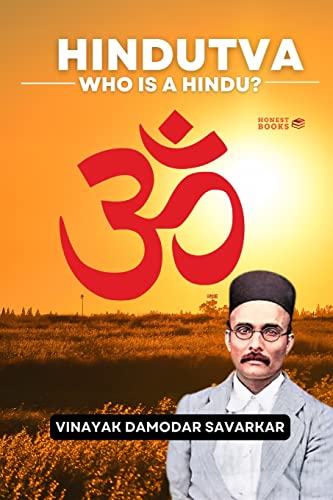
As we discussed, Savarkar believed the term "Hindu" had been wrongly confined to a purely religious meaning. His project was to expand it into a comprehensive political and cultural identity. To do this, he proposed a set of qualifications, or tests, that one must meet to be considered a Hindu.
The Three Pillars of Hindu Identity
Savarkar’s definition rests on three interconnected pillars: shared territory (Rashtra), shared blood (Jati), and shared culture (Sanskriti). Let's examine each one.
1. Rashtra (Common Nation) & Pitribhumi (Fatherland)
The first criterion is territorial. For Savarkar, a Hindu is someone who considers the land of India, or Bharatvarsha—stretching "from the Indus to the Seas"—as their fatherland.
Pitribhumi (पितृभूमि): Literally "father-land." This signifies a deep, ancestral, and patriotic connection to the geographical territory of India.
This is the foundational requirement. It establishes that a Hindu's primary secular loyalty is to the Indian nation-state. This may seem straightforward, but it's only the first step. An American citizen, for example, could move to India and develop a patriotic love for the land, but according to Savarkar, this alone would not make them a Hindu.
2. Jati (Common Race or Blood)
The second criterion is one of shared ancestry. Savarkar argues that Hindus are united not just by a common motherland but also by "the bonds of a common blood." He uses the word Jati (जाति) in this context not to mean caste, but race or a "born brotherhood."
He posits that Hindus share a common racial heritage, descended from the ancient Vedic "Sindhus" and incorporating various other groups over millennia. While acknowledging the reality of intermingling, he argues that this process has created a distinct Hindu race, just as the English or French are considered distinct races despite their own histories of mixing. In his words:
"A Hindu marrying a Hindu may lose his caste but not his Hindutva. A Hindu... may lose his sect but not his Hindutva—his Hinduness—because the most important essential which determines it is the inheritance of the Hindu blood."
This element grounds the identity in a shared biological and historical lineage, making it something inherited rather than simply chosen.
3. Sanskriti (Common Culture) & Punyabhumi (Holyland)
This third pillar is the most complex and, politically, the most significant. It combines two ideas: a shared civilization and a shared sacred geography.
Sanskriti (संस्कृति): A common culture and civilization. This includes shared history, literature (like the Ramayana and Mahabharata), heroes, art, laws, festivals, and rites.
Punyabhumi (पुण्यभूमि): Literally "holy-land." This signifies that the land of India is not just the fatherland but also the cradle of one's religion and the abode of one's prophets, seers, and sacred sites.
For Savarkar, what truly binds Hindus is a shared civilization (Sanskriti). However, he argues that this shared culture is inextricably linked to the land of India being the Punyabhumi.
This is the crucial step where his definition becomes exclusionary. While an Indian Muslim or Christian may share the Pitribhumi (fatherland) and even the Jati (bloodline, through conversion of ancestors), Savarkar argues that they cannot be considered Hindu because their Punyabhumi lies elsewhere—in Arabia or Palestine. He claims their "love is divided."
The Synthesis: Pitribhumi + Punyabhumi
Savarkar masterfully combines these elements into a single, powerful definition. To fully grasp his argument, let's read the concluding passage of his definition from the original text.
[PDF] Essentials of Hindutva - Veer Savarkar
In this section, Savarkar brings together all the strands of his argument to deliver his final, concise definition of who is a Hindu.
Please read the entire section titled "A Hindu, therefore...". As you read, pay close attention to how he defines a Hindu first in a long sentence incorporating all three pillars, and then distills it into the simple formula of Pitribhu and Punyabhu.
As you've just read, Savarkar's ultimate litmus test is this: A Hindu is one for whom India (Sindhusthan) is not only a Fatherland (Pitribhumi) but also a Holyland (Punyabhumi).
This elegant and potent formula achieves two things simultaneously:
- Inclusion: It creates a broad, unified "Hindu" identity that encompasses not just followers of Vedic traditions but also Buddhists, Jains, Sikhs, and other indigenous faiths, since all their religions originated in India, making it their Punyabhumi.
- Exclusion: It draws a sharp line that deliberately places Indian Muslims and Christians outside this definition of the nation's core identity.
The following video provides a clear summary of these criteria and their political implications.
Political Thoughts of Savarkar: Hindutva
This clip from POL SC HELP explains Savarkar's three criteria and clearly articulates who is included and who is excluded by this definition.
Please watch from this segment. The speaker outlines the three conditions: regarding India as the fatherland, having Hindu ancestry, and considering India the holy land. Notice how he explains that this framework unites Hindus, Buddhists, Jains, and Sikhs while distinguishing them from Muslims and Christians.
The concept of a divided loyalty, rooted in the punyabhumi being outside India, remains a powerful theme in Hindutva discourse today. It is often invoked to question the patriotism of minority communities. The following clip, from a Q&A session, demonstrates how Savarkar's century-old framework is still used to interpret contemporary events.
Savarkar's Shocking Truth: How Hindu Chivalry Caused 800 Years of Defeat | Historical Analysis
In this excerpt from a talk hosted by Sangam Talks, an audience member asks about Savarkar's definition, and the speaker applies it to modern examples concerning Indian Muslims and Christians.
Watch the exchange from this timestamp. Note how the speaker justifies Savarkar's definition by citing examples where the loyalty of some Indian Muslims or Christians is allegedly directed towards external religious figures (like the Khalifa or the Pope) rather than the Indian state. This is a direct, modern application of the punyabhumi argument.
Conclusion
In this lesson, we have moved beyond the general distinction between Hinduism and Hindutva to analyze the core of the ideology's foundational text. You have examined the specific criteria laid out by V.D. Savarkar in Hindutva: Who is a Hindu?.
Key takeaways from this lesson are:
- Savarkar’s definition of a Hindu is political, not religious, and is based on three pillars: common nation (Rashtra), common race (Jati), and common culture (Sanskriti).
- These pillars are synthesized into the defining test of a Hindu: one who considers India their Fatherland (Pitribhumi) and their Holyland (Punyabhumi).
- This definition was strategically designed to create a unified bloc of all "Indic" religions (Hinduism, Buddhism, Jainism, Sikhism) while simultaneously framing Indian Muslims and Christians as outsiders to the core national identity due to their "foreign" holy lands.
Having dissected the ideological cornerstone of Hindutva, our next step is to understand the organization that was created to translate this philosophy into a mass movement. In the next lesson, we will explore the founding of the Rashtriya Swayamsevak Sangh (RSS) by K.B. Hedgewar in 1925 and its unique structure designed to cultivate a cadre dedicated to the vision of a Hindu Rashtra.