Hello! Welcome back to your course on building a Go-to-Market (GTM) strategy.
In our first lesson, we established that a GTM strategy is the master blueprint that aligns your entire company to achieve your revenue goals. It’s the roadmap for your journey to 5 crore rupees.
Today, we take the first and most critical step in building that map: defining your destination. The objective for this lesson is to analyze your existing successful customers to create a detailed Ideal Customer Profile (ICP). A well-defined ICP is the foundation of an effective GTM strategy; it provides the focus needed for your sales, marketing, and product efforts to be truly efficient and impactful.
1. What is an Ideal Customer Profile (ICP)?
An Ideal Customer Profile (ICP) is a clear, specific description of the company or organization that gets the most value from your product and, in return, provides the most value to your business. It's not about individuals (we'll cover that later); it's about the characteristics of the perfect client organization.
For your business, an ICP would describe the ideal educational institution (e.g., a language school, a study abroad consultancy, a university department) that is a perfect fit for your platform.
To start, watch this short video for a clear definition of an ICP and how it differs from a "buyer persona."
How to Create Your Ideal Customer Profile | ICP Marketing
This video from WebFX offers a concise definition of an ICP and clarifies the important distinction between an ICP and a buyer persona.
Please watch from 00:49 to 02:37. Focus on how an ICP describes the company, while a buyer persona describes the individuals within that company.
As the video explains, the distinction is crucial:
- Ideal Customer Profile (ICP): Describes the perfect company. It's defined by firmographics like industry, company size, location, and budget.
- Buyer Persona: Describes the fictional people who work at your ideal customer companies. These are the decision-makers, influencers, and users your sales team will interact with.
This image provides a great visual summary of this hierarchy. You first define the ideal company (Enterprise Persona/ICP), and then you identify the key people within it (Buyer Personas). We will focus solely on the ICP today.

2. The Power of Focus: Defining Your Initial Customer Profile
Your e-learning platform could likely serve a wide range of organizations. A common mistake, especially when aiming for ambitious growth, is to try and be everything to everyone. This dilutes your resources, confuses your messaging, and makes your sales efforts inefficient.
As a leader, one of your most powerful strategic tools is focus. The goal is to identify the segment of the market where you have the highest probability of winning and concentrate your resources there to build momentum. This is why we will define a single, initial customer profile. Think of it as establishing a beachhead before expanding your territory.
The following video from TK Kader explains why focusing on one ICP is critical for growth and how to think about it quantitatively.
Ideal Customer Profile (3 Things You Need to Know About Creating a Great ICP)
This video from B2B growth expert TK Kader makes a strong case for focusing on a single ICP and using data to identify 'where the heat is' in your current customer base.
Please watch from 02:48 to 05:06 and from 09:50 to 12:01. Pay close attention to the concepts of having 'one ideal customer profile' and using both qualitative and quantitative data to vet it.
3. A Practical Guide to Creating Your ICP
Since your platform is already operational, the best way to build your ICP is by looking inward at your existing successes. The process involves identifying your best customers, understanding what they have in common, and formalizing those traits into a profile.
Let's walk through a structured, data-driven approach. The article "How to Create an Ideal Customer Profile (ICP) With Template" from Cognism provides a great framework for this.
How to Create an Ideal Customer Profile (ICP) With Template
This article provides a step-by-step guide to building a B2B ICP by analyzing your existing customers. We will use its core methodology in the steps below.
Read the sections titled 'How do you create an ideal customer profile for B2B?', '1. Identify your super users', '2. Request an interview', and '3. Analyse the data'. Focus on the practical steps and the example interview questions provided.
Here is a summary of the process, tailored for your business:
Step 1: Identify Your "Super Users"
List your top 10-15 current customers. Now, rank them not just by revenue, but by a combination of factors that define a "best" customer:
- High Lifetime Value (LTV): They've been with you a long time and/or have a high contract value.
- High Satisfaction: They are happy, provide positive feedback, and act as advocates.
- Low Churn Risk: They are deeply integrated with your platform and see immense value.
- Profitability: They don't require excessive support and are on a profitable pricing plan.
- Growth Potential: They have expanded their usage since signing up (e.g., added more students or courses).
The goal is to isolate a group of 5-10 customers who represent the "best" of your business.
Step 2: Collect Data and Interview Them
For your list of super users, start by gathering firmographic data you already have:
- Industry/Type: Are they study abroad consultancies, private language institutes, K-12 schools, university departments?
- Company Size: Number of employees, number of students they serve annually.
- Location: Are they concentrated in specific cities or regions?
- Revenue Model: How do they make money?
Next, as the Cognism article suggests, reach out to them for a conversation. Given your sales background, this should be a natural process. The goal isn't to sell, but to learn. Key questions to ask include:
- "Before you found us, what was your biggest challenge related to mock tests and student evaluation?"
- "What problem does our platform solve for you that is most critical?"
- "What was your decision-making process like? Who else was involved?"
- "What specific outcomes or benefits have you seen since using our platform?" (e.g., time saved, higher student scores, increased student intake)
Step 3: Analyze and Synthesize
Gather all the data from your research and interviews. Look for the common threads.
- Do your best customers all tend to be mid-sized consultancies with 10-50 employees?
- Are they all located in Tier-1 metro areas?
- Do they all mention "saving teachers' time on evaluations" as the primary benefit?
- Do they all have a specific person, like an 'Academic Head', who champions the purchase?
These commonalities are the building blocks of your ICP.
Step 4: Draft Your ICP Document
Formalize your findings into a simple, one-page document. This becomes the guiding star for your sales and marketing teams.
Here is an example of a filled-out ICP template.
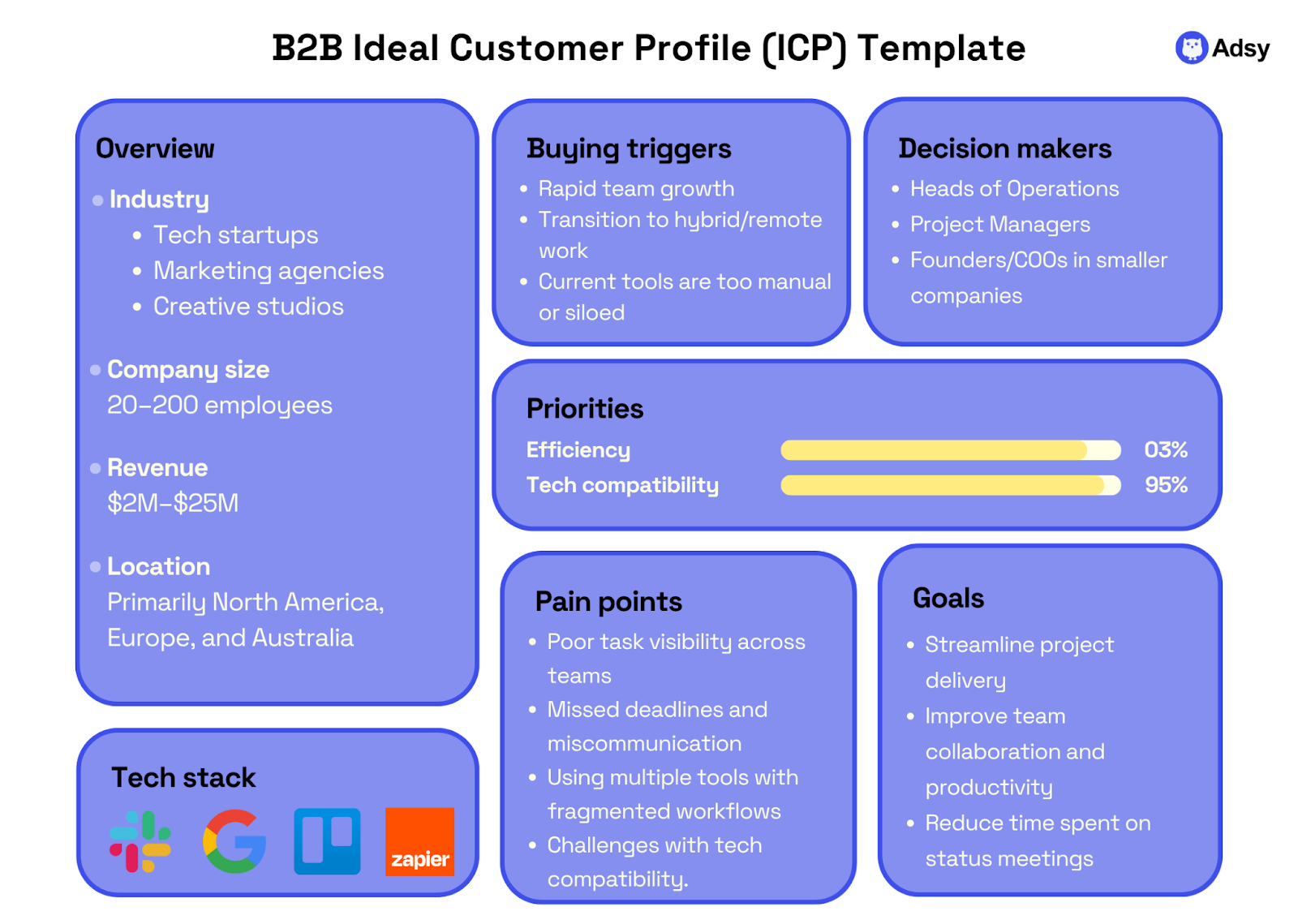
Based on this, here is a template tailored to your e-learning business:
| Category | Description |
|---|---|
| Industry/Type | e.g., Study Abroad Consultancies, Private Language Institutes |
| Location | e.g., India - Tier 1 & 2 cities |
| Size (Students) | e.g., 200-1000 students per year |
| Size (Staff) | e.g., 10-50 employees, with at least 5 dedicated faculty members |
| Key Pain Points | e.g., "Faculty is overworked with manual test grading," "Lack of standardized mock tests across branches." |
| Business Goals | e.g., "Increase student success rates," "Scale operations without hiring more administrative staff." |
| "Watering Holes" | Where do they get information? e.g., "Study abroad agent association events," "LinkedIn groups for educators." |
| Buying Triggers | What event prompts them to look for a solution? e.g., "Expanding to a new city," "Losing students to competitors with better tech." |
| Red Flags | Characteristics of customers who are a bad fit. e.g., "Fewer than 50 students/year," "No dedicated budget for technology." |
Test your understanding!
A new lead comes in. It's a large, prestigious university that wants to use your platform for a small, internal faculty training program for 20 professors. This is outside your current focus on study abroad courses.
How would you use your newly drafted ICP to decide whether to pursue this lead aggressively?
Show answer
You would compare the lead's characteristics against your ICP. While the prestige of the university is attractive, it doesn't fit the core ICP attributes.
A good thought process would be:
- Fit Analysis: It's a university, not a consultancy (mismatch on 'Industry/Type'). The use case is internal training, not student test prep (mismatch on 'Pain Points' and 'Business Goals').
- Resource Allocation: Pursuing this lead would require your sales team to learn a new use case and develop custom messaging, pulling them away from targeting prospects that perfectly match your ICP.
- Strategic Decision: Based on the ICP, you would likely decide to "de-prioritize" this lead. This doesn't mean ignoring them, but you would invest minimal resources. You might send them standard information and let them self-qualify, while your team focuses its primary effort on finding more companies that look exactly like your ICP. This demonstrates the strategic discipline an ICP provides.
Conclusion
Today, we've moved from the abstract concept of a GTM strategy to the concrete first step of execution.
Key Takeaways:
- An Ideal Customer Profile (ICP) is a detailed description of the company that is a perfect fit for your product.
- Creating your ICP is a data-driven process of analyzing your most successful existing customers to find common, winning attributes.
- Focusing on a single initial ICP is a powerful strategy that concentrates your resources, clarifies your message, and accelerates growth by targeting your most probable opportunities first.
You now have a framework to identify the organizations where your platform can have the greatest impact. This clarity is the single most important factor in scaling your sales and marketing efforts efficiently.
In our next lesson, we will build on this foundation. Having defined which companies to target, we will explore how to segment your target market based on organization type, size, and buying behavior, allowing for even more tailored outreach.