Hello! Welcome back to your GTM strategy course.
In our last lesson, we focused intently on creating your Ideal Customer Profile (ICP)—a precise definition of the perfect customer for your e-learning platform. The ICP represents the bullseye of your target.
Today, we zoom out to map the entire archery range. While the ICP is your perfect fit, your 5 crore revenue goal will be achieved by winning business across a broader market. This requires understanding all the potential customers out there and grouping them intelligently. The objective of this lesson is to segment your target market based on organization type, size, and buying behavior. This process will enable you to tailor your sales and marketing efforts for maximum efficiency and impact.
1. The Foundations of B2B Market Segmentation
Market segmentation is the practice of dividing your broad target market into smaller, more manageable groups of businesses that share common characteristics. Instead of a one-size-fits-all approach, you can create targeted strategies for each group.
For a B2B business like yours, the most common ways to segment the market are:
- Firmographic: Based on company attributes like industry, company size (employees or revenue), and location.
- Behavioral: Based on their actions and attitudes, such as their purchasing habits, usage rate, and relationship with technology.
- Geographic: Based on their physical location, which can influence buying habits and needs.
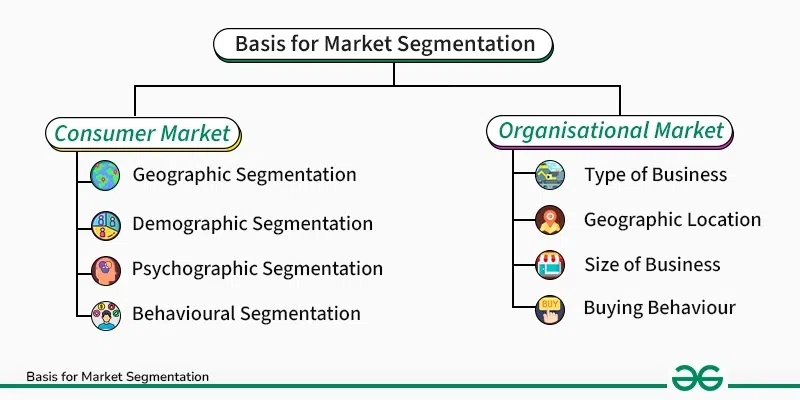
This mind map provides a clear visual overview of the different bases for segmentation in organizational markets.
To get a quick overview of these concepts in action, please watch this short video.
This video from Startup Akademia offers a concise introduction to the most common segmentation methods used in B2B markets.
Watch the entire video (it's short, under 3 minutes). Pay attention to the examples provided for firmographic and behavioral segmentation, as these are most relevant to your business.
2. Applying Segmentation to Your E-Learning Platform
Now, let's translate these concepts into a practical framework for your business. We'll focus on segmenting by size and buying behavior, as these will have the biggest impact on your sales process design—a key interest of yours.
Segmentation by Organization Size: Rabbits, Deer, and Elephants
Not all customers are created equal in terms of their potential value and the effort required to acquire them. A useful, sales-oriented way to think about this is the "Rabbits, Deer, and Elephants" framework. It segments customers based on their potential Annual Contract Value (ACV).
Using a B2B SaaS Go-to-Market Segmentation strategy for ...
The article 'Using a B2B SaaS Go-to-Market Segmentation strategy' introduces a powerful analogy for segmenting customers by deal size. This will help you think strategically about how to allocate your sales resources.
Please read the first three sections: '1. Small: aka Rabbits', '2. Medium: aka Deer', and '3. Large: aka Elephants'. As you read, think about what kinds of organizations in your market would fall into each category.
Let's apply this to your business:
- Rabbits (Small ACV, e.g., < ₹50,000/year): These might be individual tutors or very small coaching centers. You need a high volume of them, so the sales process must be low-touch or fully automated (self-service sign-up, content marketing).
- Deer (Medium ACV, e.g., ₹50,000 - ₹5,00,000/year): This could be your sweet spot. Think of mid-sized study abroad consultancies or established language institutes. They are large enough to warrant an inside sales team but don't require the extensive resources of an enterprise sale.
- Elephants (Large ACV, e.g., > ₹5,00,000/year): These are large educational chains or university departments. Landing one is a huge win, but it requires a dedicated, high-touch enterprise sales motion with longer sales cycles.
Your ICP from the last lesson likely falls into the "Deer" category, but your GTM strategy must account for how you will efficiently capture "Rabbits" and decide if you have the resources to hunt "Elephants."
Segmentation by Buying Behavior: The Technology Adoption Curve
Beyond size, how organizations make decisions is a critical segmentation variable. The Technology Adoption Curve is a classic framework for this, categorizing customers based on their willingness to embrace new technology.
This image provides a helpful overview of different segmentation types, distinguishing between easily observable data (like firmographics) and more nuanced, unobservable data (like behavior and psychographics) that is highly effective for messaging.

To understand this in more detail, let's return to the T2D3 article.
Using a B2B SaaS Go-to-Market Segmentation strategy for ...
The same article also provides an excellent summary of the Technology Adoption Journey, which is a powerful way to segment customers based on their mindset and buying behavior.
Read the section titled 'Knowing your Audience - the Technology Adoption Journey', which covers Innovators, Early Adopters, Pragmatists (Early Majority), Conservatives (Late Majority), and Skeptics (Laggards).
For your platform, this means:
- Innovators/Early Adopters: Might be new, tech-forward consultancies looking for a competitive edge. They are great for initial feedback but are a small part of the market.
- Pragmatists (Early Majority): This is the mainstream market. These are established institutes that will adopt your platform once they see clear proof (case studies, testimonials) that it solves a real problem and delivers ROI. Winning this group is key to reaching 5 crore.
- Conservatives/Skeptics: These are old-school organizations resistant to change. They will only buy when your platform becomes the industry standard. They often require the most effort to sell to.
Test your understanding!
You have two prospective clients:
- Client A: A well-established, 20-year-old language institute. They have a great reputation but still use paper-based mock tests. They are worried about the cost and the effort of training their teachers on a new system.
- Client B: A new study abroad consultancy started by young entrepreneurs. They want to use technology to be more efficient than their competitors from day one.
Which technology adoption segment would you place each client in? How might your initial sales conversation differ for each?
Show answer
- Client A is likely a Conservative or Pragmatist. Your sales approach should focus on de-risking the decision. You would emphasize case studies from similar institutions, offer a detailed onboarding and training plan, and provide a clear ROI calculation showing how the platform saves money or time in the long run.
- Client B is an Early Adopter. Your conversation can be more vision-oriented. You would focus on innovation and the competitive advantage your platform provides. They will be more interested in cutting-edge features and how your platform can help them disrupt the market.
3. A Dynamic Approach: Layering Segments with "Customer Lenses"
The most effective GTM strategies don't rely on a single segmentation model. Instead, they layer multiple criteria to create highly specific micro-segments. A powerful way to conceptualize this is the "Dynamic Customer Lens" framework.
Think of it like getting an eye exam: the optometrist layers different lenses (one for distance, one for astigmatism) to find the perfect prescription. Similarly, you can layer segmentation "lenses" (e.g., size + industry + tech adoption) to get a crystal-clear picture of your customer.
This video explains the concept in detail. Given your background, you'll appreciate how this framework moves beyond static profiles to a flexible system for generating targeted messaging.
Customer segmentation in complex B2B markets
This video from the Product Marketing Alliance introduces the 'Dynamic Customer Lens' framework, a sophisticated way to handle segmentation in complex B2B markets.
This video is a bit longer, so focus on these key parts: What is a complex B2B market? (09:48 - 11:50): See if this reflects your own market. The challenge and the different lenses (11:50 - 15:43): Understand the various firmographic and psychographic lenses you can use. Introducing the Dynamic Framework (15:43 - 18:44): Grasp the core concept of a modular, layered approach. Scenario in Action (20:44 - 24:55): Pay close attention to how a salesperson uses this framework to prepare for a complex sales meeting. This is a highly practical application.
Applying this to your business, a salesperson preparing for a meeting could "activate" several lenses:
- Lens 1: Organization Type:
Study Abroad Consultancy - Lens 2: Size:
Deer(mid-sized) - Lens 3: Tech Adoption:
Pragmatist - Lens 4: Key Influencer:
Academic Head
The combination of these lenses instantly provides a playbook: the messaging should focus on proven ROI (for the Pragmatist), highlight features relevant to managing multiple branches (for the Deer-sized consultancy), and address the specific pain points of an Academic Head (like teacher workload and quality control).
Conclusion
In this lesson, we've expanded from the "perfect" customer to the entire universe of potential customers. By systematically segmenting this market, you create the foundation for a scalable and efficient GTM machine.
Key Takeaways:
- Segmentation divides your market into groups with shared needs, allowing for targeted sales and marketing.
- Firmographics (size, type) and Behavior (tech adoption) are powerful segmentation models for your B2B e-learning platform.
- The "Rabbits, Deer, Elephants" framework helps you align your sales efforts with the potential value of each customer segment.
- A layered, dynamic approach (like "Customer Lenses") allows you to create highly specific and effective messaging for different micro-segments.
You now have the tools to not only identify your ideal customer but also to categorize and approach the entire spectrum of organizations that could benefit from your platform.
In our next lesson, we will dive deeper into the buying process. Having segmented the organizations, we will map the typical buying committee and decision-making process within your key target segments. This will prepare you to navigate complex deals and engage the right people at the right time.