Hello! Welcome to the first lesson in your personalized course on building a Go-to-Market (GTM) strategy.
Your goal is to scale your B2B e-learning platform to 5 crore rupees in revenue. This course is designed to give you the strategic and tactical tools to build the plan to achieve that. In this introductory lesson, we will start with the foundational concept that underpins this entire journey: the Go-to-Market strategy itself.
Our objective today is to define what a GTM strategy is, understand why it's crucial for scaling your existing business, and identify its core components. This will provide the framework for everything we will cover in subsequent lessons, from defining your customers to building your sales team.
1. What is a Go-to-Market (GTM) Strategy?
Given your experience in sales leadership, you're deeply familiar with sales plans and quotas. A GTM strategy is a broader, more comprehensive plan. It's not just a marketing plan or a sales plan; it's the overarching strategy that aligns your entire company—product, marketing, sales, and customer success—to deliver your unique value to a specific market and achieve your revenue goals.
Think of it as the master blueprint for an expedition. To reach your destination (5 crore revenue), you need to understand the terrain (your market), choose the best path (your channels), pack the right gear (your product and messaging), and ensure your entire team knows the plan and can adapt to changing conditions.
To get a concise overview, let's start with a short video from the Product Marketing Alliance.
What is a go-to-market strategy?
This video provides a clear definition of a GTM strategy, explains its purpose, and differentiates it from a general marketing plan.
Please watch from 00:54 to 03:46. Focus on how the video defines the elements of a GTM strategy and the benefits it provides for a business.
As the video highlights, a GTM strategy is different from a general marketing plan:
- Marketing Plan: Focuses on creating awareness and generating demand. Its primary goal is lead generation and building brand visibility.
- GTM Strategy: A broader, cross-functional plan focused on how to successfully enter or scale within a market to generate revenue. It includes marketing but also encompasses product-market fit, pricing, sales strategy, and distribution.
2. Why is a GTM Strategy Crucial for Scaling Your Business?
You're not starting from scratch; you have an operational e-learning platform with an existing customer base. Your challenge is one of scale. As the saying goes, "What got you here won't get you there." A formal GTM strategy is the mechanism that provides the necessary leverage to move from your current state to your 5 crore target.
A simple, powerful way to think about this is through three principles that govern any customer purchase, especially in a B2B context. For an institution to buy your e-learning services, they must first know you, then understand you, and finally trust you.
To explore this idea, watch the following segment from a video by TK Kader, a B2B SaaS growth expert.
B2B Go-To-Market Strategy: Building the Marketing and Sales Machine to Scale Your SaaS
This video explains the core principles of customer acquisition (Know, Understand, Trust) and the distinct roles of marketing and sales in achieving scale.
Please watch from 03:03 to 09:07. Pay close attention to the 'Know, Understand, Trust' framework and the distinction between marketing's one-to-many leverage and sales' one-to-one trust-building role.
Here’s how this applies to your platform:
- Know: How do you get on the radar of the thousands of educational consultancies, language schools, or universities that could use your platform? Relying solely on a direct sales team to make cold calls is inefficient. This is where leveraged, one-to-many marketing activities come in.
- Understand: Once they know you exist, how do they grasp what makes your platform for study abroad courses different or better than others? Your messaging and positioning must clearly articulate this value.
- Trust: In B2B, a purchase involves significant investment and career risk for the decision-maker. Your one-on-one sales process is where your team builds the personal trust and credibility needed to close a deal, especially for larger contracts.
A GTM strategy ensures that your marketing efforts (building the "Know" and "Understand" at scale) and your sales efforts (building the "Trust" and converting) are perfectly aligned and working together, not in silos.
3. The Core Components of a GTM Strategy
Now that we understand the what and the why, let's break down the core components of a GTM strategy. These elements are the pillars of the roadmap we will build throughout this course.
For an excellent, detailed breakdown relevant to your industry, please read through the following article from eLearning Industry.
Go-To-Market Strategy 2026: A Complete GTM Framework ...
This article, 'Go-To-Market Strategy 2026: A Complete GTM Framework For Learning Vendors', provides a step-by-step guide to building a GTM strategy, tailored specifically for businesses like yours.
Please read the section titled '8 Steps To Create A Go-To Market Strategy'. Focus on understanding each of the eight components, as these will form the basis of our upcoming lessons.
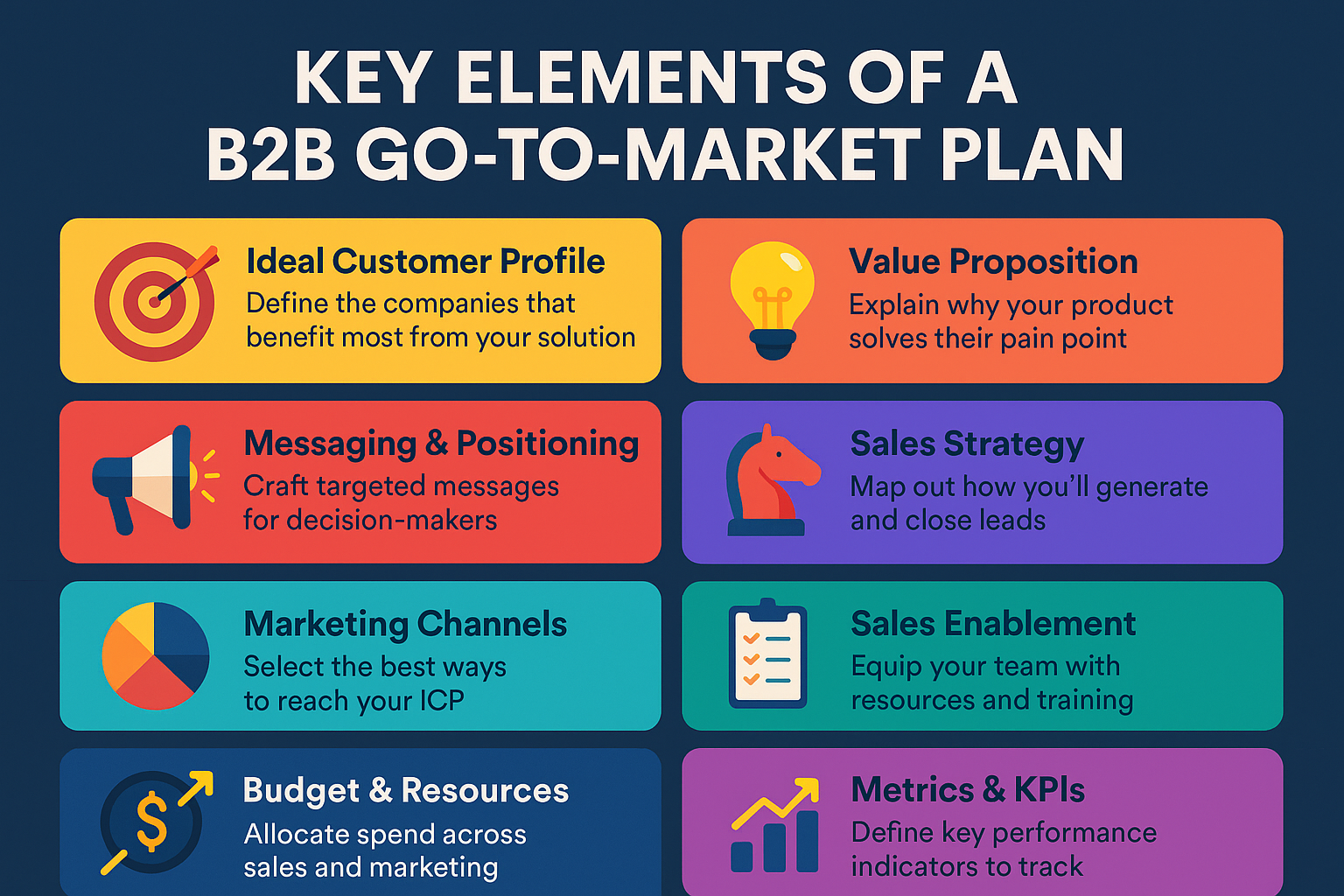
To summarize and structure these components, here is a list of the key building blocks of your GTM strategy. The image below provides a great visual summary.
- Ideal Customer Profile (ICP) & Target Market: Defining precisely which organizations are the best fit for your platform. Are they small study abroad consultancies, mid-sized coaching chains, or university language departments?
- Value Proposition & Positioning: A clear statement on the value you provide and how you are different from competitors. For example: "We help study abroad consultancies increase student success rates by 25% with our integrated mock test and evaluation platform."
- Pricing & Packaging: How you structure your offering into tiers and set prices (e.g., per-student, per-course license, annual subscription) that align with the value delivered.
- Distribution Channels & Sales Strategy: The model for how you sell. Will you use an internal sales team (inside/field sales), channel partners (like education agents), or a self-service online model?
- Marketing Strategy & Demand Generation: The plan to make your ICP "know" and "understand" you through channels like content marketing, paid advertising, webinars, and events.
- Sales Enablement & Team Alignment: Equipping your sales team with the right tools, content (proposals, case studies), and training, and ensuring sales and marketing are aligned on goals and processes.
- Budget & Resources: Allocating the necessary financial and human resources to execute the strategy. This directly connects to your questions about team size and hiring.
- Metrics & KPIs: The key numbers you will track to measure progress towards your 5 crore goal, such as Customer Acquisition Cost (CAC), Lifetime Value (LTV), and sales conversion rates.
Test your understanding!
Imagine you have to pitch the need for developing a formal GTM strategy to your business partner, who believes you simply need to hire more salespeople to hit the 5 crore target.
Based on what you've learned, how would you explain why starting with a GTM strategy is more effective than immediately expanding the sales team?
Show answer
A strong answer would focus on efficiency and foundation. You could explain that simply hiring more salespeople without a clear strategy is like sending more explorers on an expedition without a map.
You might say: "Hiring more salespeople will only be effective if they have the right foundation. A GTM strategy provides that foundation by first helping us define exactly who our best customers are (our ICP) and what message will resonate with them (our value proposition). It also forces us to build a scalable marketing engine to make potential customers aware of us before a salesperson ever calls them. This makes our sales team far more efficient, reduces the cost of acquiring each customer, and ensures we are all aligned on the path to our 5 crore goal, rather than just working harder with diminishing returns."
Conclusion
In this lesson, we've laid the groundwork for our journey. Here are the key takeaways:
- A Go-to-Market strategy is a comprehensive, cross-functional plan that aligns your entire business to achieve its revenue goals in a specific market.
- It is more than just a sales or marketing plan; it integrates product, pricing, sales, and marketing into one cohesive strategy.
- For a scaling business like yours, a GTM strategy is crucial for creating leverage, moving beyond brute-force sales efforts by systematically making your market know, understand, and trust you.
- The strategy is built on core components, including your target market, value proposition, pricing, channels, and the metrics you'll use to measure success.
We've now defined the blueprint. In our next lesson, we will start building the first and most critical piece of it: analyzing your existing successful customers to create a detailed Ideal Customer Profile (ICP). This will give your sales and marketing efforts the focus they need to be truly effective.