Hello! Welcome back to our second module, "Price Imbalances: The Institutional Footprint."
In our last session, we built a foundational framework for trading Fair Value Gaps (FVGs). You learned how to use them as entry zones, where to place a stop-loss, and how to identify a logical take-profit target. We also emphasized that the highest-probability setups occur with confluence, such as a break of structure creating a fresh FVG.
However, a critical question remains: when price retraces to an FVG, how can we anticipate whether it will simply tap the level and reverse, or trade straight through it? This is the key puzzle we'll solve today. Our learning outcome is to differentiate between FVGs that are likely to be filled versus respected. Mastering this distinction is crucial for refining your trade selection, improving your entry timing, and avoiding failed setups—skills that are vital for both discretionary trading and for building the robust logic required for your future trading bots.
1. The Default Expectation: Efficiency vs. Momentum
As you know, an FVG represents an inefficiency in the market. The default algorithmic behavior is to eventually return to that area to rebalance price. This is why we can use them as entries or targets. But whether this rebalancing happens immediately and completely depends on the current market narrative.
Think of it as a tug-of-war between two forces:
- The drive for efficiency: The market's tendency to fill the gap.
- The force of momentum: The market's urgency to reach a specific target (a draw on liquidity).
When momentum is strong, the market is in a hurry. It may only perform a shallow retracement—respecting the FVG—before continuing its mission. When momentum is weak or the target has been reached, the drive for efficiency takes over, and the gap is more likely to be fully filled.
2. Key Factors for Differentiating FVGs
So, how do we read the context to know which force is in control? We look for specific clues. Let's break down the most important ones.
Factor 1: The "First Line of Defense" and Momentum
An FVG rarely exists in a vacuum. It often forms near other important price levels, such as order blocks or breaker blocks. When an FVG is aligned with or "protected" by another one of these institutional reference points, that other level acts as a first line of defense. Price is likely to react at that first level, making it less likely to trade all the way through the FVG.
Furthermore, if there is a clear draw on liquidity (e.g., a prominent old high or low) and price is moving towards it with strong momentum (large, one-sided candles), it is less likely to make a deep, time-consuming retracement to fill the FVG.
The following video explains these two concepts—the first line of defense and momentum—very clearly. It also introduces the idea of a Breakaway Gap, which is an FVG that forms in a high-momentum environment and is expected to be respected, not filled.
Know Which Fair Value Gap To Use (Breakaway Gap)
The video 'Know Which Fair Value Gap To Use (Breakaway Gap)' by Arjo provides an excellent framework for identifying strong FVGs. Focus on how he uses the concepts of a 'first line of defense' and the 'draw on liquidity' to determine which gaps will likely hold.
Please watch from 03:01 to 15:26. The first part (until 10:58) explains the 'first line of defense' with multiple examples. The second part discusses how strong momentum towards a clear 'draw on liquidity' causes FVGs to be left open as Breakaway Gaps.
As the video demonstrates, when you see an FVG that is also aligned with a breaker or order block, your expectation should shift. You should anticipate a reaction at the edge of the FVG, rather than a deep fill.
Factor 2: Inversion - The Ultimate Sign of Failure
The clearest signal that an FVG will be filled rather than respected is when price shows no respect for it at all. Specifically, when a candle body closes through the FVG, it is considered invalidated.
This event is not just a failure; it's a powerful signal in itself. The FVG is now considered inverted. A bullish FVG that fails becomes a bearish reference point, and a bearish FVG that fails becomes a bullish one. This is a crucial concept for understanding shifts in market direction.
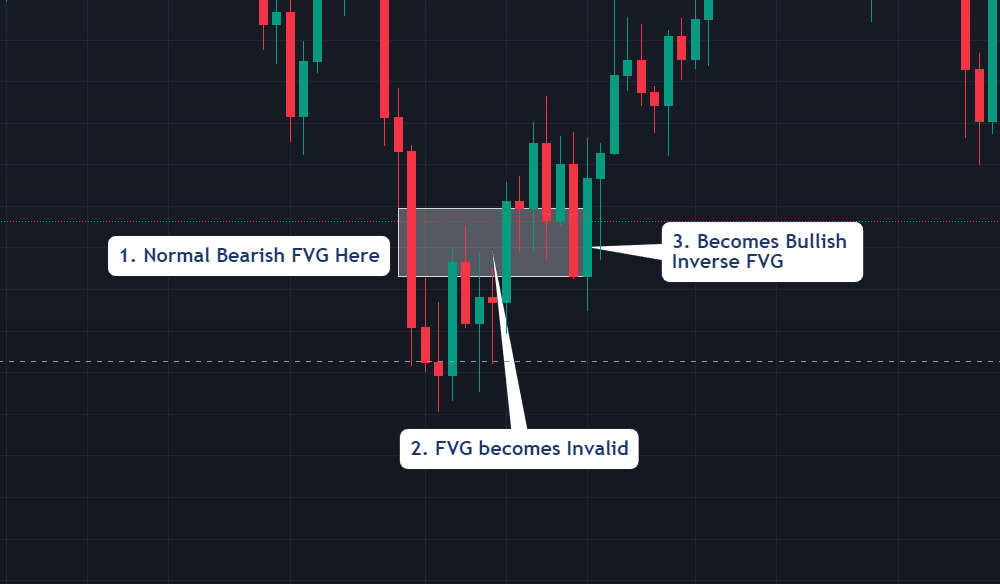
The next video explains this concept of inversion and introduces a simple but powerful way to gauge the intrinsic strength of an FVG before it's even tested.
The Only Fair Value Gap Video You'll Ever Need.
The video 'The Only Fair Value Gap Video You'll Ever Need' by Casper SMC introduces two fantastic concepts: Inverted FVGs and 'Consistency Theory.' This will give you a clear, mechanical rule for when an FVG fails and how to judge its initial strength.
First, watch from 06:33 to 09:26 to understand Inverted FVGs. Notice his emphasis on a candle closing beyond the gap. Then, watch from 11:55 to 14:35 to learn about 'Consistency Theory'—the difference between one-sided (high-probability) and two-sided (low-probability) gaps.
To summarize the key ideas from the video:
- Inverted FVG (IFVG): A candle body closing completely through an FVG invalidates it and flips its function. This tells you the original momentum has failed, and price is now likely heading in the other direction.
- Consistency Theory:
- One-Sided FVG: All three candles forming the FVG are the same color (all bullish or all bearish). This shows clear, decisive momentum and creates a high-probability FVG that is likely to be respected.
- Two-Sided FVG: The candles are mixed (e.g., a bearish candle starts a bullish FVG). This shows indecision and creates a low-probability FVG that is more likely to fail and be filled.
Factor 3: Timeframe and Mitigation Status
Not all FVGs are created equal. Their importance is heavily influenced by the timeframe they appear on and whether they have been tested before.
Fair Value Gap: Explanations, Types, Indicator, Trading ...
The article 'Fair Value Gap: Explanations, Types, Indicator, Trading ...' by Strike.money provides some useful context on how timeframes affect FVGs and their likelihood of being filled.
First, read the table under 'Advantages vs Limitations'. Note the limitation: 'Not all FVGs get filled, especially in strong trends.' Then, read the section 'Is Fair Value Gap a Reliable Trading Concept?' to reinforce that context is key. Finally, review the table under 'How Long Does it Take for an FVG to Fill?' to see how the expected fill time varies by timeframe.
The key takeaways are:
- Timeframe: Higher timeframe FVGs (Daily, Weekly) are more significant. They act as powerful magnets for price and are more likely to be respected as major support or resistance. Lower timeframe FVGs (1m, 5m) are more common and more likely to be filled or invalidated by market noise.
- Mitigation: The "Fair Value Gap (FVG) Trading Guide" from Alchemy Markets introduces this term. An unmitigated FVG is fresh and has not been traded back into yet. It is the most potent. Once price has traded back into an FVG, it is considered mitigated (either partially or fully) and is less reliable on subsequent tests. A fully filled FVG is fully mitigated and no longer a valid area of imbalance.
A Spectrum of Interaction
It's helpful to think of price interacting with an FVG not as a binary choice (respect vs. fill), but as a spectrum.

- Entry Drill / IOFED (Institutional Orderflow Entry Drill): Price just dips into the FVG before aggressively moving away. This shows extreme respect for the level and typically occurs in high-momentum environments. The FVG is respected.
- Consequent Encroachment (C.E.): Price trades to the 50% midpoint of the FVG. This is a very common reaction level, representing a literal "fair value" point within the imbalance. The FVG is respected.
- Full Fill: Price trades through the entire FVG, rebalancing the range completely. If price immediately reverses at the far end of the FVG, the level is still considered valid. However, if a candle body closes beyond the FVG, the level has failed and is now considered inverted. The FVG is filled.
Conclusion
You now have a multi-faceted toolkit to assess the probable outcome when price approaches an FVG. Instead of seeing every gap as an automatic entry, you can now qualify them based on the market's story.
Key Takeaways:
- An FVG is likely to be respected (price reverses at or inside it) when:
- There is strong momentum towards a clear draw on liquidity.
- It is a "one-sided" FVG, showing consistent buying or selling pressure.
- It aligns with another key level like an order block (first line of defense).
- It is on a higher timeframe (4H, Daily).
- An FVG is likely to be filled (price trades through it) when:
- Momentum is weak or the draw on liquidity has already been met.
- It is a "two-sided" FVG, showing indecision.
- A candle body closes completely through it, causing an inversion.
- It is on a very low timeframe with a lot of market noise.
Preview for the Next Lesson:
We've touched upon the importance of FVGs aligning with order blocks. This relationship is one of the most powerful confluences in the ICT toolkit. In our next lesson, we will "Analyze the relationship between order blocks and FVGs," exploring how they form together and how you can use their combined power to frame exceptionally high-probability trades.