Hello! Welcome back to our course.
In our last lesson, we established the first and most critical rule of risk management: how to set a stop loss based on a structural invalidation level. This gave us a logical, price-based definition of when a trade idea is wrong.
Today, we will build directly on that foundation. Knowing your risk in pips or points is only half the battle. The other half is translating that into a consistent monetary value. This lesson, part of our module on Systematic Risk and Trade Management, will teach you how to calculate the appropriate position size based on your account size and risk per trade.
Mastering this skill is what separates amateur speculators from professional traders. It is the core mechanism for preserving your capital and ensuring your long-term survival and profitability in the markets.
The Problem with Inconsistent Risk
Before we dive into the "how," let's solidify the "why." Many novice traders make the mistake of using a fixed contract or lot size for every trade. For example, they might decide to always trade "1 NQ contract" or "0.10 lots of EUR/USD."
This approach is flawed because your actual dollar risk will change dramatically depending on the stop-loss distance for each specific trade. A trade with a 10-point stop will risk far less money than a trade with a 40-point stop, even with the same contract size. This inconsistency makes it impossible to manage your account's growth or drawdown predictably.
The professional approach is to risk a fixed percentage or dollar amount of your account on every single trade.
Position Sizing For Trading - Futures & Forex
To see why this is so important, let's watch the first part of the video 'Position Sizing For Trading - Futures & Forex' from the TTrades channel. It clearly illustrates how inconsistent sizing breaks the relationship between win rate and risk-to-reward.
Watch from the beginning until 03:56. Pay close attention to the two scenarios presented: one with consistent dollar risk and one without. This will make the importance of today's lesson crystal clear.
As the video demonstrates, consistent risk is the bedrock upon which a profitable trading system is built. It ensures that your wins and losses are mathematically proportional, allowing your trading edge to play out over time.
The Core Formula for Position Sizing
Calculating your position size is a straightforward mathematical process. While there are tools to automate this (which we'll cover), understanding the formula is essential.
The calculation can be broken down into two main steps. The article "Position Size Calculator for Smart Money Traders" lays this out nicely.
Position Size Calculator for Smart Money Traders
This article from InnerCircleTraders.net provides a formal definition of position sizing and the underlying math. We'll use it to structure our understanding.
Please read the section titled 'The Core Risk Formula: The Math Behind Calculating Position Size'. This breaks down the calculation into clear, logical steps.
Let's formalize those steps:
Step 1: Determine Your Dollar Risk
This is the maximum amount of money you are willing to lose on a single trade. It's usually a small percentage of your account.
- Example: On a $50,000 account, risking 1% per trade means your dollar risk is $50,000 * 0.01 = $500.
Step 2: Calculate Your Position Size
This step uses your dollar risk and the trade's specific parameters to find the correct number of contracts or lots.
Let's apply this to a futures trading example, which is a key interest of yours.
Position Sizing For Trading - Futures & Forex
The TTrades video we watched earlier also demonstrates this manual calculation for futures contracts. Let's see it in action.
Watch the section from 03:56 to 05:23. The video shows exactly how to plug the numbers into the formula for the NASDAQ (NQ) futures contract.
Market-Specific Considerations
It's important to know that the "Value per Point/Pip" changes depending on the market you trade.
- Futures (ES, NQ): This is straightforward. Each contract has a fixed dollar value per point. For example, the E-mini NASDAQ 100 (NQ) is $20 per point, and the E-mini S&P 500 (ES) is $50 per point.
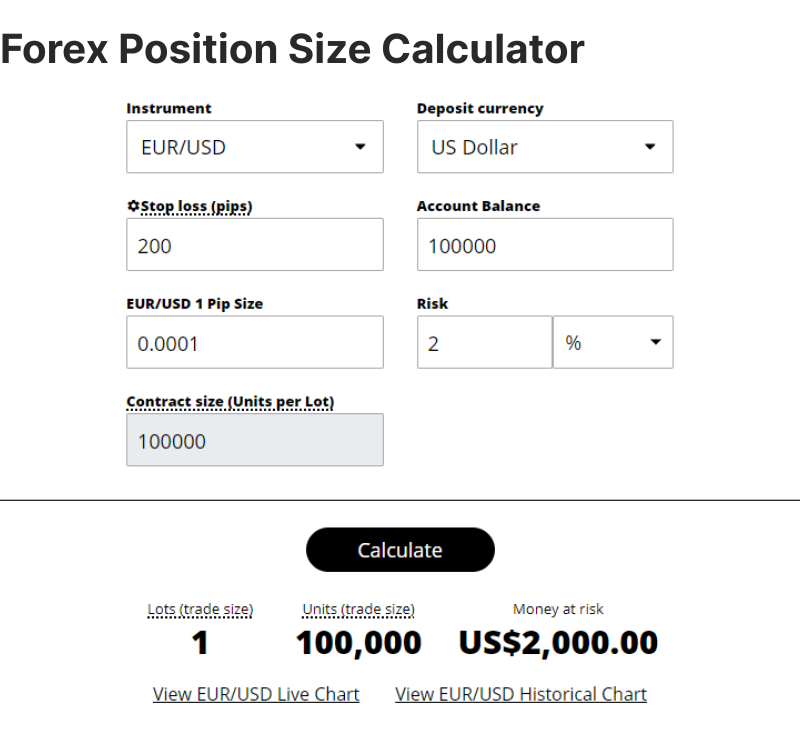
- Forex (EUR/USD, GBP/JPY): This can be more complex. The value of a pip depends on the currency pair you're trading and your account's denomination. For example, if you trade GBP/JPY from a USD account, the value of the pip loss (in JPY) must be converted back to USD.
Thankfully, most modern trading platforms and calculators handle these conversions automatically.
Test your understanding!
You are trading a $25,000 account and have a policy of risking 1% per trade. You identify a long setup on the E-mini S&P 500 (ES), which has a value of $50 per point. Your structural stop loss, placed below a protected swing low, is 8 points away from your entry.
How many ES contracts should you trade?
Show answer
-
Calculate Dollar Risk:
$25,000 (Account Size) * 0.01 (Risk %) = $250 -
Calculate Value of Stop per Contract:
8 points (Stop Distance) * $50 (Value per Point) = $400 -
Calculate Position Size:
$250 (Dollar Risk) / $400 (Value of Stop) = 0.625 contracts
You should trade 0.625 ES contracts. But wait... you can't trade a fraction of a standard contract! This leads us to our next crucial topic.
Precision Sizing with Micros and Calculators
The problem in the exercise above is common. The solution in the futures market is to use micro contracts.
A micro contract is exactly 1/10th the size of its E-mini equivalent.
- 1 E-mini S&P 500 (ES) contract = 10 Micro E-mini S&P 500 (MES) contracts.
- 1 E-mini NASDAQ 100 (NQ) contract = 10 Micro E-mini NASDAQ 100 (MNQ) contracts.
Using micros allows you to fine-tune your position size with much greater accuracy, ensuring your risk stays consistent.
ICT FOR DUMMIES | RISK MANAGEMENT EP. 11
The 'ICT FOR DUMMIES' video from PB Trading has an excellent segment explaining the practical use of micros for accurate risk management.
Watch the clip from 27:09 to 29:31. The hosts explain the relationship between minis and micros and why using micros is essential for most account sizes.
Using Automated Tools
While you know the formula, in practice, you'll use a calculator. The most convenient is built directly into TradingView.
The Long/Short Position tool in TradingView can do this automatically.
ICT FOR DUMMIES | RISK MANAGEMENT EP. 11
Let's see a full demonstration of using TradingView's tool. This is the method you will likely use for every trade.
Watch this detailed walkthrough from 29:31 to 37:34. The video shows a real-time example of setting up a trade, opening the position tool's settings, inputting the account size and risk, and adjusting the number of micro contracts to precisely match the desired risk.
To summarize the process in TradingView:
- Place the Long or Short Position tool on your chart.
- Adjust the entry, stop-loss, and take-profit levels.
- Double-click the tool to open its Settings.
- Under the 'Inputs' tab, enter your Account Size and desired Risk percentage.
- Ensure the Lot Size is set to 1 for futures.
- The Quantity field will now show you exactly how many contracts (or micros) to trade to achieve your desired risk.
Position Sizing for Prop Firm Accounts
A huge part of the modern ICT trading world involves proprietary (prop) trading firms. When trading for a prop firm, especially during an evaluation, the concept of "account size" changes. You don't have access to the full nominal account value (e.g., $100,000); your real capital is the maximum drawdown allowed.
Position Sizing For Trading - Futures & Forex
This is a crucial distinction that many traders miss. Let's watch the final segment of the TTrades video, which is dedicated to this topic.
Watch from 09:35 to the end. The video explains why you should base your risk calculations on the drawdown limit, not the headline account figure.
So, for a prop firm evaluation:
- "Account Size" becomes "Maximum Drawdown."
- If you have a $100k account with a $5,000 drawdown limit, you should calculate your risk percentage based on the $5,000.
- Risking 1% of the drawdown ($50) is a common and sustainable approach for evaluations.
Conclusion
You have now connected the two pillars of risk management. You know how to find your invalidation level (stop loss) based on market structure, and you know how to calculate your position size to ensure every trade carries a consistent, predefined monetary risk.
Key Takeaways:
- Professional trading requires risking a fixed percentage of your capital on every trade, not using a fixed contract size.
- The position size formula is: Position Size = Dollar Risk / (Stop Distance * Value per Point).
- Use micro contracts (like MNQ and MES) for futures to achieve precise risk, especially on smaller accounts or with tighter stops.
- Leverage tools like the TradingView Position Size Calculator to automate this process for every trade.
- For prop firm accounts, base your risk calculations on the maximum drawdown, not the nominal account size.
Preview for the Next Lesson:
We have now fully defined the risk side of a trade plan: a logical entry, a structural stop, and a precise position size. The final component is knowing where to take profit. In our next lesson, we will learn how to define primary and secondary take-profit targets using ICT concepts like liquidity pools. This will complete our framework for building a full, systematic trade idea from start to finish.