Hello! Welcome back to our module on Advanced ICT Trade Models.
In our last lesson, you learned how to identify the distinct stages of the Market Maker Buy Model (MMBM), from the initial consolidation and liquidity engineering to the smart money reversal and the final expansion.
Today, we transition from identifying the model to acting on it. The goal of this lesson is to formulate a trade plan for executing a trade based on the MMBM. A systematic plan is the backbone of consistent trading, whether you are executing trades manually or designing an automated strategy for a trading bot. We will build a step-by-step framework that covers the necessary context, entry triggers, risk management, and profit objectives.
1. The Blueprint of an MMBM Trade Plan
An effective trade plan needs more than just an entry signal. It requires a complete blueprint that guides your decisions from start to finish. We'll structure our MMBM plan around four critical pillars:
- Context: The "when" and "where." Is the market environment right for an MMBM?
- Trigger: The "what." What specific price action confirms the model is in play?
- Stop Loss: The "invalidation." Where is the trade idea proven wrong?
- Take Profit: The "objective." What is the logical target for the trade?
Let's dive into each pillar.
2. Pillar 1: Establishing the Context (The Prerequisites)
Before you even start looking for an entry, you must confirm that the broader market narrative supports a potential MMBM. This model has the highest probability of success when specific prerequisite conditions are met on the higher timeframes (HTF).
Market Maker Buy Model (MMBM) – ICT Trading Model
The article 'Market Maker Buy Model (MMBM) – ICT Trading Model' from writofinance.com clearly outlines the foundational requirements for the MMBM. Understanding these prerequisites is the first step in any trade plan.
Please read the first four paragraphs of the article, down to the end of the section titled 'Understanding ICT Market Maker Buy Model (MMBM)'. Focus on the three key factors that must be aligned before you consider trading this model.
Based on that reading, here is a summary of the essential context you need to establish:
- Bullish Higher Timeframe Structure: The MMBM is a pro-trend model. It should form within an existing bullish market on a higher timeframe (e.g., Daily, 4H). You should see a pattern of higher highs and higher lows, indicating that institutional order flow is already to the upside.
- Clear Draw on Liquidity: There must be a specific pool of buy-side liquidity (BSL) above the current price that the market is likely reaching for. This could be a prominent swing high, equal highs, or a large HTF Fair Value Gap (FVG). This is your ultimate target and the reason for the trade.
- A Move into a HTF Discount Array: The sell-side portion of the MMBM is a retracement on the higher timeframe. The turning point—the Smart Money Reversal (SMR)—should ideally happen after price trades down into a significant HTF discount PD Array, such as a daily order block or a weekly FVG.
Only when these three conditions are met do you have the proper context to start looking for an MMBM to form on a lower timeframe.
3. Pillar 2 & 3: The Entry Trigger and Stop Loss
With the context established, you can now zoom into a lower timeframe (e.g., 1H, 15M) to find your entry trigger. This involves pinpointing the Smart Money Reversal and entering on the subsequent confirmation.
The following video provides a clear breakdown of the entry and accumulation phases, which are crucial for defining your trade.
ICT Market Maker Model - Explained In-depth!
In 'ICT Market Maker Model - Explained In-depth!' by DanDowdTrading, the presenter details the entry opportunities that arise after the SMR. This segment will clarify where to enter and where to place your initial risk.
Please watch from 04:31 to 08:35. Pay close attention to: The definition of the Smart Money Reversal (market structure shift + FVG). The concept of the 'Low-Risk Buy' entry. How the low of the SMR becomes a 'protected' low, which is the logical place for your stop loss.
Let's combine this with a step-by-step guide to formalize the entry and stop-loss rules.
ICT Market Maker Buy Model [Lower High & Trend Reversal]
The article 'ICT Market Maker Buy Model' from tradingfinder.com provides a concise, step-by-step guide on how to trade the model, including entry confirmation and stop loss placement.
Read the section 'How to Trade Using the Market Maker Buy Model', focusing on steps #4, #5, and #6. Note how it combines a Break of Structure (BOS), SMT Divergence, and an FVG for the entry trigger.
Here is the trigger and risk management plan:
- Identify the Smart Money Reversal (SMR): At your HTF discount array, watch for price to sweep a key sell-side liquidity (SSL) pool (like a previous day's low).
- Confirm with a Market Structure Shift (MSS): The reversal is confirmed when price moves up with displacement, breaking a recent lower high from the sell-side curve. This MSS should leave behind a Fair Value Gap (FVG).
- Add Confluence with SMT Divergence: As you learned previously, check for a bullish SMT divergence between correlated assets at the SMR low. This is a powerful confirmation that the move down was manipulation.
- Execute the Entry: Your entry is a buy order placed as price retraces back into the FVG created during the MSS. This is known as the Low-Risk Buy.
- Set the Stop Loss: Place your stop loss just below the absolute low of the Smart Money Reversal. If price trades below this level, the MMBM thesis is invalidated.
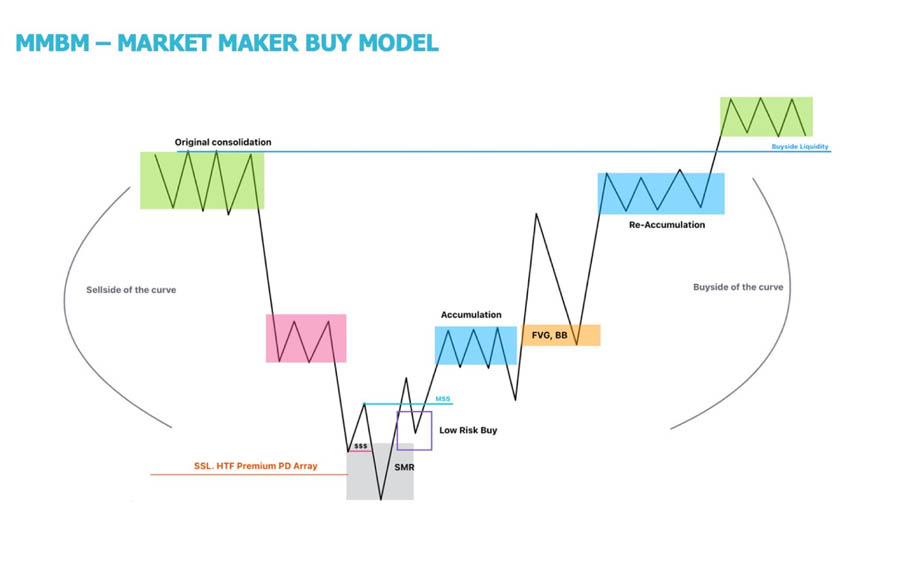
4. Pillar 4: The Take Profit (The Objective)
Once you're in a trade, you need a logical plan for taking profits. The MMBM provides clear, built-in targets.
- Primary Target: The main objective is the buy-side liquidity resting above the Original Consolidation high. This is where smart money intends to pair their accumulated long positions.
- Intermediate Targets: The lower highs created during the sell-side curve are pools of engineered liquidity. You can use these levels to take partial profits as price moves in your favor.
For more objective targets, you can use Fibonacci standard deviation projections, as shown in the video from our last lesson. By drawing the Fibonacci tool from the SMR low to the MSS high, the -2.0 to -2.5 standard deviation levels often align with the Original Consolidation high.
5. The Complete MMBM Trade Plan Checklist
Let's synthesize everything into a single, actionable checklist. This is the kind of rule-based logic you would use to build a discretionary trading plan or to start programming an automated scanner.
Phase 1: Pre-Trade Analysis (Context)
- Is the Daily/4H chart showing a bullish market structure (higher highs and higher lows)?
- Is there a clear BSL target (e.g., old high) that price is likely drawn to?
- Has price retraced into a key HTF discount PD Array (e.g., Daily FVG, Weekly OB)?
Phase 2: Trade Execution (Trigger, Entry, Risk)
- Has price swept a key SSL pool on the 1H/15M chart?
- Has a bullish SMT Divergence occurred at the low? (Confirmation)
- Has price created a clear MSS with displacement, leaving an FVG? (Trigger)
- Entry: Place a buy order on the retracement into the FVG.
- Stop Loss: Place SL below the SMR swing low.
- Position Size: Calculate based on your risk tolerance and the distance to your stop loss.
Phase 3: Trade Management (Profit Targets)
- TP1: Set a partial take profit at the first significant engineered BSL high.
- TP2: Set a partial take profit at the next BSL high.
- Final TP: Target the high of the Original Consolidation.
- Consider moving your stop loss to breakeven after TP1 is hit.
Test your understanding!
You are analyzing EUR/USD. The daily chart is bullish. Price has just tapped into a daily bullish order block. On the 15-minute chart, price sweeps the Asian session low, reverses, and breaks the last 15M swing high with a large FVG. At the low, EUR/USD made a lower low, but the correlated DXY (US Dollar Index) failed to make a higher high. According to the trade plan, what should you do?
Show answer
The conditions for the trade plan are met:
- Context: Daily chart is bullish, and price is at a HTF discount array (daily OB).
- Trigger: Price swept SSL (Asian low) and had an MSS with an FVG.
- Confirmation: The failure of DXY to make a higher high indicates a bullish SMT divergence for EUR/USD.
According to the plan, the next step is to place a buy order on the retracement into the 15M FVG, with a stop loss below the low of the sweep. The ultimate target would be a clear HTF buy-side liquidity pool.
6. A Glimpse of the Inverse: The Market Maker Sell Model (MMSM)
The logic you've just learned is perfectly mirrored for bearish scenarios in the Market Maker Sell Model (MMSM). While we'll cover it in more detail later, the concept is identical but inverted.
The ULTIMATE MMXM Guide! | The ONLY Model You Will Ever Need!
The video 'The ULTIMATE MMXM Guide!' by Trading Patiently gives a fantastic, simplified overview of both the buy and sell models. This section will introduce the MMSM.
Watch from 07:04 to 08:04. Notice how every element is simply the inverse of the MMBM: price accumulates higher into a premium array, the SMR is a bearish reversal, and the target is the original consolidation low.
Conclusion
You now have a complete, rule-based trade plan for executing high-probability trades using the Market Maker Buy Model. By moving from simple identification to a structured plan, you are taking a significant step towards trading with consistency and precision.
Key Takeaways:
- A complete MMBM trade plan is built on four pillars: Context, Trigger, Stop Loss, and Take Profit.
- The ideal Context is a bullish HTF trend where price has retraced to a HTF discount array.
- The Trigger is a Smart Money Reversal, confirmed by an MSS with an FVG and ideally a bullish SMT divergence.
- The Stop Loss is placed at the point of invalidation: below the SMR low.
- The primary Take Profit target is the buy-side liquidity above the Original Consolidation.
Preview for the Next Lesson:
We've had a brief introduction to the Market Maker Sell Model (MMSM). In the next lesson, we will focus exclusively on this bearish counterpart. You will learn to identify the stages of the Market Maker Sell Model (MMSM), just as you did for the MMBM, solidifying your ability to read the market's narrative in both directions.