Hello! Welcome to the next lesson in our module on Advanced ICT Trade Models.
In the previous lesson, we constructed a detailed trade plan for executing the Market Maker Buy Model (MMBM). You learned that the MMBM is not just a random pattern but a logical template for how smart money accumulates long positions. We concluded with a brief glimpse of its bearish counterpart.
Today, we will dive deep into that bearish mirror image. The learning outcome for this lesson is to identify the stages of the Market Maker Sell Model (MMSM). By the end of this lesson, you will be able to look at a bearish price swing and recognize the distinct phases of institutional distribution, from the initial manipulation to the final price delivery. This is a crucial skill for reading the market narrative in both directions, which is essential for your goals in both discretionary trading and algorithmic strategy development.
1. The Logic Behind the Market Maker Models
Before we dissect the sell model, let's refresh our understanding of the fundamental purpose of these models. They aren't just patterns; they are conceptual frameworks for how central banks and large institutions provide liquidity to the market.
The MMXM Trader | Advanced ICT MMXM Lesson (Everything You Need To Know)
The video 'The MMXM Trader' by TTrades offers an excellent high-level explanation of the logic behind market maker models. Understanding this 'why' will make the 'what'—the stages of the pattern—much more intuitive.
Watch the segment from 00:47 to 03:24. The first part introduces the concept of MMXM as a hedging program. The second part explains the buy model, but the logic is what's important: notice how institutions build positions against the apparent trend to provide liquidity before profiting on the reversal. The sell model works on the exact same principle, just inverted.
In essence, for an MMSM:
- As price climbs higher, smart money isn't chasing the move; they are building a net short position by selling into the rally.
- They do this to engineer buy-side liquidity and offer it to other market participants.
- The "Smart Money Reversal" at the top is where their net short position is largest, and they profit as price is delivered lower to target sell-side liquidity.
2. The Anatomy of the Market Maker Sell Model
Like its bullish counterpart, the MMSM can be broken down into a series of distinct, sequential stages. It unfolds across two "curves":
- The Buy Side of the Curve: A manipulative move upwards that engineers liquidity and sets the stage for the reversal.
- The Sell Side of the Curve: The true distribution move downwards where price seeks lower objectives.
The diagram below provides a clear visual map of this entire process.

3. Deconstructing the MMSM: A Stage-by-Stage Breakdown
Let's walk through each phase of the model. We'll use a combination of text and video to explain the purpose and appearance of each stage.
Mastering the ICT Market Maker Sell Model
For a concise overview, the article 'Mastering the ICT Market Maker Sell Model' from OPOFINANCE provides a clear, structured list of the model's phases. This will serve as our written guide.
Please read the section titled 'The Phases of the ICT Market Maker Sell Model'. Focus on the three main phases it outlines: Buy Program, Smart Money Reversal (SMR), and Sell Program. We will be expanding on each of these.
Now, let's explore these stages in greater detail.
Stage 1: Original Consolidation (OC)
This is the starting block. Before any significant move, price will often consolidate in a range. In the context of an MMSM, this consolidation creates a pool of sell-side liquidity (SSL) below its lows. This area becomes the ultimate target for the entire sell model.
Stage 2: The Buy Program (Engineering Liquidity)
This is the deceptive part of the model. Price leaves the Original Consolidation and begins to trend upwards. This is not a genuine bullish trend but a manipulation to:
- Induce unsuspecting traders to go long.
- Create a series of higher lows, which builds up sell-side liquidity underneath them.
This upward move often has several phases, which ICT labels First Stage Accumulation and Second Stage Accumulation (or Re-accumulation).
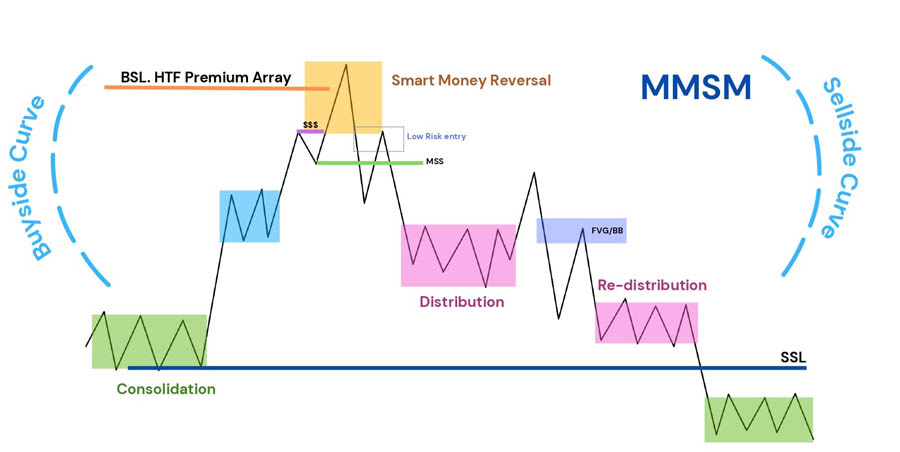
Stage 3: The Smart Money Reversal (SMR)
This is the climax of the manipulation and the turning point of the entire model. The SMR occurs when the upward move reaches a key Higher Timeframe (HTF) Premium PD Array (like a bearish order block or a daily FVG).
At this point, you will typically see:
- A raid on Buy-Side Liquidity (BSL): Price sweeps an old high to trigger buy stops.
- A Market Structure Shift (MSS): Price aggressively displaces downwards, breaking the last swing low formed during the up-move.
- SMT Divergence: As a final confirmation, you'll often see a bearish Smart Money Technique (SMT) divergence between correlated assets (e.g., EUR/USD makes a higher high, while GBP/USD fails to do so).
ICT Market Maker Model - All You Need To Know
The video 'ICT Market Maker Model - All You Need To Know' by DanDowdTrading has an excellent segment explaining the SMR in detail, including the crucial role of SMT divergence.
Watch from 12:52 to 14:42. The presenter explains how an SMR typically takes two forms of liquidity and is confirmed by a 'crack in correlation' or SMT divergence. This is a key concept you specifically wanted to cover.
Stage 4: The Sell Program (Distribution)
Once the SMR is complete, the true institutional intention is revealed. Price begins its journey down towards the Original Consolidation low. This "Sell Side of the Curve" also has distinct stages where you can identify potential entries:
- Low-Risk Sell: The first pullback after the initial MSS. This offers the earliest, though sometimes hardest to catch, entry opportunity.
- First Stage Distribution: A subsequent retracement higher into a bearish PD Array (like an FVG or order block) before another leg down.
- Second Stage Redistribution: Another retracement providing an entry opportunity, often leading to the most aggressive and rapid part of the sell-off as price makes its final push towards the objective.
Stage 5: Terminus (The Target)
The model is complete when price reaches its objective: the sell-side liquidity below the Original Consolidation low. At this point, the institutional players who built short positions during the Buy Program can now offload those positions by buying them back at a cheaper price, using the sell stops from other traders to facilitate their exit.
4. An Annotated Example
Let's watch a video walkthrough that ties all these stages together on a real chart. Seeing it in action is the best way to solidify your understanding.
ICT Market Maker Model - All You Need To Know
We'll return to the video from DanDowdTrading. This segment provides a clear, step-by-step analysis of an MMSM, labeling each stage as it unfolds.
Please watch from 09:41 to 11:20 and then from 27:37 to 31:42. The first part gives a schematic overview of the sell model. The second, longer part walks through a real chart example, identifying the Original Consolidation, the SMR, the Low-Risk Sell, and the distribution/redistribution stages. Pay close attention to how he identifies each stage in sequence.
Test your understanding!
You are observing a 15-minute chart of a forex pair. The higher timeframe trend is bearish. Price was in a tight range for several hours (Original Consolidation). It then broke out to the upside and has been forming a series of higher lows. It has just swept an old 4H high and immediately sold off, breaking the most recent 15M swing low. What stage of the MMSM has just been confirmed?
Show answer
The Smart Money Reversal (SMR) has just been confirmed. The break of the recent 15M swing low constitutes a Market Structure Shift (MSS). The next expected stage would be a retracement up for a Low-Risk Sell entry, followed by the First Stage of Distribution.
Conclusion
You have now deconstructed the Market Maker Sell Model into its core components. You can see it's not a magical pattern but a logical process of liquidity engineering and institutional order distribution. Being able to identify these stages as they form in real-time gives you a powerful edge in anticipating market direction.
Key Takeaways:
- The MMSM is the bearish inverse of the MMBM, describing how smart money distributes short positions.
- The model begins with an Original Consolidation, which sets the ultimate downside target.
- The Buy Program is a manipulative move up to engineer liquidity and reach a premium price level.
- The Smart Money Reversal (SMR) is the key turning point, confirmed by a raid on BSL and a bearish Market Structure Shift.
- The Sell Program consists of distribution stages (Low-Risk Sell, Distribution, Redistribution) that offer entry opportunities.
- The model completes at its Terminus when it attacks the liquidity below the Original Consolidation.
Preview for the Next Lesson:
Now that you can identify the structure of both the MMBM and MMSM, we're going to zoom in on a very specific, time-based trade setup that often occurs within these larger models. In our next lesson, you will learn to execute the 'Silver Bullet' trade setup within its specific time window and conditions. This is a high-probability ICT model that you specifically requested to learn, and it fits perfectly within the distribution legs of the market maker models we've just studied.