Hello!
In our last lesson, we focused on horizontal scaling—systematically finding new audiences for your ads. You learned how to expand Lookalikes, test new interests strategically, and when to graduate to broad targeting. Now that you have a process for identifying winning ads and promising new audiences, the next logical step is to structure your campaigns to leverage these assets for maximum reach and efficiency.
This lesson addresses the structural side of scaling. We'll focus on how to repurpose winning ad sets and creatives into new campaign structures to expand reach. You'll learn the professional workflow for moving proven ads from testing environments to scaling campaigns without losing valuable social proof, and how to use those same winners to explore new frontiers in your account. This is a cornerstone of building the repeatable scaling playbook you're aiming for.
The Core Principle: Separate Testing from Scaling
A common mistake advertisers make is mixing testing and scaling within the same campaign. This muddies the data and leads to inefficient spending. Sophisticated media buyers maintain separate structures for each job: one to find what works, and another to maximize what works.
The industry-standard approach is a two-part system:
- Ad Set Budget Optimization (ABO) Campaigns for Testing: You use ABO to give each ad set (and the new creatives within it) a dedicated, equal budget. This ensures you get clean data on which creative is a true winner, as the budget is controlled and not automatically shifted by the algorithm.
- Campaign Budget Optimization (CBO) Campaigns for Scaling: Once a creative is proven in an ABO environment, you move it to a CBO campaign. Here, you let Meta's algorithm dynamically allocate a larger, shared budget to the best-performing ads in the campaign, maximizing efficiency at scale.
This workflow provides the best of both worlds: the control of ABO for clear test results and the algorithmic efficiency of CBO for profitable scaling.
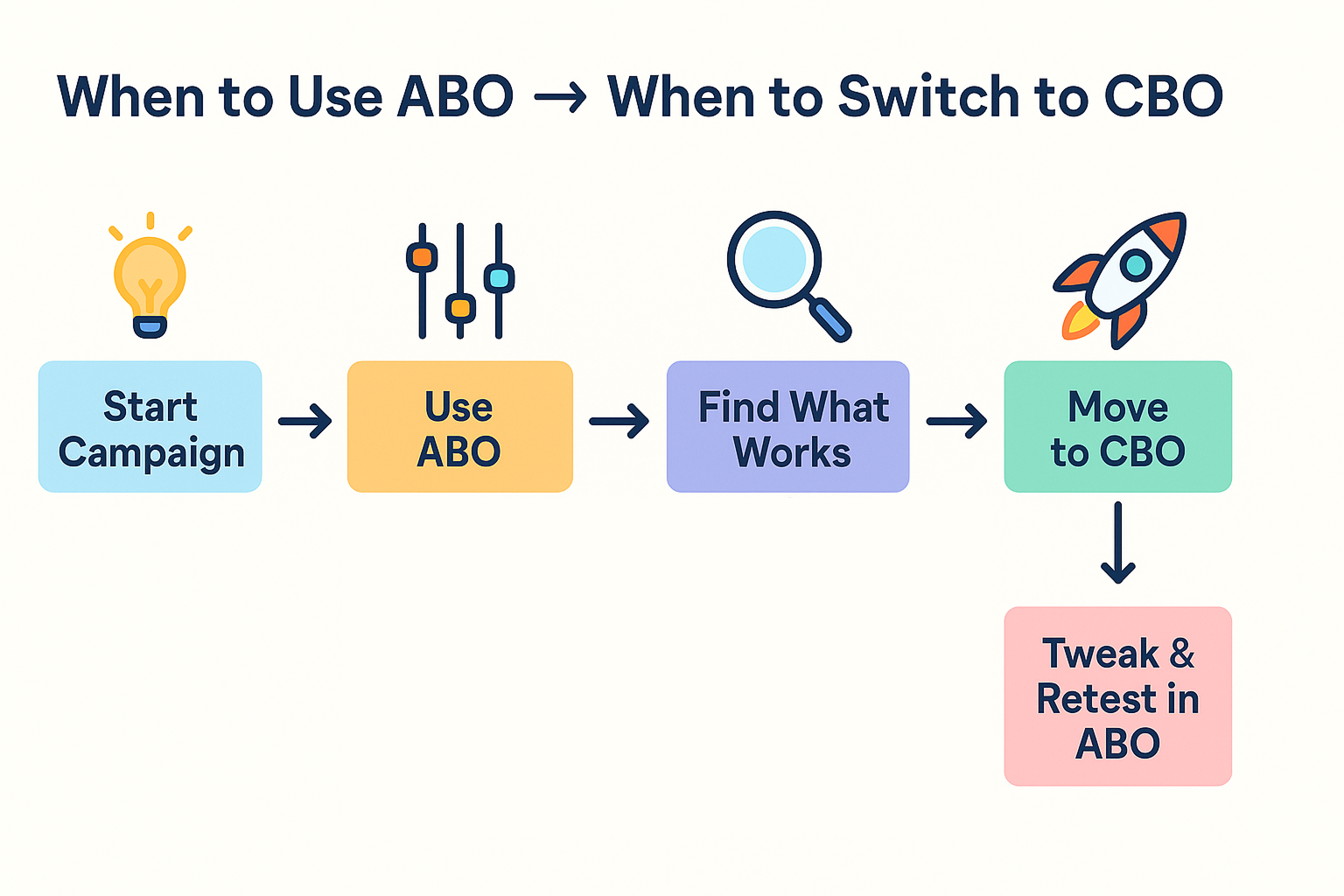
To solidify this foundational concept, the following reading breaks down this strategic workflow.
How Top Media Buyers Use ABO and CBO Together
This article from Ad's Uploader provides a concise overview of the professional workflow for using both budget strategies.
Read the section "How Top Media Buyers Use Both Together" and the subsection "The Scaling Workflow." Focus on how this process separates the goal of data clarity (testing) from the goal of efficiency (scaling).
The Key Technique: Preserving Social Proof with Post IDs
When you identify a winning ad—one with great metrics and lots of likes, comments, and shares—you want to preserve that social proof. It acts as a powerful signal of trust and quality, often leading to lower costs (CPMs) and higher conversion rates.
If you simply "duplicate" an ad into a new campaign, Meta treats it as a brand-new post, and all that hard-won engagement is lost. The solution is to use the ad's Post ID.
A Post ID is a unique identifier for a specific post on Facebook or Instagram. By using it, you can tell Meta to run the exact same post in a new campaign or ad set, carrying over all its existing social proof.
The video below gives a clear explanation of why this is so important and a step-by-step tutorial on how to do it.
How Facebook Post IDs Will Help You Scale In 2026 (Full Tutorial)
In "How Facebook Post IDs Will Help You Scale," Spencer Pawliw provides a full tutorial on finding and using Post IDs.
Watch these key parts: First, understand why Post IDs are crucial for scaling and maintaining performance. Next, follow the step-by-step process for finding the Post ID of a winning ad. Finally, see how to use the Post ID to create a new ad in your scaling campaign. The video also covers troubleshooting steps in case the primary method doesn't work, which is a valuable reference for later.

Now that you know the "what" and "how" of Post IDs, let's apply this to specific campaign structures.
Application 1: The Dedicated "Scale" Campaign
The most direct way to repurpose a winning ad is to move it into a dedicated scaling campaign. Think of this as your "hall of fame"—a CBO campaign reserved exclusively for your absolute best-performing ads. This campaign is designed for one purpose: to get as many conversions as possible from your proven winners, efficiently and at a large scale.
The video below outlines a complete account structure that includes this concept. We'll focus on the part about creating and populating the "Scale" campaign.
The NEW BEST Facebook Ads Campaign Structure for 2026
In this video on campaign structure, Sam Piliero explains how to build a dedicated scaling campaign.
Watch the segment from 06:43 to 09:52, which details the setup and purpose of a "Scale" campaign. Pay close attention to how he identifies top performers (using incremental attribution) from his other campaigns and duplicates them into this new structure.
Here is the workflow for this application:
- Identify a Winner: In your testing campaign (ABO), find an ad that has consistently hit your target CPA/ROAS and has sufficient spend and conversions.
- Retrieve its Post ID: Using the method from the previous video (LINK), find and copy the Post ID of this winning ad.
- Duplicate into the Scale Campaign: Create a new ad in your CBO "Scale" campaign. In the ad setup, choose "Use existing post" and paste in the Post ID.
- Monitor and Scale: With your best ads now consolidated, you can confidently increase the CBO budget of the Scale campaign to achieve vertical scaling. You leave the original ad running in its testing campaign.
Application 2: Repurposing Winners to Test New Audiences
In our last lesson, we discussed finding new audiences through horizontal scaling. You can supercharge this process by repurposing winning creatives. When you test a new audience (e.g., a new interest group), you want to isolate the audience as the only variable. The best way to do this is by using a creative that you already know works.
This creates a powerful feedback loop: you use a winning ad to test a new audience. If the test is successful, you've not only found a new audience to scale into but have also given the Meta algorithm more data about who your customer is, making all your campaigns smarter.
Let's return to the same video on account structure to see how this is done.
The NEW BEST Facebook Ads Campaign Structure for 2026
This part of the video explains how to use proven ads to test new interest audiences.
Watch the section from 09:52 to 11:42. The key insight is that when creating a new ad set to test an interest, you populate it with your best-performing ads (the same ones you'd put in your Scale campaign). This way, you know the ad works, and the performance of the ad set is a pure reflection of the new audience's quality.
This tactic elegantly combines creative optimization with audience expansion, forming a core part of a sophisticated scaling strategy.
Bringing It All Together: A Coherent Structure
By applying these principles, your account structure becomes a clear, logical system for growth:
- Testing Campaigns (ABO): This is your lab. You launch new creatives here in controlled ad sets to find your next winner.
- Prospecting Campaign (CBO): This is your main workhorse. It contains broad-audience ad sets with creatives that have shown promise. It's also where you can add new ad sets to test new interests using your proven winning creatives.
- Scaling Campaign (CBO): This is your "best of the best" portfolio. It contains only the top-tier, validated winning ads, duplicated via Post ID to preserve social proof. This campaign receives the majority of your scaling budget.
This separation of concerns allows you to test aggressively without disrupting the performance of your scaled campaigns and ensures you're always putting your budget behind your strongest assets.
This playbook from Spiral reinforces the concepts of systematic repurposing and structured scaling campaigns.
Read the following sections to connect these ideas: "Effective Process": Note the points on "Repurpose systematically" and "Double down on what works." "Scaling Ads": Focus on the criteria to "Scale" and the section "How to structure scaling campaigns." This provides another expert's take on a go-to setup for scaling with proven winners.
Conclusion
You've now learned how to create a campaign structure that bridges the gap between testing and scaling. This isn't just about organization; it's a strategic framework for maximizing the value of every winning creative you produce.
Here are the key takeaways:
- Separate your campaigns by job: Use ABO for controlled testing and CBO for efficient scaling.
- Always use Post IDs to move winners: This preserves social proof, which is a valuable performance asset.
- Build a dedicated "Scale" campaign: This CBO campaign acts as a hall of fame for your best ads and is the primary vehicle for vertical scaling.
- Repurpose winning ads to test new audiences: This isolates the audience as the variable, leading to cleaner data and more effective horizontal scaling.
In our next lesson, we'll address what to do when things go wrong. Now that you have a powerful engine for scaling, we'll cover how to diagnose common scaling problems like audience saturation, creative fatigue, and CPM inflation, ensuring you can maintain profitability as you grow.