Hello!
In our last lesson, we built a professional campaign structure for scaling, separating testing in ABO campaigns from scaling in CBO campaigns. You now have a system for moving winning creatives into dedicated scaling campaigns to maximize their reach. However, as you increase your budget and push this system harder, performance can unexpectedly decline. This is a universal challenge in performance marketing.
This lesson will equip you to handle these situations. We will focus on how to diagnose the three most common scaling problems: audience saturation, creative fatigue, and CPM inflation. Your goal is to move from reacting with random changes to systematically identifying the root cause of a performance drop. This ability to diagnose accurately is a critical skill for profitably scaling campaigns and is a key component of the data-driven playbook you're building.
Why Performance Declines at Scale
When you scale, you are fundamentally asking Meta to find more customers, faster. This creates pressure on several parts of the advertising ecosystem. The article "Meta Ads Scaling: Break Through Plateaus" explains this well.
Meta Ads Scaling: Break Through Plateaus
This article from Admetrics provides a high-level overview of why scaling isn't linear.
Read the introduction and the section "Why Meta Ads Scaling Hits a Wall." Then, jump to the FAQ at the end and read "What is Meta ads scaling and why does it plateau?" Pay close attention to the four reasons mentioned: Exhausting responsive audiences Increased competition Creative fatigue Audience overlap
As the article explains, a drop in ROAS is a symptom. Our job is to diagnose the underlying cause by looking at a core set of diagnostic metrics.
Your Diagnostic Toolkit: Key Metrics
To diagnose problems, you need the right tools. In Meta Ads, our tools are metrics. While you look at ROAS and CPA to judge the final outcome, you need to look at leading metrics to diagnose why the outcome has changed.
This video provides a great refresher on the most important metrics and how they function as diagnostic signals.
Every Important Meta Ad Metric Explained (2025)
In "Every Important Meta Ad Metric Explained," Michael Diaz breaks down the key performance indicators.
Focus on two key sections: Watch the explanation of Reach, Impressions, Frequency, and CPM from 04:09 to 06:31. These are your primary delivery and cost metrics. Then, watch the discussion on Frequency from 20:22 to 21:43. Notice how he frames it as an indicator of audience burnout, which is a crucial concept for this lesson.
The three most critical diagnostic metrics for scaling problems are:
- Frequency: The average number of times a person has seen your ad. This is the primary indicator for both creative fatigue and audience saturation.
- CPM (Cost Per 1,000 Impressions): The cost to show your ad 1,000 times. A rising CPM is the definition of cost inflation and can signal either market competition or audience saturation.
- CTR (Click-Through Rate): The percentage of people who click your ad after seeing it. A falling CTR is the classic sign of creative fatigue.
Now, let's use these metrics to diagnose each specific problem.
Diagnosis 1: Creative Fatigue
Creative fatigue happens when your audience has seen a specific ad so many times that they become blind to it and stop engaging. It's the most common reason a winning ad eventually fails.
Meta's platform will sometimes give you a direct warning, which looks like this:
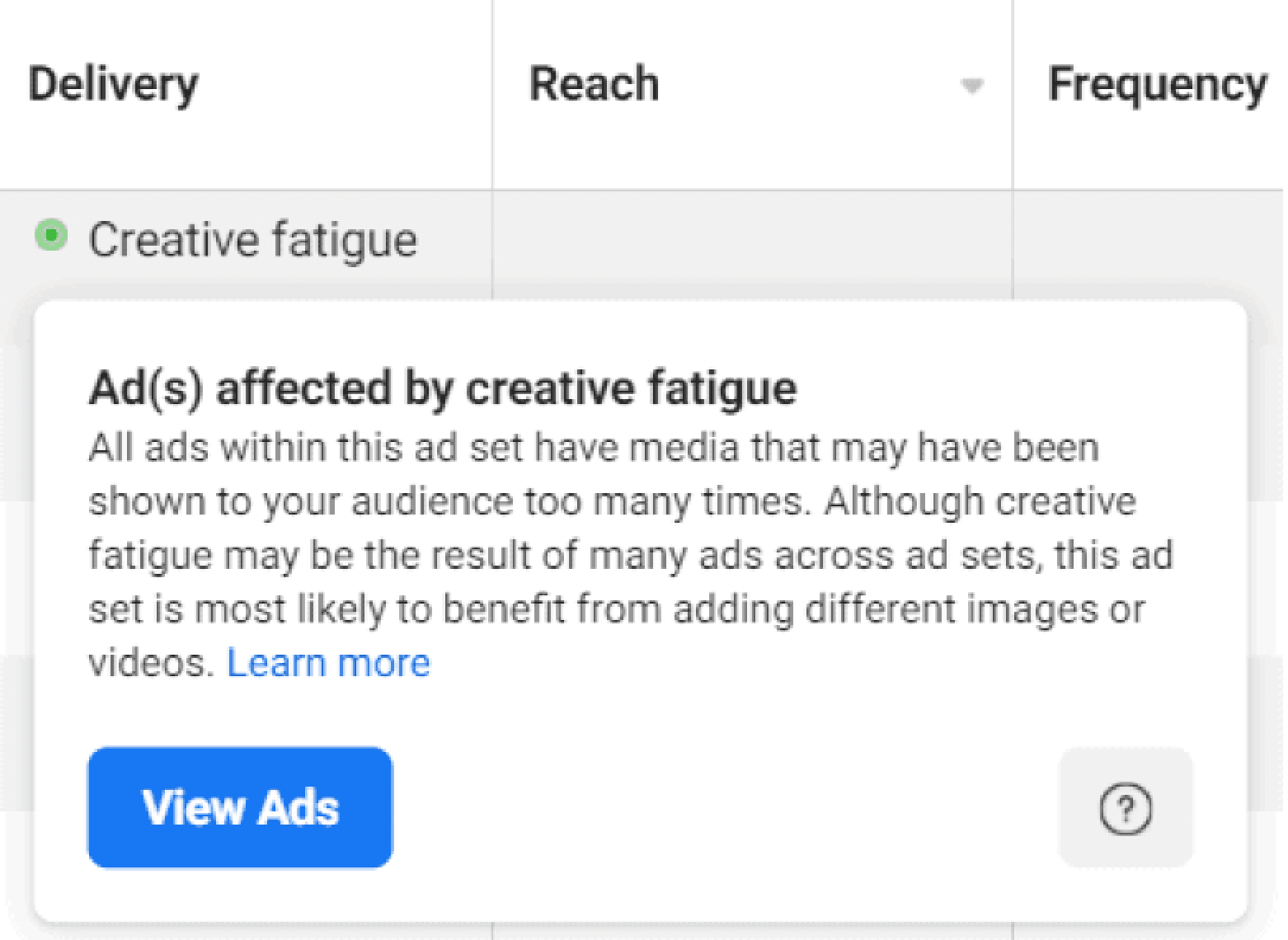
However, you need to be able to diagnose this yourself using data, often before Meta's warning appears. The signs are a combination of rising frequency and declining engagement.
How To Overcome Facebook Ad FATIGUE
The video "How To Overcome Facebook Ad FATIGUE" by Ben Heath gives a focused tutorial on identifying and solving this exact problem.
Watch these two segments: First, learn how to use the Frequency metric to assess fatigue from 00:59 to 03:33. Pay attention to the different frequency benchmarks he suggests for cold vs. warm audiences. Next, understand the primary solution: new ad creative from 03:33 to 06:25. This reinforces the importance of your creative optimization cycle.
Creative Fatigue Diagnostic Checklist:
- Is Frequency rising? For prospecting campaigns, a frequency above 2.5-3.0 is a warning sign. For retargeting, this can be much higher (e.g., 8-10+), but the principle is the same.
- Is CTR falling? Compare the ad's current CTR to its performance when it was launched. A drop of 30% or more is a strong indicator of fatigue.
- Is Cost per Result increasing? As CTR falls, your cost per click (CPC) will rise, which in turn usually increases your overall cost per conversion.
If you answer "yes" to these questions, creative fatigue is the likely culprit.
Diagnosis 2: Audience Saturation & CPM Inflation
While creative fatigue is about a specific ad getting stale, audience saturation is about a specific audience being exhausted. You've simply reached most of the available people in that targeting group, and Meta struggles to find new users to show your ads to.
CPM inflation is the direct consequence. It can be caused by two things:
- Market Competition: An external factor, like Black Friday, where more advertisers bid on the same users, driving up costs for everyone.
- Audience Saturation: An internal factor. As your audience becomes saturated, Meta's algorithm has to work harder and enter more expensive micro-auctions to find the remaining people, thus increasing your CPM.
Your job is to figure out which it is. A structured diagnostic guide is invaluable here.
How to Diagnose Low ROAS on Meta Ads
This step-by-step guide from Niblin provides a detailed framework for diagnosing performance issues, including CPM inflation and audience exhaustion.
Read the following two sections in "Phase 3: Deep Diagnosis": "Phase 3E: CPM Increased (Market Competition)": Focus on the table "Confirm It's Market-Wide." This teaches you the crucial skill of distinguishing a general market trend from a problem specific to your audience. "Phase 3F: Audience Exhaustion (High Frequency)": Study the "Diagnose Exhaustion Level" table. This provides clear, actionable benchmarks for both Frequency and Reach Saturation to determine if an audience is tapped out.
Audience Saturation & CPM Inflation Diagnostic Checklist:
- Is CPM rising?
- If it's rising across all your campaigns (including ones with different audiences), it's likely a market-wide trend.
- If it's rising significantly in one specific ad set or campaign while others are stable, you're likely looking at audience saturation.
- Is Frequency rising steeply? A frequency climbing past 4-5 on a prospecting audience suggests you are repeatedly hitting the same people because there are few new ones to find.
- Is your Reach approaching your Potential Audience Size? In Ads Manager, look at your
Reachfor the last 30-60 days and compare it to thePotential Audience Sizefor that ad set. If your reach is over 50-70% of the potential size, the audience is becoming saturated.
A Unified Framework for Diagnosis
To make your diagnosis systematic and repeatable, it's best practice to compare a "problem period" with a "baseline period" where performance was good. This helps you quantify exactly which metrics have degraded.
The "How to Diagnose Low ROAS" guide provides an excellent template for this.
How to Diagnose Low ROAS on Meta Ads
Let's return to the Niblin guide to build our complete diagnostic framework.
Study these sections carefully: "Phase 2: Build Your Diagnostic Table": This is the core of your diagnostic playbook. Understand the process of exporting data for two time periods and calculating the percentage change for each key metric. "Common patterns and what they mean" (table at the end of Phase 2): This decision tree is your cheat sheet. It directly connects patterns in your data (e.g., "Frequency ↑↑, CTR ↓") to a primary problem ("Audience exhaustion").
By creating this diagnostic table each time you see a sustained performance drop, you replace guesswork with a data-driven process. The pattern of changes in your key metrics will point you directly to the root cause:
| If you see... | The likely problem is... |
|---|---|
| CTR ↓ with stable or slightly rising Frequency | Creative Fatigue (The ad itself is the issue) |
| Frequency ↑↑, CTR ↓, and CPM ↑ | Audience Exhaustion (The audience is tapped out) |
| CPM ↑ across all campaigns | Market Competition (An external factor) |
Conclusion
You now have a professional framework for diagnosing the inevitable challenges that come with scaling Meta Ads. Instead of panicking when ROAS drops, you have a clear, logical process to follow.
Key Takeaways:
- Performance drops at scale are normal and are caused by creative fatigue, audience saturation, or increased market competition.
- Use leading metrics—Frequency, CPM, and CTR—to diagnose the root cause, not just the outcome metrics like ROAS.
- Creative Fatigue is signaled by a falling CTR and rising frequency for a specific ad.
- Audience Saturation is signaled by a steeply rising frequency and CPM within a specific audience, and a high percentage of the audience having been reached.
- CPM Inflation can be market-wide (affecting all campaigns) or audience-specific (a symptom of saturation).
- Implement a diagnostic table comparing a baseline period to a problem period to systematically identify which metric is the primary driver of the decline.
In our next lesson, we will move from diagnosis to action. We'll explore a key strategy for managing these scaling pressures: applying a decision framework for managing prospecting vs. retargeting budget allocation. This will help you balance finding new customers with re-engaging interested ones to maintain overall account health and profitability at scale.