Introduction
In our last lesson, we focused on how a client should handle transient failures using intelligent retry strategies like exponential backoff with jitter. This protects a struggling service from a "thundering herd." However, retries assume the service will recover quickly. What happens if a service is completely down for an extended period? Continuously retrying, even with backoff, consumes valuable resources on the calling service (like connection pool slots and threads) and adds pointless traffic to the network.
This lesson addresses that exact problem. Your learning outcome is to describe the circuit breaker pattern and its states (closed, open, half-open) as a mechanism to prevent cascading failures.
The circuit breaker pattern is a fundamental building block for creating resilient, fault-tolerant distributed systems. Understanding it is non-negotiable for a senior backend role, as it demonstrates you think about system stability beyond a single request-response cycle.
The Anatomy of a Cascading Failure
In a microservices architecture, services often depend on each other. A failure in a single downstream service can trigger a chain reaction, bringing down multiple upstream services. This is a cascading failure.
Imagine an Order Service that calls a Payment Service. If the Payment Service becomes slow or unresponsive, the Order Service's threads will start to block, waiting for responses that never come.
Circuit Breaker Pattern - Fault Tolerant Microservices
To understand the mechanics of this failure, let's watch a section from the 'Circuit Breaker Pattern - Fault Tolerant Microservices' video by Defog Tech. It provides a clear technical explanation of how timeouts in one service lead to resource exhaustion in another.
Watch from 02:08 to 03:53. Focus on how waiting for a slow downstream service consumes threads in the calling service's thread pool, eventually exhausting it and making the calling service itself unresponsive. This is the essence of a cascading failure.
As you saw, a single slow service can paralyze its callers. The core issue is that the calling service keeps trying to contact a service that is clearly unhealthy, wasting its own resources in the process. This is where the circuit breaker pattern comes in.
The Circuit Breaker: Failing Fast to Stay Healthy
The circuit breaker pattern acts as a stateful proxy that wraps calls to a remote service. It monitors for failures and, if they reach a certain threshold, it "trips" or "opens the circuit." Once open, it immediately rejects all further calls to that service without even attempting to make the network call. This is called failing fast.
This approach provides two critical benefits:
- Protects the Calling Service: It prevents the caller's resources (threads, memory, connections) from being tied up waiting for a failing service.
- Protects the Failing Service: It gives the unhealthy service "breathing room" to recover by stopping the flow of requests.
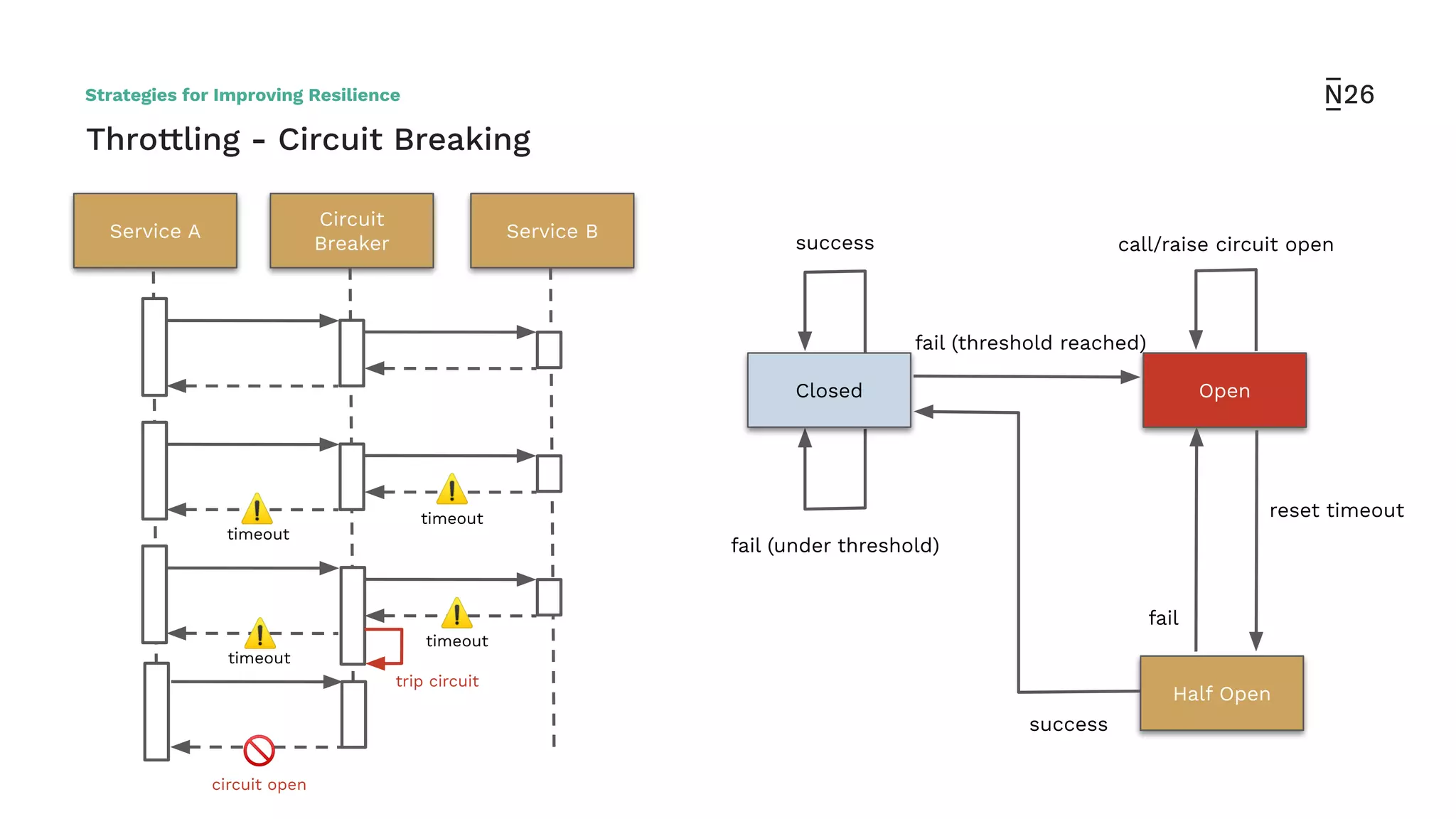
The state diagram on the right is the heart of the pattern. Let's break down each state.
The Three States: Closed, Open, and Half-Open
A circuit breaker operates as a finite-state machine. Understanding these states and their transitions is crucial for any interview discussion on the topic.
Circuit Breaker Pattern in Microservices
The 'Circuit Breaker Pattern in Microservices' video from ByteMonk gives a clear walkthrough of these three states.
Watch from 05:40 to 07:08. As you watch, mentally map the explanation to the state diagram in the image above.
Here is a summary of the states:
-
CLOSED:
- Behavior: This is the normal, healthy state. Requests are passed through to the downstream service.
- Monitoring: The circuit breaker counts the number of failures (e.g., exceptions, timeouts).
- Transition: If the failure count exceeds a configured
failure_thresholdwithin a specific time window, the circuit transitions to the OPEN state.
-
OPEN:
- Behavior: The circuit is "tripped." All calls to the downstream service fail immediately with an error (e.g.,
CircuitBreakerError), without any network attempt. This is the "fail fast" mechanism in action. - Timer: When the circuit opens, it starts a
recovery_timeouttimer. - Transition: When the timer expires, the circuit transitions to the HALF-OPEN state to check if the downstream service has recovered.
- Behavior: The circuit is "tripped." All calls to the downstream service fail immediately with an error (e.g.,
-
HALF-OPEN:
- Behavior: This is a probing state. The circuit allows a limited number of requests to pass through to the downstream service to test its health.
- Transition (on Success): If these probe requests succeed (up to a configured
success_threshold), the circuit breaker assumes the service has recovered and transitions back to CLOSED. - Transition (on Failure): If any probe request fails, the circuit breaker assumes the service is still unhealthy. It transitions back to OPEN and resets the recovery timer.
Circuit Breakers and Retries: A Powerful Combination
It's important to distinguish the circuit breaker pattern from the retry pattern we discussed in the previous lesson.
- Retry Pattern: Best for handling intermittent, transient failures. It assumes the error is temporary and will likely succeed on the next attempt.
- Circuit Breaker Pattern: Best for handling systemic, persistent failures. It assumes the service is down for a longer period and that retrying is futile and harmful.
In a production system, you almost always use them together. A function call is wrapped by a circuit breaker, and inside that, it might have a retry mechanism.
Circuit Breaker (Wraps the entire operation)-> Retry Logic (Handles a few transient failures)-> Actual Network Call
A few failed retries for a single operation would increment the circuit breaker's failure counter. Once the counter hits its threshold, the breaker opens, and no further retries are even attempted until the breaker moves to the half-open state.
Implementation and Configuration: The Senior-Level Details
For an interview, describing the states is good, but demonstrating you know how to implement and configure a circuit breaker is what sets you apart. Since you have a strong Python background, let's look at a practical implementation.
How to Configure Circuit Breaker Patterns
The article 'How to Configure Circuit Breaker Patterns' from OneUptime provides a fantastic, thread-safe Python implementation that you can use as a reference. It also includes sections on fallbacks and best practices.
Read the sections 'Basic Circuit Breaker Class' and 'Using the Circuit Breaker as a Decorator'. You don't need to memorize the code, but understand its structure: How the CircuitState enum and the state variables (_state, _failure_count) are used. How the call method checks the state before executing the function. How easy it is to apply this logic using a Python decorator (@payment_circuit).
The true complexity of circuit breakers lies not in the code, but in the tuning of its parameters. A misconfigured circuit breaker can be as bad as having none at all.
Your Circuit Breaker is Misconfigured
Now, let's dive deep into configuration trade-offs. The Shopify Engineering blog post 'Your Circuit Breaker is Misconfigured' is an exceptional resource for thinking like a senior engineer about this problem.
Read the sections 'Error Threshold', 'Error Timeout', and 'Half Open Resource Timeout'. For each parameter, focus on the trade-offs: Error Threshold: What's the risk of setting it too low (false positives) versus too high (slow to open)? Error Timeout (Recovery Timeout): What's the trade-off between a short timeout (faster recovery check) and a long timeout (less load during an outage)? Half Open Resource Timeout: This is a key advanced concept. Why is it beneficial to have a separate, shorter timeout just for the half-open probe requests?
Interview-Ready Talking Points on Configuration:
- "The goal is to open the circuit quickly on a real outage but avoid tripping on transient blips." This shows you understand the
error_thresholdtrade-off. - "Tuning the recovery timeout is a balance. Too short, and you risk probing a service that hasn't fully recovered. Too long, and you extend the perceived outage for your users." This demonstrates your grasp of the
error_timeoutparameter. - "A critical optimization is using a much shorter
half_open_resource_timeout. During a prolonged outage, the circuit will periodically probe the failing service. By using a very short timeout for these probes (e.g., 50ms), you minimize the time your application threads are blocked, even while confirming the service is still down." Mentioning this specific optimization shows significant depth. - "Configuration shouldn't be a one-time guess. It requires monitoring and tuning based on the specific service's SLOs and failure characteristics. A critical payment service would have different settings than a non-essential recommendation service." This highlights a production-oriented mindset.
Conclusion
You've now added another essential resilience pattern to your toolkit. While the retry pattern helps clients survive brief, transient faults, the circuit breaker protects your system from the much more dangerous scenario of a prolonged service outage and prevents cascading failures.
Key Takeaways:
- Cascading failures occur when a failure in one service triggers a chain reaction, taking down dependent services due to resource exhaustion (e.g., thread pools).
- The Circuit Breaker pattern prevents this by acting as a stateful proxy that "fails fast" when a downstream service is unhealthy.
- The three states are Closed (normal), Open (failing fast), and Half-Open (probing for recovery).
- Correctly configuring and tuning the thresholds and timeouts is what makes the pattern effective in production and is a key discussion point in senior interviews.
- Circuit breakers and retries are complementary patterns that work together to build robust, fault-tolerant systems.
Preview of the Next Lesson:
We've now covered two key patterns for managing service-to-service communication resilience. We will now shift our focus down the stack to the persistence layer. In the next module, we'll dive into Advanced Database Strategies. Our first lesson will be on how to formulate an indexing strategy to dramatically improve query performance—a critical skill for any backend engineer dealing with data at scale.