Introduction
In our last lesson, we designed a server-side resilience pattern: the rate limiter. We saw how it protects our services by rejecting excess traffic and telling clients to "try again later." This lesson focuses on the other side of that interaction: how a well-behaved client should act when it encounters a transient failure or is told to back off.
Your learning outcome is to implement a retry strategy with exponential backoff and jitter, explaining how it handles transient failures without causing a thundering herd.
Simply retrying a failed request immediately might seem intuitive, but when scaled to thousands of clients, this behavior can be catastrophic for a struggling service. Mastering intelligent retry strategies is a hallmark of a senior backend engineer who thinks about the entire system, not just a single service. This is a frequent topic in both system design and backend deep-dive interviews.
The Problem: Naive Retries and the "Thundering Herd"
Imagine one of your downstream services has a momentary glitch—perhaps a brief network partition or a pod restarting. The service is temporarily unavailable and starts failing requests. If all your clients are programmed to retry immediately, what happens?
Thundering Herd Problem and How not to do API retries
The video 'Thundering Herd Problem and How not to do API retries' from Arpit Bhayani succinctly explains why simple, immediate retries are dangerous at scale.
Watch from the beginning to 04:41. Focus on these two key points: The Core Problem (00:00 - 01:00): How do individual client retries collectively create a massive load spike? Why Immediate Retries Fail (02:30 - 04:41): Understand how immediate retries can prevent a service from ever recovering, essentially turning a transient fault into a full-blown outage.
This massive, synchronized wave of retry requests is called a thundering herd. Instead of giving the service time to recover, the flood of retries pushes it over the edge, guaranteeing it stays down. This is a classic example of how a well-intentioned recovery mechanism can cause a cascading failure.
A Better Approach: Exponential Backoff
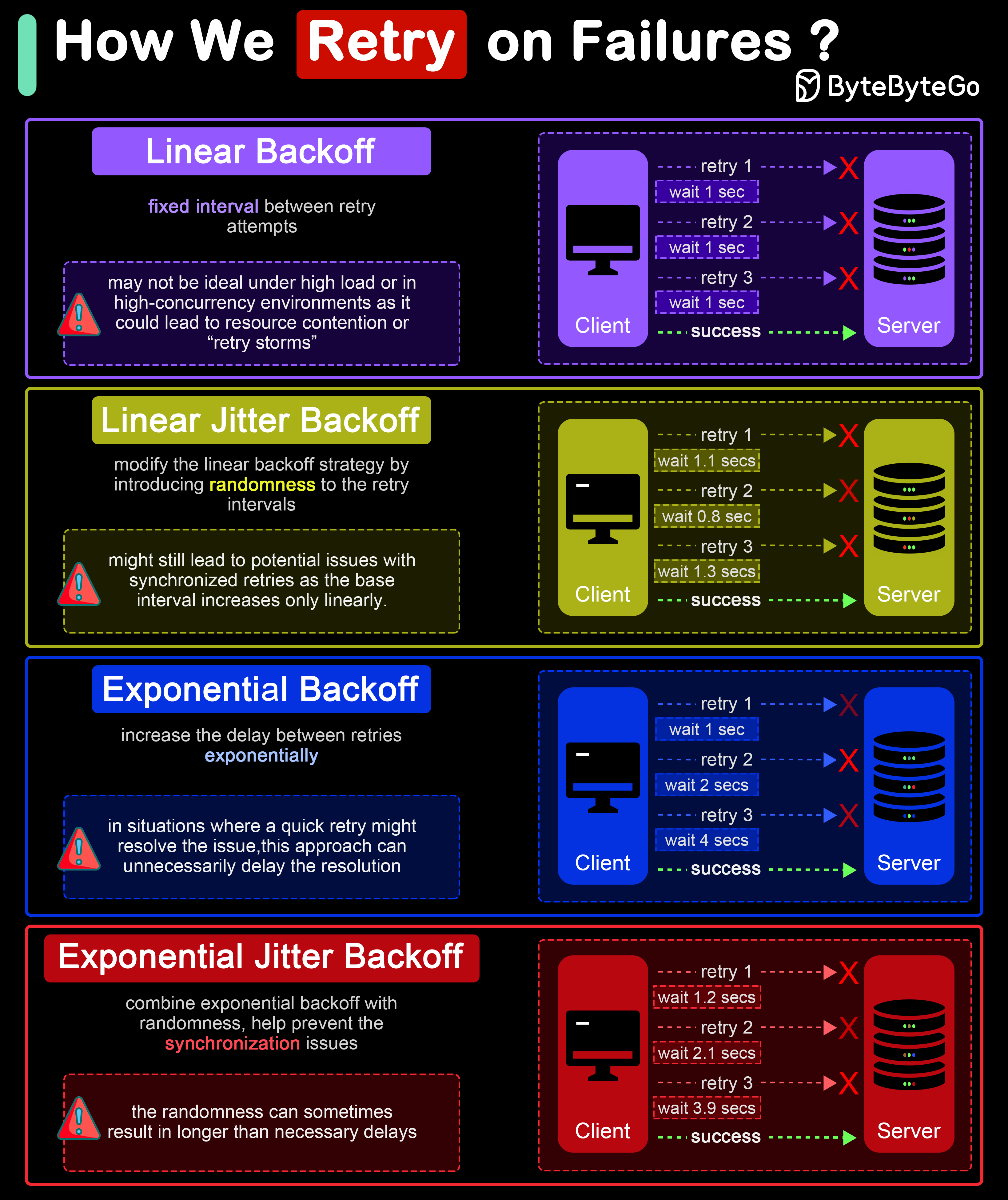
To prevent a thundering herd, clients need to give the server "breathing room." The first step is to wait before retrying. A more sophisticated approach is to increase the wait time after each failed attempt. This is called exponential backoff.
The strategy is simple:
- After the 1st failure, wait for
xseconds. - After the 2nd failure, wait for
2*xseconds. - After the 3rd failure, wait for
4*xseconds. - ...and so on. The delay grows exponentially.
The general formula for the delay before the -th retry is:
\text{delay} = \text{base_time} \times 2^{(n-1)}In practice, you would also cap this delay at a reasonable maximum to prevent excessively long waits.
Retries & Exponential Backoff - Deep Dive
The video 'Retries & Exponential Backoff - Deep Dive' from glich.stream provides an excellent walkthrough of the mechanics of exponential backoff.
Watch from 19:11 to 22:51. Pay attention to: The Formula: How the retry delay is calculated based on the attempt number. The Growth Curve: Notice how the delay period grows slowly at first and then much more rapidly, giving the server an increasing amount of time to recover.
Exponential backoff is a significant improvement. It dramatically reduces the pressure on a failing service compared to immediate retries. However, it has one remaining, subtle flaw.
The Final Piece: Adding Jitter
Imagine a network event causes thousands of clients to see a failure at the exact same moment. Even with exponential backoff, they will all wait for 1 second, then retry. If that fails, they will all wait for 2 seconds, then retry again. The thundering herd is still happening, just in synchronized, delayed waves.
The solution is jitter—adding a small amount of randomness to the backoff delay. This de-synchronizes the clients and spreads their retry attempts out over time, smoothing the load on the server.
Let's explore this critical refinement.
Thundering Herd Problem and How not to do API retries
Let's return to the 'Thundering Herd Problem' video, which explains how adding jitter solves the synchronization problem.
Watch from 07:58 to 10:22. The key takeaway is how randomness prevents the retry attempts from coinciding, which finally solves the thundering herd problem.
For a powerful visual confirmation of this effect, we can look at data from AWS.
Timeouts, retries and backoff with jitter
The article 'Timeouts, retries and backoff with jitter' from the AWS Builders' Library is a foundational text on this topic. It clearly explains why jitter is not just a nice-to-have, but a necessity.
Read the section titled Jitter. The key insight is understanding how correlation defeats simple backoff and how randomness (jitter) breaks that correlation.

There are several jitter strategies, but a common and highly effective one is "full jitter":
\text{delay} = \text{random_uniform}(0, \text{base_time} \times 2^{(n-1)})Instead of waiting for the full exponential backoff period, you wait for a random duration between 0 and the calculated backoff period. This effectively distributes the retry load.
Implementing Retries in Python with tenacity
In an interview, you should advocate for using a well-vetted library rather than implementing complex retry logic from scratch. For Python, the industry standard is tenacity. Your experience with Django and FastAPI means you're used to leveraging robust third-party packages, and this is a prime example.
tenacity provides a simple decorator-based API to add sophisticated retry behavior to any function.
How to Implement Retry Logic with Exponential Backoff in Python
The article 'How to Implement Retry Logic with Exponential Backoff in Python' provides a practical guide to using the tenacity library.
Read the sections 'Getting Started with Tenacity', 'Understanding Wait Strategies', and 'Best Practices'. Focus on: The basic @retry decorator pattern. The different wait strategies, especially wait_exponential_jitter and wait_random_exponential. The best practice of adding jitter to prevent thundering herds.
Here's a practical, production-ready example combining these concepts. We want to fetch data from an external API, retrying only on server-side or network errors, using exponential backoff with full jitter.
import requests
import random
from tenacity import retry, stop_after_attempt, wait_random_exponential


# Custom function to decide if an error is retryable.
# We should NOT retry on 4xx client errors (e.g., 400 Bad Request, 404 Not Found),
# as these will likely fail every time.
def is_retryable_error(exception):
    """Return True if we should retry, False otherwise."""
    if isinstance(exception, requests.exceptions.HTTPError):


        # Retry on 5xx server errors, but not 4xx client errors
        return exception.response.status_code >= 500


    # Also retry on network-related issues
    return isinstance(exception, (requests.exceptions.ConnectionError, requests.exceptions.Timeout))

@retry(


    # Use full jitter for the wait time. Start with a 1s multiplier, max wait of 60s.
    wait=wait_random_exponential(multiplier=1, max=60),


    # Give up after 5 attempts.
    stop=stop_after_attempt(5),


    # Specify which exceptions should trigger a retry.
    retry_if_exception=is_retryable_error
)
def fetch_critical_data(url: str):
    """
    Fetches data from a URL with a robust retry strategy.
    An exception will be raised if all retries fail.
    """
    print("Attempting to fetch data...")
    response = requests.get(url, timeout=5)
    response.raise_for_status()  # Raises HTTPError for bad responses (4xx or 5xx)
    print("Successfully fetched data!")
    return response.json()

if __name__ == "__main__":


    # Example usage with a URL that will likely fail
    # (use httpstat.us to simulate errors)
    API_URL = "https://httpstat.us/503" # Simulates a 503 Service Unavailable error

    try:
        data = fetch_critical_data(API_URL)
        print("Data:", data)
    except Exception as e:
        print(f"Failed to fetch data after all retries. Final error: {e}")
Why this is a strong interview answer:
- It uses a standard, battle-tested library (
tenacity). - It correctly implements exponential backoff with jitter (
wait_random_exponential). - It demonstrates critical thinking by only retrying on transient errors (5xx codes, connection errors) and not client errors (4xx codes).
- It includes a stop condition (
stop_after_attempt) to prevent indefinite retries.
Conclusion
You've now learned how to implement a resilient client that can gracefully handle transient failures without contributing to a system-wide outage. This client-side strategy is the perfect complement to the server-side rate limiting we discussed previously.
Key Takeaways:
- Naive retries are dangerous: They can cause a thundering herd problem, turning a small failure into a major outage.
- Exponential Backoff is the solution: By progressively increasing the wait time between retries, it gives struggling services time to recover.
- Jitter is essential: Adding randomness to the backoff delay de-synchronizes clients and prevents delayed thundering herds, smoothing out the retry load.
- Implement intelligently: Use libraries like
tenacityin Python, only retry on transient/server-side errors, and always have a stop condition.
Preview of the Next Lesson:
Retries are effective when a service is temporarily unavailable. But what if a service is completely down for an extended period? Continuing to send requests—even with backoff—is wasteful and can slow down your own application. In the next lesson, we will explore the circuit breaker pattern, a mechanism that detects a complete service failure and stops sending requests altogether, allowing for a much faster failure response and recovery.