Introduction
In our last lesson, we built an asynchronous task executor capable of handling a high volume of I/O-bound tasks concurrently. We even simulated a transient IOError to acknowledge that real-world operations can fail. However, in a production system, simply letting a task fail on a temporary network glitch isn't acceptable. We need to build for resilience.
This lesson directly addresses that gap. We will implement one of the most fundamental resilience patterns: a generic retry decorator with exponential backoff. This powerful tool will allow you to make any function more robust by automatically retrying it upon specific, transient failures. For an interviewer, this demonstrates your understanding of distributed systems failure modes and your ability to write clean, reusable, production-grade code.
Our goal is to implement a generic retry decorator in Python with exponential backoff, configurable max retries, and specific exception filtering.
1. The "Thundering Herd" Problem: Why Naive Retries Fail
The most intuitive way to retry a failed operation is to wrap it in a loop and try again immediately, perhaps after a fixed delay.
# A naive retry approach
for _ in range(5):
    try:
        result = call_flaky_api()
        break
    except NetworkError:
        time.sleep(1) # Wait 1 second and retry
While simple, this approach has a critical flaw in distributed systems. Imagine a service that is temporarily overloaded and starts failing requests. If thousands of clients all use this fixed-delay retry logic, they will all wait for one second and then hammer the service again at the exact same time. This coordinated retry storm is known as a thundering herd, which can prevent the recovering service from ever coming back online.
Retries & Exponential Backoff - Deep Dive
To understand the dynamics of service failure and the thundering herd problem, let's watch this deep dive. It explains how failures cascade and why a simple retry strategy can make things worse.
Watch the following two segments: The Scenario (01:07 - 04:40): Understand the multi-service architecture and how a failure in one downstream service can affect the entire system. The Problem with Simple Retries (13:36 - 19:11): Pay close attention to the explanation of the 'thundering herd' problem. The graph showing the spike in requests after a service comes back online is a crucial concept.
2. The Solution: Exponential Backoff and Jitter
To solve the thundering herd problem, we need a more intelligent delay strategy that spreads out the retry attempts from multiple clients over time.
Exponential Backoff
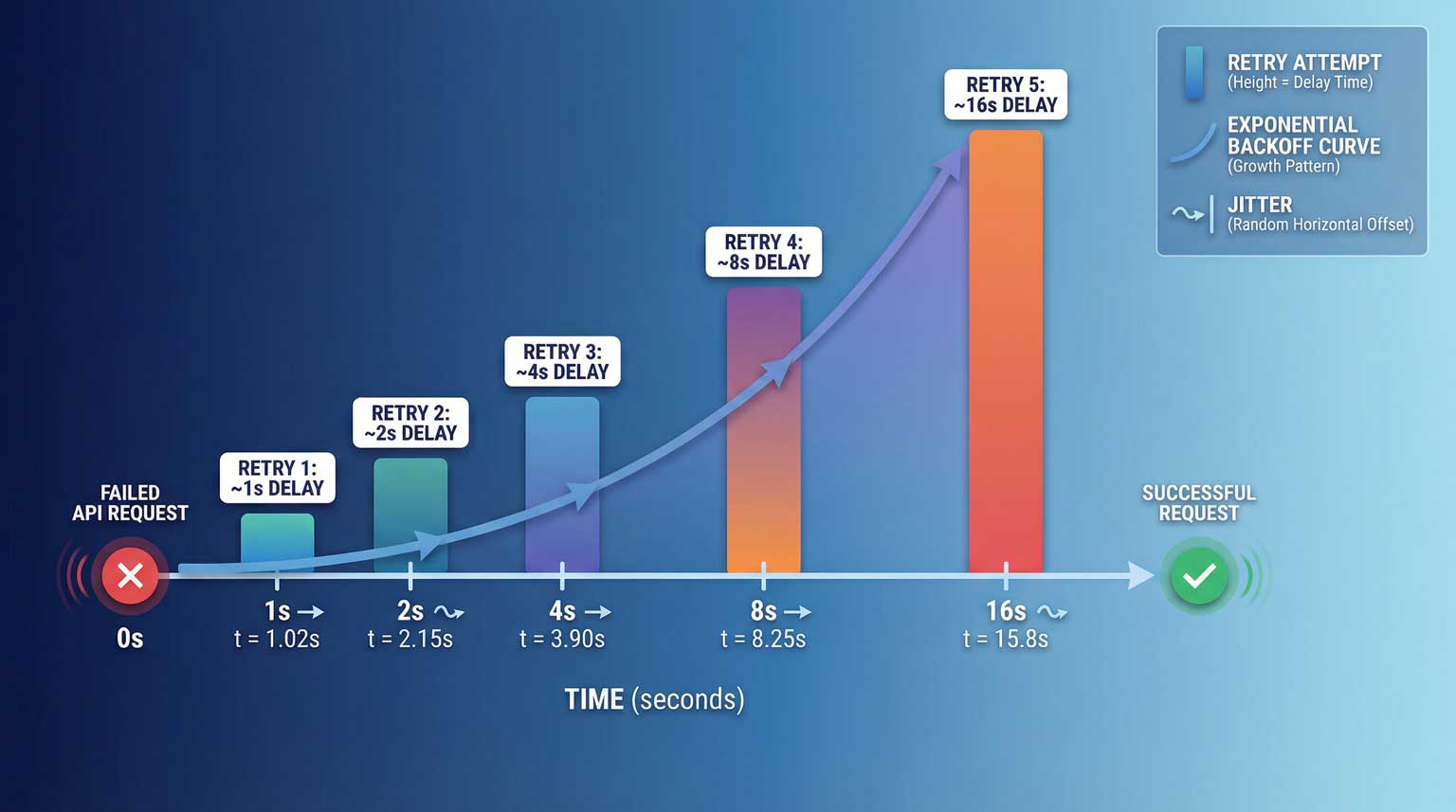
Instead of a fixed delay, we exponentially increase the waiting period after each failed attempt. For example:
- After 1st failure: wait 1 second
- After 2nd failure: wait 2 seconds
- After 3rd failure: wait 4 seconds
- And so on...
This gives a struggling service progressively more "breathing room" to recover.

Jitter
Exponential backoff is a huge improvement, but clients retrying at the same time will still have correlated delays (e.g., they all wait 1s, then 2s, then 4s). To de-correlate them, we add jitter—a small amount of randomness to the backoff delay. For example, instead of waiting exactly 4 seconds, a client might wait a random duration between 3 and 5 seconds. This spreads the requests out smoothly, preventing smaller, clustered retry storms.
Retries & Exponential Backoff - Deep Dive
The same deep-dive video that introduced the problem also explains the solution. It covers exponential backoff and, critically for a senior-level interview, introduces jitter by referencing a famous AWS architecture blog post.
Now watch these two segments from the same video: Exponential Backoff (19:11 - 22:51): See how the retry delay is calculated with a formula and how it creates an exponential curve. Jitter (22:51 - 29:57): This is the key part. Understand why exponential backoff alone can still lead to request clustering and how adding jitter solves this by randomizing delays.
3. Implementing the Retry Decorator in Python
A decorator is the perfect way to apply retry logic cleanly. A decorator that accepts arguments (like retries=5) has a specific three-level structure:
- An outer function that accepts the decorator's arguments (
retry). - A middle function that accepts the function to be decorated (
decorator). - An inner function that wraps the original function and contains the retry logic (
wrapper).
Retry Pattern: The Secret to Resilient Python Code
Let's watch a practical guide on building a retry decorator from scratch. This video from ArjanCodes walks through the process, from a simple retry function to a full-featured decorator.
Watch from 01:33 to 14:42. Focus on these key steps: Basic Retry Function (01:33 - 05:10): The initial implementation of the core retry loop. Adding Exponential Backoff (07:13 - 09:33): How to modify the delay calculation to be exponential. Refactoring to a Decorator (09:33 - 14:42): The crucial step of converting the logic into a reusable decorator, including the use of functools.wraps.
Now, let's look at some production-grade code examples. These examples from Stack Overflow and SaltyCrane blog demonstrate different ways to structure the decorator with all the features we need.
Trying out a Retry decorator in Python
The following blog post provides a classic and well-explained example of a retry decorator with exponential backoff. It also includes valuable unit tests.
First, review the main code block in the article (section 1). Notice its parameters: ExceptionToCheck, tries, delay, backoff. Then, look at the examples for 'always fail' (section 2) and 'multiple exceptions' (section 5). Finally, and most importantly, review the unit tests (section 6). Understanding how to test this decorator is as important as writing it.
Using Python decorators to retry request
This Stack Overflow answer provides a very clean and modern implementation that is close to our target. It includes parameters for max_delay and exceptions as a tuple.
Read the answer provided by the user Yavuz. Pay close attention to the function signature: retry(tries, delay, max_delay, backoff, exceptions, log). This is an excellent template for a configurable, production-ready decorator.
4. A Production-Ready Retry Decorator
By synthesizing the concepts from the videos and code examples, we can create a single, robust, and well-documented retry decorator. This implementation includes everything an interviewer would expect: configurability, exponential backoff, jitter, specific exception handling, and logging.
import time
import random
import logging
from functools import wraps
from typing import Callable, Any, Tuple, Type


# Configure a logger for the decorator to use
logging.basicConfig(level=logging.INFO, format='%(asctime)s - %(levelname)s - %(message)s')
logger = logging.getLogger(__name__)

def retry(
    retries: int = 3,
    delay: float = 1.0,
    backoff: float = 2.0,
    exceptions: Tuple[Type[Exception], ...] = (Exception,),
    add_jitter: bool = True
) -> Callable:
    """
    A generic retry decorator with exponential backoff and jitter.

    Args:
        retries (int): The number of times to retry before giving up.
        delay (float): The initial delay between retries in seconds.
        backoff (float): The multiplier for the delay in each subsequent retry.
        exceptions (Tuple[Type[Exception], ...]): A tuple of exception types to catch and retry on.
        add_jitter (bool): Whether to add a random jitter to the delay.
    """
    if retries < 1:
        raise ValueError("retries must be at least 1.")

    def decorator(func: Callable) -> Callable:
        @wraps(func)
        def wrapper(*args: Any, **kwargs: Any) -> Any:
            current_delay = delay
            for attempt in range(retries):
                try:
                    return func(*args, **kwargs)
                except exceptions as e:
                    if attempt == retries - 1:
                        logger.error(
                            f"Function '{func.__name__}' failed after {retries} attempts. Raising exception."
                        )
                        raise

                    logger.warning(
                        f"Attempt {attempt + 1}/{retries} for '{func.__name__}' failed with {type(e).__name__}. "
                        f"Retrying in {current_delay:.2f}s..."
                    )

                    time.sleep(current_delay)


                    # Calculate next delay
                    current_delay *= backoff


                    # Add jitter to avoid thundering herd
                    if add_jitter:
                        jitter = current_delay * 0.1 # e.g., 10% jitter
                        current_delay += random.uniform(-jitter, jitter)

        return wrapper
    return decorator


# --- Example Usage ---

class NetworkError(Exception):
    """Custom exception for simulating network errors."""
    pass

@retry(retries=5, delay=0.5, backoff=2, exceptions=(NetworkError,))
def fetch_data_from_flaky_api(api_url: str):
    """
    Simulates fetching data from an API that fails intermittently.
    """
    print(f"Attempting to fetch data from {api_url}...")
    if random.random() > 0.3: # 70% chance of failure
        raise NetworkError("Failed to connect to the API.")

    print("Successfully fetched data!")
    return {"data": "some important data"}

if __name__ == "__main__":
    fetch_data_from_flaky_api("https://api.example.com/data")
5. Interview Discussion: Trade-offs and Best Practices
Implementing the code is only half the battle. A senior candidate must be able to discuss the implications.
- When NOT to Retry: The
exceptionsparameter is critical. You should only retry on transient errors (e.g.,503 Service Unavailable,TimeoutError, network connection errors). Never retry on permanent or client-side errors like401 Unauthorized,404 Not Found, or validation errors (400 Bad Request). Retrying these just wastes resources. - Idempotency: Retries are only safe for operations that are idempotent. An idempotent operation can be performed multiple times with the same result as performing it once (e.g.,
GET,PUT,DELETE). A non-idempotent operation, like an endpoint that creates a new record (POST /users), could result in duplicate data if retried without a special mechanism like an idempotency key (which you've covered in a previous lesson). - Sync vs. Async: The implementation above uses
time.sleep(), which is a blocking call. If you were applying this decorator to anasync deffunction (like the tasks in our previous lesson's executor), you would need to create anasyncversion of the decorator that usesawait asyncio.sleep()instead. The overall structure remains the same. - Configuration: In a real application, these parameters (
retries,delay) wouldn't be hardcoded in the decorator call. They would be loaded from a configuration file or environment variables, allowing operators to tune the system's resilience without changing the code.
Conclusion
You have now built a production-ready retry decorator, a cornerstone of resilient backend engineering. This single piece of code encapsulates several advanced concepts—decorators, exponential backoff, and jitter—and demonstrates a deep understanding of how to handle failures in distributed systems.
Key Takeaways:
- Naive retry logic with fixed delays can cause a thundering herd, worsening an outage.
- Exponential backoff gives a struggling service breathing room, and jitter de-correlates client retries to smooth out request load.
- A decorator is an elegant and reusable way to apply this logic without cluttering your core business functions.
- The ability to configure which exceptions to retry is crucial for distinguishing between transient and permanent failures.
- Always consider idempotency before applying a retry mechanism.
Preview of the Next Lesson:
We've now built several key components for a robust backend system: an async task executor and a retry decorator. But what happens when things go wrong despite these measures? In our next lesson, we will move into the crucial domain of operations and debugging. You will learn to walk through a systematic process for diagnosing a sudden API latency spike, a common and stressful production scenario that every senior engineer must be prepared to handle.