Hello! Welcome to the first lesson of our third module, where we shift our focus from the sources of our beliefs to their structure.
In our last lesson, we explored memory and testimony. We saw how a simple belief derived from testimony—say, a historical fact you read in a book—relies on a chain of trust. You trust the book, the author trusted their sources, those sources trusted eyewitnesses, and so on. This raises a pressing question: If every justification needs its own justification, where does it all end? This is not just a puzzle for testimony; it applies to any belief you hold.
Today, our goal is to formally explain the epistemic regress problem and why it poses a fundamental challenge for justifying beliefs. This problem, which has concerned philosophers for millennia, lies at the very heart of epistemology. Understanding it is the key to appreciating why theories of justification like foundationalism and coherentism were developed in the first place.
The Never-Ending "Why?"
The epistemic regress problem is, at its core, a very intuitive idea. It's the philosophical version of a child's endless game of asking "Why?". You state a belief, and for every reason you provide, one can simply ask for the reason for that reason, and so on, seemingly forever.
Let's begin by watching a short video that introduces this concept clearly.
The Epistemic Regress Problem - Epistemology | WIRELESS PHILOSOPHY
This video from Wireless Philosophy uses the simple analogy of a child's questioning and a common belief about the president's location to demonstrate how the demand for justification can lead to a potentially infinite chain of reasons.
Watch from the beginning to 03:19. Notice how a straightforward belief can quickly unravel into a long series of 'why' questions, each demanding a new justification.
As the video shows, if every justified belief must be supported by another justified belief, we seem to be pushed backwards into a "regress" of reasons. This isn't just a modern puzzle; the ancient Greek philosopher Aristotle identified this very problem when he considered how we can have scientific knowledge.
Agrippa's Trilemma: The Three Paths of Justification
The ancient skeptics formalized this challenge into what is now known as Agrippa's Trilemma. The trilemma states that any chain of justification, when traced back, must take one of three possible paths. The problem is that all three paths appear to be dead ends for securing knowledge.
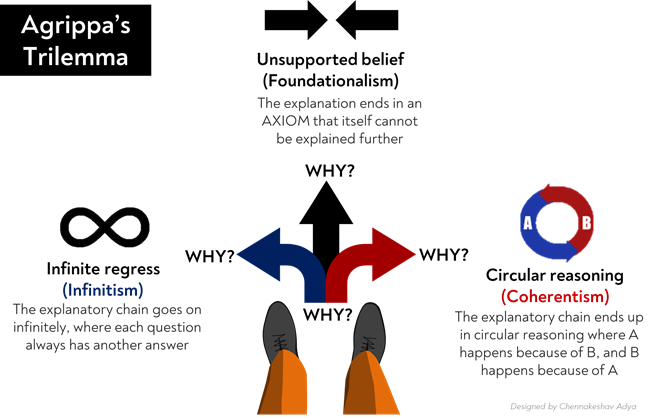
The three "horns" of the trilemma are:
- Infinite Regress: The chain of reasons goes on forever.
- Arbitrary Assumption: The chain stops at a belief that has no further justification.
- Circularity: The chain of reasons eventually loops back to support itself.
To get a solid grasp of these three options, let's turn to a clear textual explanation.
This reading from a philosophy textbook by Mark Mercer defines Agrippa's Trilemma and provides excellent, easy-to-follow examples for each of its three horns.
Please read the section titled '2. Agrippa’s trilemma'. As you read, focus on how the examples illustrate the three distinct patterns that any chain of justification might follow.
Why Each Horn Is a Problem
The power of the trilemma comes from the fact that each of these options seems to undermine our claim to be justified.
- If our justification is an infinite regress, we can never complete it. Since we are finite beings, we can't actually possess an infinite chain of reasons. Therefore, our justification is never fully secured.
- If our justification rests on an arbitrary assumption—a belief we hold for no reason—then the entire chain built upon it is unstable. A belief based on an arbitrary starting point seems no better than a guess.
- If our justification is circular, it offers no real support. It's like saying "I know that the book is true because it says it's true." The argument presupposes what it is trying to prove.
The skeptic's conclusion is that since these are the only three possibilities, and none of them can truly ground our beliefs, genuine justification is impossible.
Test your understanding!
Consider the belief: "Dinosaurs existed millions of years ago." Try to trace back your justification for this belief. Which of the three horns of Agrippa's Trilemma do you feel your chain of reasoning most closely resembles, and why?
Show answer
There's no single right answer, as it depends on how you trace your reasoning. Here are some possibilities:
- Infinite Regress: You might say you believe it because of scientific consensus. Why trust the consensus? Because of the peer-review process. Why trust that? Because of the integrity of scientists. Why trust them? ...and so on. The chain seems to regress through layers of social and institutional trust.
- Arbitrary Assumption: You might trace it back to fossils. Why trust that fossils are evidence of past life? You might eventually hit a point where you say, "I just trust what my senses and basic scientific principles tell me." This could be seen as a foundational belief that you don't justify further—an assumption, in the skeptic's view.
- Circularity: You might say you trust paleontology because it has accurately explained the fossil record. And you believe the fossil record is evidence for paleontology's claims. This can start to look circular: the theory is justified by the evidence, and the evidence is interpreted and given meaning by the theory.
The Problem as a Map
While the regress problem is a profound challenge, epistemologists don't simply throw up their hands and accept skepticism. Instead, they use the trilemma as a map to guide their theories of justification. The three horns of the trilemma correspond to the three main families of theories about the structure of justification.
Let's watch the final clip from the Wireless Philosophy video, which neatly lays out these options.
The Epistemic Regress Problem - Epistemology | WIRELESS PHILOSOPHY
This short segment maps the three logical possibilities for a chain of reasons to the major theories we will be studying.
Watch from 03:19 to 04:17. Note the three options presented for how the chain of reasons could behave.
As the video suggests, philosophers have taken these three paths and tried to show that one of them is, in fact, a viable route to justification:
- Foundationalism: Argues that the chain does stop at certain "properly basic beliefs" that don't need justification from other beliefs. This accepts the second horn of the trilemma but denies that the stopping points are arbitrary.
- Coherentism: Argues that justification is circular, but in a good way. It envisions our beliefs as a large, interconnected web where beliefs mutually support each other, rather than a linear chain.
- Infinitism: Argues that an infinite chain of reasons can provide justification. This is a minority view but has its modern defenders.
Conclusion
Today we've unpacked the epistemic regress problem, a foundational challenge in the theory of knowledge. It forces us to think critically about what it means to give a reason for our beliefs.
Key Takeaways:
- The epistemic regress problem arises when we demand that every belief be justified by another belief, leading to a chain of justifications that seems to have no end.
- Agrippa's Trilemma formalizes this problem, arguing that any chain of justification must either (1) regress infinitely, (2) end in an arbitrary assumption, or (3) be circular.
- Each of these options appears to make justification impossible, giving rise to skepticism.
- However, the trilemma also provides a framework for the major theories of justification—Foundationalism, Coherentism, and Infinitism—which each try to show how one of the "horns" can be a legitimate path to knowledge.
Preview of the Next Lesson:
Before we dive into foundationalism and coherentism, we need to make one more crucial distinction. The regress problem makes us ask: what counts as a good reason or a proper stopping point? Does the justification have to be something you are aware of inside your own mind, or can it be an external factor, like the reliability of your vision? In our next lesson, we will explore this by distinguishing between internalist and externalist theories of justification. This distinction will shape everything we discuss afterward.