Hello! Welcome to your next lesson.
In our last session, we grappled with the epistemic regress problem and saw how any attempt to justify a belief seems to lead to one of three problematic outcomes: an infinite chain, an arbitrary stopping point, or a circle of reasoning. This challenge, known as Agrippa's Trilemma, sets the stage for the major theories of justification.
Today, we take a step back to ask a more fundamental question that the regress problem forces upon us: What kind of thing can even count as a justification? Must a good reason for a belief be something you are aware of, something accessible within your own mind? Or can a belief be justified by factors entirely outside your conscious awareness?
Our learning outcome for this lesson is to distinguish between internalist and externalist theories of justification. This is one of the most significant divides in contemporary epistemology, and understanding it is essential for making sense of the theories we'll explore next, such as foundationalism and coherentism.
The Core of the Disagreement
At its heart, the debate between internalism and externalism is about the location of the properties that make a belief justified.
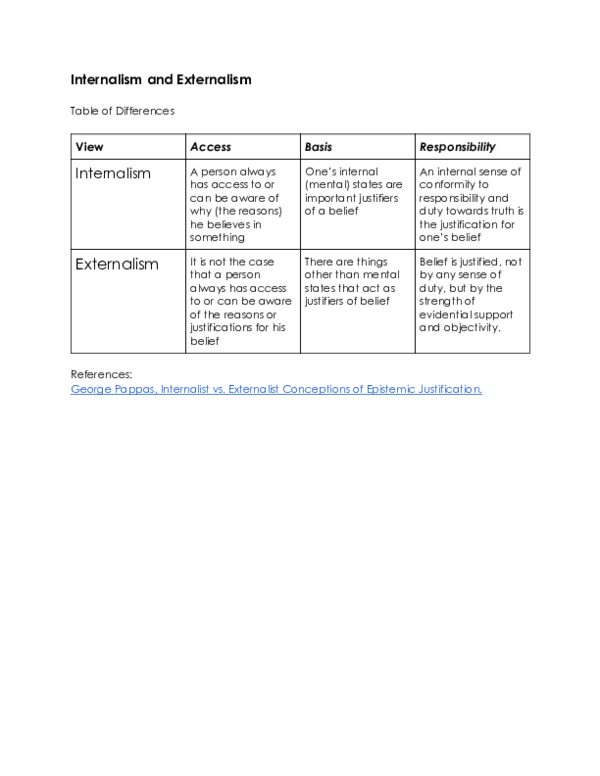
- Internalism holds that a belief's justification is determined solely by factors that are internal to the believer's mind. These are things you have access to, like other beliefs, sensations, and memories.
- Externalism holds that a belief's justification can depend on factors that are external to the believer's mind, such as the reliability of the belief-forming process or the causal relationship between the belief and the world.
To begin, let's watch a short video that introduces this core distinction with a helpful example.
Internalism and Externalism - Epistemology Video 13
The video 'Internalism and Externalism' by Victor Gijsbers provides a clear and accessible definition of both positions. It explains that for an internalist, the 'justifiers' for a belief must be consciously accessible upon reflection.
Please watch the first 3 minutes and 41 seconds of the video. Pay close attention to the example of believing there is an elephant in the hallway and what would count as an internal justification for that belief.
As the video explains, the internalist position is highly intuitive. If someone asks you "Why do you believe that?" you are expected to provide reasons you are aware of. The idea that your belief could be justified by something you have no knowledge of seems strange to many.
What Does "Internal" Mean?
The power of internalism lies in its connection to the idea of epistemic responsibility—the notion that you should believe responsibly, based on the evidence available to you. But what exactly counts as "internal"? Philosophers typically identify a few key ideas, which are often grouped into two main camps:
- Accessibilism: This is the view we just saw in the video. It states that the justifying factors must be accessible to you upon reflection. You don't have to be thinking about your reasons all the time, but you could bring them to mind if you reflected on why you hold a certain belief.
- Mentalism: This view states that justification is determined by your mental states (your beliefs, experiences, sensations, etc.). This is slightly different from accessibilism because it could, in theory, include mental states that you can't easily access through reflection. However, for most purposes, the core idea is that what justifies your belief is "in your head."
This table provides a helpful visual summary of the key differences that stem from this core disagreement.
The Externalist Alternative: Reliabilism
Externalists challenge the idea that you must have cognitive access to your reasons. They argue that what matters for justification is a reliable connection to the truth, whether you're aware of that connection or not.
The most prominent externalist theory is Process Reliabilism. It proposes that:
A belief is justified if and only if it is the result of a reliable belief-forming process.
Vision, hearing, and memory are generally reliable processes—they tend to produce more true beliefs than false ones. According to the reliabilist, a belief formed through one of these processes is justified simply because the process is reliable. You don't also need to have a belief about the reliability of your vision for your visually-formed beliefs to be justified.
Let's return to the same video to see how this works in practice.
Internalism and Externalism - Epistemology Video 13
This next segment of the video explains Process Reliabilism as the classic example of an externalist theory, contrasting it sharply with the internalist picture.
Watch from 13:15 to 16:22. Notice the key claim: the reliability of the method is what matters, not your internal awareness or beliefs about that method.
A Test Case: The New Evil Demon Problem
Thought experiments are excellent tools for testing our intuitions about these abstract concepts. One of the most famous is the "New Evil Demon Problem," which highlights the stark difference between internalist and externalist views.
Imagine two people:
- You: Living in the real world, your senses are reliable. When you see a tree, it's because there is a tree there causing your perception.
- Your Twin: A brain in a vat (BIV), being fed experiences by a powerful computer. Your Twin's experiences are identical to yours in every way. When they seem to see a tree, their experience is indistinguishable from yours, but it's caused by the computer, not a real tree.
Now, consider the belief, "I am seeing a tree."
-
An internalist would argue that you and your Twin are equally justified. Why? Because from your internal perspectives, everything is identical. You both have the same visual experience and the same accessible evidence. Since justification is determined by internal factors, your justificatory status must be the same.
-
An externalist (specifically, a reliabilist) would argue that you and your Twin are not equally justified. Your belief is formed by a reliable process (real-world perception), while your Twin's belief is formed by an unreliable one (computer simulation). Since justification is determined by this external factor—the reliability of the process—only your belief is justified.
This thought experiment powerfully illustrates the fundamental disagreement. Internalism focuses on the first-person perspective and rational coherence, while externalism focuses on the third-person perspective and the connection to truth.
Test your understanding!
Let's consider a variation of a classic case. Imagine a man named Norman, who, without his knowledge, has a perfectly reliable clairvoyant power. One day, he suddenly forms the belief, "The President is in New York City." The belief is true, and it was caused by his reliable power. However, from Norman's perspective, the belief just popped into his head. He has no evidence for it and no idea where it came from.
Is Norman's belief justified? How would an internalist and an externalist answer?
Show answer
-
An internalist would almost certainly say no, Norman's belief is not justified. He has no reasons, no evidence, and nothing accessible to him upon reflection that would support this belief. From his perspective, it is a complete groundless hunch, and believing it would be epistemically irresponsible.
-
An externalist (specifically a process reliabilist) would likely say yes, his belief is justified. It was produced by a 100% reliable belief-forming process. The fact that Norman is unaware of this process is irrelevant to the externalist. What matters is the objective reliability, not Norman's subjective awareness.
Conclusion
Today we've mapped out a crucial dividing line in the theory of justification. This isn't just a technical debate; it's about what we value in our pursuit of knowledge. Do we value the ability to give a rational account of our beliefs from our own perspective, or do we value having beliefs that are objectively likely to be true, regardless of our ability to explain why?
Key Takeaways:
- Internalism states that all factors required for a belief to be justified are internal to the believer's mind (e.g., accessible upon reflection).
- Externalism denies this, stating that justification can depend on external factors, such as a reliable connection between the belief and the world.
- Process Reliabilism is a key externalist theory, claiming a belief is justified if it's produced by a reliable cognitive process.
- Thought experiments like the New Evil Demon problem reveal our competing intuitions, showing that internalism aligns with our sense of first-person responsibility, while externalism aligns with our desire for a connection to truth.
Preview of the Next Lesson:
Now that we have distinguished between the "location" of justification (internal vs. external), we will turn to its "strength." How good does a justification have to be to support a belief? Must it guarantee truth, or is it enough for it to simply make the belief probable? In the next lesson, we will address this by explaining the distinction between fallibilism and infallibilism.