Hello! Welcome to your third lesson in our module on the structure of justification.
In our last session, we explored the divide between internalism and externalism, which centered on the location of the factors that justify a belief—are they inside your head or can they be outside? We saw that internalism champions the first-person perspective of rational responsibility, while externalism focuses on an objective, reliable connection to the truth.
Today, we shift from the location of justification to its strength. How good does a reason have to be? Must our justification guarantee that our belief is true? Or can a belief be justified even if it's possible that it's false? This brings us to a fundamental distinction in epistemology.
Our learning outcome for this lesson is to explain the distinction between fallibilism and infallibilism in the context of knowledge and justification. Understanding this will clarify the standards we set for what counts as a good reason to believe something.
The Quest for Certainty: Infallibilism
Let's start with the more demanding and historically influential position: infallibilism.
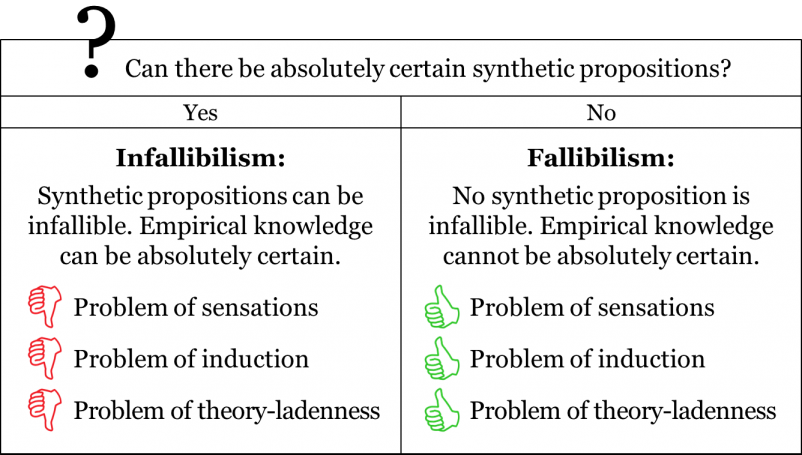
Infallibilism is the view that for a belief to be justified (and thus a candidate for knowledge), its justification must be so strong that it guarantees the belief is true. In other words, if your belief is genuinely justified, it is impossible for it to be false.
The classic champion of this view is René Descartes. He sought to place all of human knowledge on a perfectly secure foundation. To do this, he employed a method of radical doubt, questioning everything that could possibly be false.
To appreciate the high bar set by infallibilism, let's watch a short video that walks through Descartes' famous thought experiments. He used these scenarios not because he believed them, but to test which of his beliefs, if any, were truly immune to doubt.
Fallibilism - Is Certainty Possible?
The video 'Fallibilism - Is Certainty Possible?' from the channel Philosopher Games illustrates the powerful skeptical arguments Descartes used in his quest for absolute certainty.
Please watch from 0:30 to 3:44. This section covers both the dream argument and the evil demon argument. As you watch, consider how these extreme possibilities challenge the certainty of even your most basic beliefs about the world around you.
As you can see, if you demand absolute certainty, very few beliefs make the cut. The infallibilist standard is incredibly high. While Descartes believed he found a certain foundation in his own existence ("I think, therefore I am"), most philosophers today believe that such certainty is unavailable for the vast majority of our beliefs about the world. This leads us to the alternative view.
A More Modest Standard: Fallibilism
Most contemporary epistemologists have concluded that the infallibilist standard is too high. They are fallibilists.
Fallibilism is the thesis that a belief can be justified even if the justification does not guarantee its truth. For a fallibilist, it is possible to have a justified false belief. This doesn't mean our beliefs are all false or that we shouldn't care about truth. It simply means that our justification for a belief can be good enough for knowledge without being logically airtight.
For a precise definition and to clear up some common misconceptions, let's turn to the Internet Encyclopedia of Philosophy.
The IEP article 'Fallibilism' provides a clear and careful formulation of this crucial concept. It explains what fallibilism is, what it isn't, and how it relates to our rationality.
Please read the introduction (Section 1), 'Formulating Fallibilism: Preliminaries' (Section 2), and 'Formulating Fallibilism: A Thesis about Justification' (Section 3). Focus on the core idea that fallibilism is about the nature of justification—that it is never conclusive—and not about whether our beliefs are actually true or false.
As the article makes clear, fallibilism is the idea that "no belief can ever be rationally supported or justified in a conclusive way." There is always room for rational doubt.
This visual chart summarizes the core disagreement:
How Does Fallible Justification Work?
If justification doesn't guarantee truth, what does it do? Fallibilists often use the concept of defeasible or prima facie justification.
A belief is prima facie justified if it is justified "on the face of it." This justification is good enough to hold the belief rationally, unless it is defeated by new evidence.
For example:
- You look at a wall and it appears white. Your belief "the wall is white" is prima facie justified by your sensory experience.
- Then, someone tells you the room is lit by special white-colored lights that make everything look white. This new information acts as a defeater.
- Your initial justification is now defeated, and you are no longer justified in believing the wall is white.
This model allows our beliefs to be rational and justified based on the evidence we have, while acknowledging that our knowledge is provisional and can be corrected in light of new information.
To see a more formal explanation of this idea, you can refer to the following text.
Lecture Notes, Lehrer's Theory of Knowledge, Chapter 4 ...
These lecture notes on Keith Lehrer's 'Theory of Knowledge' offer a concise explanation of 'prima facie' justification, a key mechanism in fallibilist theories.
Please read the section titled 'Prima Facie Justification.' Notice how this legal term is used in epistemology to describe justification that is initially plausible but can be overturned or 'defeated.'
Test your understanding!
You read a story in a highly reputable newspaper, like the New York Times, reporting that a new scientific discovery has been made. You form the belief that this discovery occurred.
How would a strict infallibilist and a fallibilist view the justification for your belief?
Show answer
-
An infallibilist would argue your belief is not justified. Why? Because newspaper reports, even from reliable sources, can contain errors. There's no absolute guarantee of truth. The reporter could have misunderstood, or there might be a misprint. Since it's possible the belief is false, it isn't justified to the standard of certainty.
-
A fallibilist would argue your belief is justified (at least prima facie). A reputable newspaper is a reliable source, and relying on it is a rational, truth-conducive practice. The justification is strong, even if not perfect. If you later read a retraction or a report from another reliable source debunking the story, that would act as a defeater for your justification.
Does Fallibilism Lead to Skepticism?
This is a critical question. If we can never be 100% certain, does that mean we can't truly know anything?
The overwhelming answer from fallibilist philosophers is no. Most epistemologists are fallibilists who believe that we have a great deal of knowledge. They simply separate the concept of knowledge from the demand for certainty.
On this view, knowledge is typically understood as justified true belief (plus some solution to the Gettier problem, which we discussed earlier). The "justification" part doesn't have to be infallible. As long as your belief is true and you have good, albeit fallible, reasons for it, you can have knowledge. This idea of "fallible knowledge" is central to most modern epistemology.
This distinction will be especially relevant later when we consider different domains of belief, such as those based on testimony, religious experience, or faith, where infallible proof is often not available.
Conclusion
We've now drawn a crucial line regarding the strength of justification required for rational belief and knowledge.
Key Takeaways:
- Infallibilism is the demanding view that justification must guarantee the truth of a belief. It is motivated by a desire for absolute certainty.
- Fallibilism is the more common view that a belief can be justified even if it's possible for it to be false. Justification makes a belief rational to hold, but it doesn't make it immune to error.
- Fallible justification is often defeasible, meaning it can be overturned by new evidence.
- Most epistemologists are fallibilists and do not believe that fallibilism implies skepticism. They accept that we can have "fallible knowledge."
Preview of the Next Lesson:
With the concepts of internalism/externalism and fallibilism/infallibilism in hand, we are now ready to examine the major theories of how our justified beliefs are structured. In our next lesson, we will begin a new module and explore foundationalism, the theory that our beliefs are built upon a foundation of "properly basic beliefs" that do not require further justification. We will see how both fallibilist and infallibilist ideas have shaped different versions of this influential theory.