Hello! Welcome to the fourth and final lesson in our module on the sources of belief.
In our previous lessons, we explored two of the most historically significant sources: perception (the gateway for empiricism) and reason (the engine of rationalism). We saw how these two faculties provide us with beliefs about the external world and the world of abstract ideas. However, if you were to list every belief you hold, you would quickly realize that the vast majority did not come directly from your own senses or your own logical deductions. They came from what you remember and what other people have told you.
Today, we will turn our attention to these two ubiquitous, yet often overlooked, sources. Our goal is to describe the roles of memory and testimony as common sources of our beliefs. We'll examine how they function, the unique epistemic questions they raise, and why they are indispensable to our lives.
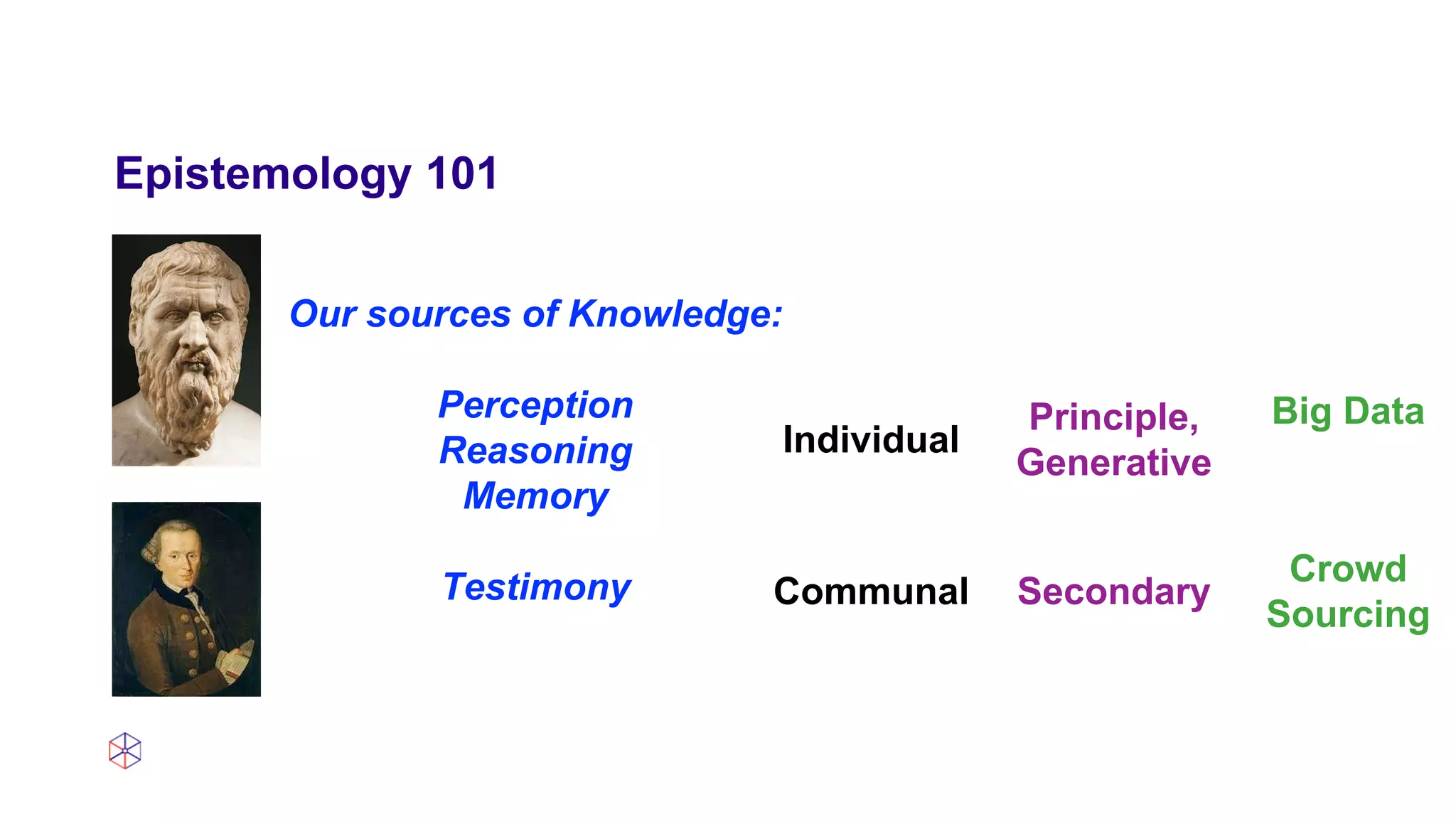
This visual chart can help frame our discussion. It categorizes Memory as an 'Individual' source, like perception and reason, and Testimony as a 'Communal' source.
Memory: The Library of the Mind
At first glance, memory might seem less like a source of new knowledge and more like a storage system for knowledge we've already acquired. As philosopher Robert Audi notes, it's a fundamental way we hold onto justification.
Robert Audi - Epistemology: How Do We Know What We Know?
Let's begin with a short clip from an interview with philosopher Robert Audi, where he situates memory alongside the other sources of justification we've discussed.
Please watch from 05:36 to 06:05. Notice how Audi naturally lists memory, perception, and reasoning together as ways we can have a ground, or justification, for believing something.
While memory does preserve beliefs, it's more complex than a simple hard drive. To understand its role, it's helpful to unpack the different kinds of memory and the epistemic puzzles it creates.
What is Memory?
Philosophers and psychologists distinguish between different memory systems. The following reading provides a clear overview of these distinctions and introduces a critical shift in how we think about memory—from a passive "storehouse" to an active "generator."
This selection from the Internet Encyclopedia of Philosophy (IEP) article 'Epistemology of Memory' will introduce you to key terminology for discussing memory's role in knowledge.
Please read the section titled '1. The Nature of Memory'. As you read, focus on: The difference between the traditional 'storehouse' view and the modern 'generative' view. The distinction between semantic memory ('remembering that...') and episodic memory ('remembering an event').
The distinction between the "storehouse" and "generative" views is significant. You might think of it in design terms:
- The storehouse view is like a static JPEG file. You open it, and it's exactly as you saved it.
- The generative view is more like a parametric design file (e.g., in Grasshopper or a complex Adobe Illustrator effect). When you open it, the software regenerates the image based on a set of rules, data, and context. The output can be slightly different each time depending on various factors.
For epistemology, the crucial distinction is between semantic memory (remembering propositions, like "Paris is the capital of France") and episodic memory (re-experiencing a past event, like remembering your visit to Paris). Epistemology mostly deals with semantic memory, as it's the one that directly provides us with beliefs we can state as facts.
The Puzzle of Stored Beliefs and Forgotten Evidence
Here is where memory becomes a fascinating source of epistemic puzzles. Many of your justified beliefs are currently stored away, not actively in your mind. Furthermore, for many beliefs you do hold, you've likely forgotten the original evidence you had for them.
This creates a problem for theories of justification. If a belief needs to be supported by evidence you currently possess, how can we say your stored beliefs are justified? What justifies your belief that, say, electrons have a negative charge, when it's not on your mind and you've forgotten the specific textbook or class where you learned it?
The following reading from the same IEP article details this challenge, which is known as the 'Problem of Stored Beliefs' and the 'Problem of Forgotten Evidence'.
Please read the subsections 'i. The Problem of Forgotten Evidence' and 'iii. The Problem of Stored Beliefs' within section '3. Memory and Justification'. Focus on understanding why these everyday phenomena pose a significant challenge to explaining how our beliefs are justified.
We won't solve this problem today, but recognizing it is crucial. It shows that memory is not just a passive container but an active player in justification, raising fundamental questions that will lead us directly into our next topic on the structure of knowledge.
Testimony: Learning from Others
Now, let's turn to testimony. In epistemology, "testimony" refers to any belief we form based on what other people (or other sources, like books and websites) tell us. It is, without a doubt, the source of the overwhelming majority of our beliefs about the world.
To get a clear definition, let's watch a clip that frames testimony as one of several "reliable sources" of knowledge.
In this clip from his lecture on 'Epistemic Externalism,' Professor Daniel Bonevac defines testimony and explains the conditions under which it can be considered a legitimate source of knowledge.
Please watch from 12:38 to 13:54. Pay attention to the definition of verbal testimony as a 'communication from a trustworthy person' and the additional conditions mentioned, like the person's intent.
The Central Debate: Trust by Default or Trust with Evidence?
Because we rely so heavily on testimony, a central question arises: is testimony a basic source of justification, like perception, that we can trust by default? Or does it need to be supported by other sources—that is, do we need positive reasons to believe a particular person or source is trustworthy?
This is the core debate in the epistemology of testimony. The following reading introduces the two opposing camps.
This selection from the IEP article 'Epistemology of Testimony' lays out the foundational debate between 'non-reductionism' and 'reductionism' using their historical proponents, Thomas Reid and David Hume.
Please read the introduction and the section titled '2.a. Characterizing the Debate'. Focus on understanding the difference between: Non-reductionism (Reid): We are justified in accepting testimony by default, unless we have reasons to doubt it. Testimony is a basic source of justification. Reductionism (Hume): We are only justified in accepting testimony if we have other reasons (based on perception, memory, and inference) to believe the speaker is reliable.
Test your understanding!
Imagine a small child who is told by their parent, "The stove is hot, don't touch it." The child has never been burned before and has no past experience to verify their parent's general reliability regarding stoves.
How would a non-reductionist and a reductionist likely differ in their evaluation of whether the child is justified in believing the stove is hot?
Show answer
-
A non-reductionist (following Reid) would argue the child is perfectly justified. They would say we have a natural, innate disposition to trust testimony. It is a basic source of justification, and the child is entitled to believe their parent unless they have a specific reason to be suspicious (e.g., the parent has been playing tricks on them all day).
-
A reductionist (following Hume) would have a harder time. They would have to argue that the child's justification isn't based on the testimony itself, but must be reduced to other evidence. Perhaps the child has inductively observed that parents are generally reliable sources of information about other dangers. The reductionist must find non-testimonial evidence to support the belief, which seems much less intuitive in this case.
This debate is profoundly important. So much of what we know—from science and history to the news—comes from testimony. Whether we need positive evidence to trust every source, or whether we can grant trust by default, has huge implications. This is especially true for the role of testimony in communities, including scientific and religious ones, a topic we will revisit later in the course.
Conclusion
Today we've added two indispensable sources to our epistemological toolkit: memory and testimony. Unlike the "pure" sources of perception and reason, these two are deeply intertwined with time, other people, and the practical realities of how we gather and maintain our beliefs.
Key Takeaways:
- Memory is not just a passive storehouse but an active, and sometimes reconstructive, process. It is a source of justification, but it also raises difficult puzzles like the Problem of Forgotten Evidence and the Problem of Stored Beliefs.
- Testimony is the source of the vast majority of our beliefs. It is what we learn from others.
- The central debate concerning testimony is between non-reductionism (which treats testimony as a basic source of justification, innocent until proven guilty) and reductionism (which demands that our trust in testimony be based on other evidence, like perception and reason).
Preview of the Next Lesson:
The puzzles we've uncovered today—especially the Problem of Forgotten Evidence—point to a much deeper question. If my belief p is justified by my memory of evidence q, what justifies my belief in q? And what justifies the reason for that belief? This chain of justification seems to go backward indefinitely. In our next lesson, we will confront this issue head-on by explaining the epistemic regress problem, a fundamental challenge for any theory of knowledge.