Hello! Welcome back to our course on epistemology.
In our last two lessons, we explored two powerful, yet distinct, sources of our beliefs. First, we examined perception and the empiricist view that all knowledge is ultimately grounded in sensory experience. Then, we turned to reason and the rationalist counter-argument that true knowledge comes from our intellectual faculties, independent of the senses.
Today, our goal is to bring these two great philosophical traditions into direct comparison. We will contrast the core principles of empiricism and rationalism, moving beyond seeing them as separate options to understanding them as opposing sides in one of epistemology's most foundational debates. By placing them head-to-head, you'll gain a clearer picture of their fundamental disagreements and their lasting influence on Western thought.
The Central Point of Disagreement
At its heart, the conflict between rationalism and empiricism can be boiled down to a single, elegant point of contention. The following reading from a lecture by philosopher Ronald Nash frames this disagreement using precise, logical definitions.
Rationalism and Empiricism - Ronald Nash
In his lecture 'Rationalism and Empiricism', Ronald Nash presents the two positions as contradictory propositions. This framing clearly isolates the core issue at stake.
Please read the first half of the transcript provided in the resource. Start from the heading 'Lesson Transcript' and read until the paragraph ending with '...the genuine objects of genuine knowledge.' Focus on how Nash defines empiricism as an 'A proposition' ('All human knowledge arises from sense experience') and rationalism as its 'O proposition' ('Some human knowledge does not arise from sense experience').
As Nash explains, the debate isn't about whether we use our senses; everyone agrees we do. The crucial difference is whether the senses are the only ultimate source of knowledge.
- Empiricism: All knowledge ultimately derives from sensory experience.
- Rationalism: Some knowledge can be acquired through reason alone, independent of sensory experience.
This single point of disagreement leads to profoundly different views on the nature of the mind, the role of reason, and the limits of human knowledge.
Three Key Battlegrounds
To make the contrast more concrete, let's watch a short video clip that breaks the debate down into three specific questions.
Descartes vs. Bacon on Rationalism vs. Empiricism & “Man’s Conquest of Nature”
In this clip from 'Descartes vs. Bacon on Rationalism vs. Empiricism,' philosopher Peter Kreeft provides a very clear and structured breakdown of the three core areas where rationalism and empiricism clash.
Please watch from 06:09 to 08:44. As you watch, pay close attention to the three points of contrast: 1. Temporal priority (what comes first?), 2. Critical judgment (which judges the other?), and 3. Extension (is reason limited by experience?).
Let's summarize those three points of conflict:
- Origin: Do we start with sensory data and build up our ideas (empiricism), or do we start with innate principles of reason and use them to interpret our experience (rationalism)?
- Standard: When a theory conflicts with an observation, which should we trust? Should data always correct our theories (empiricism), or can our rational principles overrule what our senses seem to tell us (rationalism)?
- Scope: Is our knowledge limited to what we can experience, or can reason take us beyond the empirical world to understand concepts like God, infinity, or metaphysical truths (rationalism)?
The Mind: Blank Slate or Invisible Ink?
Perhaps the most famous clash between these two traditions is over the nature of the mind itself. In a previous lesson, we touched upon the empiricist John Locke's idea of the mind as a tabula rasa, or "blank slate," on which experience writes. Rationalists fundamentally reject this.
To explore this, let's return to Ronald Nash's lecture. He explains the rationalist counter-argument with a wonderful analogy that should resonate with your design sensibilities.
Rationalism and Empiricism - Ronald Nash
This reading continues our exploration of Nash's lecture, focusing on the concepts of 'tabula rasa' versus innate ideas, and introduces a powerful analogy.
Please read the rest of the lecture transcript, starting from where you left off. Focus on the rationalist response to the 'blank slate' theory and the 'invisible ink' analogy. Pay special attention to the discussion of the famous quote from Aquinas and Leibniz's addition to it.
This leads us to one of the most succinct summaries of the entire debate. The empiricist tradition, following Aristotle and Thomas Aquinas, holds that:
"Nihil est in intellectu quod non fuerit in sensu."
(Nothing is in the intellect that was not first in the senses.)
The rationalist Gottfried Leibniz, whose "veined marble" analogy we discussed last lesson, famously added a crucial clause:
"...nisi ipse intellectus."
(...except the intellect itself.)
For the rationalist, the mind is not a passive receptacle but an active shaper of knowledge, equipped with its own structure, principles, and concepts. Experience may be necessary to make this innate knowledge explicit (like heat revealing invisible ink), but experience is not its source.
Putting It All Together: A Full-Spectrum Debate
We've broken down the conflict into its core components. Now, let's watch a short video that presents the debate as a whole, touching on how each side approaches different domains of knowledge, from science and mathematics to ethics.
Rationalism vs Empiricism Debate
The video 'Rationalism vs Empiricism Debate' from Philosophy Vibe stages a dialogue between an empiricist and a rationalist, showcasing how their foundational beliefs lead to different conclusions on various topics.
Please watch the entire video. It provides a great overview of the definitions and then explores how the debate plays out in practice. Notice how the empiricist grounds everything in observation, while the rationalist appeals to innate concepts, deduction, and intuition.
Test your understanding!
The video you just watched mentioned the scientific method. As Francis Bacon (an empiricist) argued, a scientist should be like a bee: gathering data (nectar) from the world but then processing it with their own abilities to create something new (honey).
Imagine two scientists investigating gravity.
- Scientist A (leaning Empiricist) spends years dropping objects of different masses and shapes, meticulously recording their acceleration and building a complex mathematical model that perfectly fits every single data point they've collected.
- Scientist B (leaning Rationalist) starts from the principle that the laws of nature must be simple and elegant. They propose a simple, beautiful equation for gravity. This equation doesn't perfectly match all the messy, real-world data, but it captures the fundamental relationship in a very clear way.
How does this scenario illustrate the contrast between the rationalist and empiricist approaches to knowledge?
Show answer
This scenario highlights the different priorities of the two traditions.
- Scientist A, the empiricist, privileges the data. Their standard for truth is correspondence with sensory experience. They are building knowledge from the "bottom up," starting with particular observations. Their approach is inductive.
- Scientist B, the rationalist, privileges the rational principle of simplicity and elegance. They believe the underlying reality must conform to a rational structure, even if our messy observations don't perfectly reflect it. Their approach is more "top-down," starting with a general principle and using it to make sense of the data. Their approach is deductive.
This reflects the tension between creating theories that are faithful to experience versus theories that satisfy our reason.
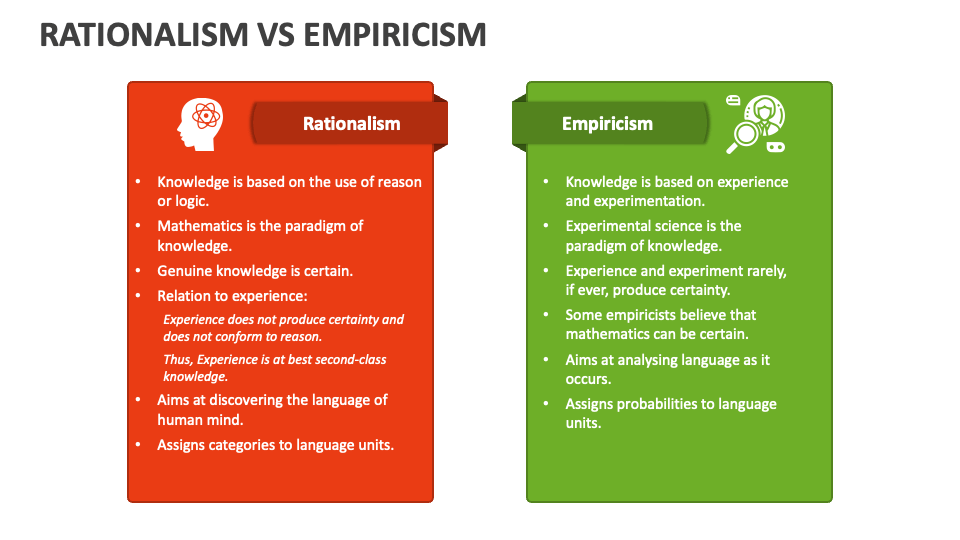
A Visual Summary
As someone with a background in design, you know the power of a clear visual summary. Here is an infographic that lays out the core contrasts we have been discussing.
Conclusion
Today we've placed the two great traditions of epistemology, rationalism and empiricism, in direct opposition. While the debate is nuanced, the fundamental conflict is clear and has shaped philosophy for centuries.
Key Takeaways:
- Core Conflict: Empiricists hold that all knowledge comes from experience, while rationalists argue that some substantive knowledge comes from reason alone.
- The Mind: Empiricists view the mind as a blank slate (tabula rasa), while rationalists see it as having innate structures or ideas (like veined marble or a page with invisible ink).
- Path to Knowledge: Empiricism champions a posteriori knowledge, gained after experience. Rationalism champions a priori knowledge, gained before or independent of experience.
- Standard of Truth: For empiricists, the ultimate test of a theory is sensory data and observation. For rationalists, it is coherence with the principles of reason, such as clarity, logic, and simplicity.
Preview of the Next Lesson:
We've now explored two major avenues for acquiring beliefs: perception and reason. But in our daily lives, much of what we think we know doesn't come directly from our own senses or rational deductions. It comes from what we remember and what others tell us. In our next lesson, we will describe the roles of memory and testimony as common and crucial sources of our beliefs.