Hello, and welcome back!
In our last lesson, we explored how empiricism grounds knowledge in perception. We saw its intuitive appeal but also its significant weakness: our senses can be fallible and mislead us, as demonstrated by illusions and perceptual variations. This fallibility led many philosophers to ask: if experience is unreliable, where can we find a more certain foundation for our knowledge?
This question leads us directly to today's topic. We will explore the main philosophical alternative to empiricism: rationalism. Rationalists argue that the primary source of knowledge is not the external world of the senses, but the internal world of the mind—our capacity to reason.
Our goal is to explain reason as a source of knowledge and, as part of that, to distinguish between two crucial categories of knowledge: a priori and a posteriori.
The Foundational Distinction: A Priori and A Posteriori
To understand the debate between empiricists and rationalists, we first need to grasp a key distinction regarding how we come to know things.
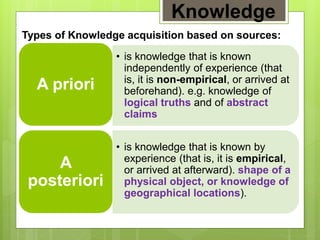
Let's break this down:
-
A posteriori knowledge is knowledge that depends on experience or empirical evidence. The term is Latin for "from the latter," meaning after experience. To know that water boils at 100°C or that it is currently sunny outside, you need to rely on observation and experience. Empiricists, as we saw last time, champion this as the source of all real knowledge.
-
A priori knowledge is knowledge that is independent of experience. The term is Latin for "from the former," meaning before experience. You can know that 2+2=4 or that all triangles have three sides just by thinking about it, using reason alone. You don't need to go out into the world and conduct experiments.
To help solidify these concepts and introduce a related distinction, please review the first part of the following text.
This brief reading from Philosophy A-Level provides clear definitions and examples of these crucial terms.
Please read the section titled 'Some definitions'. Focus on the tables defining 'Analytic/synthetic' and 'A priori/a posteriori'. The distinction between an 'analytic' truth (true by definition) and a 'synthetic' truth (true by how the world is) is key to understanding the rationalist project.
As the text highlights, everyone agrees that we can know analytic truths (like "all bachelors are unmarried") a priori. The real debate is about whether we can know synthetic truths—substantive facts about the world—through reason alone. Empiricists say no; rationalists say yes.
Test your understanding!
Categorize the following statements. Is the knowledge they represent a priori or a posteriori? Is the statement itself analytic or synthetic?
- My dog has fleas.
- A square has four equal sides.
- Every event has a cause.
- Nothing can be both entirely red and entirely green at the same time.
Show answer
- My dog has fleas: This is a synthetic statement (it tells you something about the world, not the definition of "dog") and requires a posteriori knowledge (you have to check the dog).
- A square has four equal sides: This is an analytic statement (it's part of the definition of a square) and is known a priori (through reason).
- Every event has a cause: This is tricky and philosophers debate it! It appears to be a synthetic statement (the concept of "cause" isn't necessarily part of the definition of "event"), but many rationalists would argue it can be known a priori as a fundamental principle of reason. An empiricist might argue it's just a generalization from experience (a posteriori).
- Nothing can be both entirely red and entirely green...: This also looks synthetic (it's about colors in the world, not just definitions), but seems knowable a priori. You don't need to check every red and green object; you can grasp this truth through reason. This is another prime candidate for the kind of knowledge rationalists are interested in.
Rationalism: The Power of Reason
Rationalism is the view that reason is the chief source and test of knowledge. Rationalists believe that through reason, we can access fundamental truths about reality, truths that sensory experience alone cannot give us.
Let's look at two major ways rationalists argue we can acquire this a priori knowledge.
1. Intuition and Deduction: The Method of Descartes
The French philosopher René Descartes is a classic example of a rationalist. Troubled by the unreliability of his senses, he decided to build a system of knowledge from the ground up using only reason. His method was to doubt everything he possibly could until he found something that was absolutely certain.
He found this certainty in the very act of doubting. The famous conclusion, Cogito ergo sum ("I think, therefore I am"), became his foundation.
The following video clip explains how Descartes used this as a starting point to demonstrate that we can gain substantive, synthetic knowledge a priori.
Rationalism vs. Empiricism: Intuition and Deduction and Innate Knowledge (Epistemology Episode 3)
This segment from philosophymania explains Descartes' famous Cogito argument and why it's a powerful example of a rationalist claim to synthetic a priori knowledge.
Please watch from 30:31 to 35:10. Focus on how Descartes arrives at 'I exist' and why this is considered a synthetic truth (a fact about the world) known a priori (through reason alone, even while doubting all sensory experience).
For Descartes, the Cogito is not just a logical proof; it's a moment of rational intuition—an immediate, clear, and distinct grasp of a truth by the mind alone. He believed that starting from such certain intuitive truths, we could use deduction (step-by-step logical reasoning) to discover more complex truths about the world, God, and the soul, all without relying on the messy data of the senses.
2. Innate Knowledge: The Mind as Veined Marble
Another major rationalist argument is that we are born with certain knowledge or, more subtly, with innate structures or predispositions that shape our understanding. This is the doctrine of innate knowledge.
In the last lesson, we saw John Locke's empiricist view of the mind as a tabula rasa, or "blank slate." The rationalist Gottfried Wilhelm Leibniz offered a compelling alternative analogy. He argued the mind is not a blank slate, but a block of marble with veins running through it.
Let's watch a short video that explains this powerful analogy.
Leibniz's Judgment Rationalism
This clip from a lecture by Professor Daniel Bonevac beautifully illustrates Leibniz's rationalist response to Locke's empiricism.
Watch from 04:09 to 06:48. Focus on the contrast between Locke's 'white sheet of paper' and Leibniz's 'block of marble'. This analogy explains the rationalist idea that while experience is needed to 'sculpt' our knowledge, the mind has an in-built structure that determines the final shape.
Leibniz's point is that experience may be the chisel, but our innate mental structure is the marble. We have an in-built tendency to grasp necessary truths (like the principles of logic and mathematics) that experience could never prove on its own. Experience can show you that two plus two equals four in this instance, but it can't show you that it must always equal four. For rationalists like Leibniz, that sense of necessity comes from the innate structure of our reason.
Conclusion
Today, we've explored rationalism, a powerful counterpoint to the empiricism we discussed previously. We've seen that rationalists champion reason as the primary source of knowledge, allowing us to grasp truths that are beyond the reach of our fallible senses.
Key Takeaways:
- Knowledge can be divided into a posteriori (known through experience) and a priori (known through reason alone).
- Rationalism is the philosophical view that reason is the primary source of substantive knowledge about the world.
- Rationalists argue we can know synthetic a priori truths—facts about the world that are known independently of experience.
- This knowledge can be gained through methods like intuition and deduction (exemplified by Descartes' "I think, therefore I am").
- It can also be explained by innate knowledge or innate mental structures, as illustrated by Leibniz's analogy of the mind as a block of veined marble.
Preview of the Next Lesson:
We have now examined the two great historical pillars of epistemology: empiricism (knowledge from experience) and rationalism (knowledge from reason). In our next lesson, we will put them head-to-head, contrasting their core principles to fully appreciate the fundamental divide between these two influential traditions.