Hello! Welcome back to our course on epistemology.
In our last lesson, we established the classical "gold standard" for what it means to know something: the Justified True Belief (JTB) analysis. For over two millennia, this three-part recipe—Belief, Truth, and Justification—was widely accepted as providing the necessary and sufficient conditions for knowledge. It's intuitive, elegant, and seems to cover all the bases.
Today, we will explore the moment this long-standing consensus was shattered. In 1963, a philosopher named Edmund Gettier published a very short paper that presented simple but ingenious counterexamples. These scenarios, now known as Gettier problems, describe situations where a person holds a justified, true belief but still seems to lack knowledge.
Since you've mentioned you're already familiar with the Gettier problem, today's lesson will aim to formalize that understanding. We will dissect the structure of these problems to see precisely how they challenge the classical JTB analysis and why they forced philosophers to rethink the very definition of knowledge.
What is a Gettier Problem?
Let's start with a very clear and simple example. The following short text will introduce the core idea with a relatable scenario and provide a formal definition of a Gettier problem.
The Gettier Problem: True Justified Belief without Knowledge
This reading from Academy of Social Competency introduces the concept using an intuitive example about mistaking a neighbor for one's father.
Please read the first three parts of the article: 'The Problem,' 'Explanation,' and 'Gettier Problem.' These sections set up the puzzle perfectly.
As the reading explains, a Gettier problem is any case that demonstrates the JTB analysis is insufficient. It shows that having a justified true belief isn't always enough to have knowledge. The key ingredient in these cases is a form of epistemic luck, where your justification and the truth of your belief are only coincidentally connected.
The Classic Case: Smith and Jones
Now, let's dive into one of Edmund Gettier's original examples. It's a bit more complex than the snow-shoveling case, but it's the one that started it all. The following video gives an excellent overview of the JTB theory before presenting Gettier's famous "Smith and Jones" case.
PHILOSOPHY - Epistemology: Analyzing Knowledge #1 (The Gettier Problem) [HD]
This video from Wireless Philosophy, presented by Prof. Jennifer Nagel, will walk you through Gettier's first famous counterexample.
Please watch from the beginning until 04:46. The first part (until 02:32) is a great recap of JTB theory, and the second part details the case of Smith, Jones, and the ten coins.
Let's break down the "Smith and Jones" case to see exactly where the JTB analysis fails:
- The Belief: Smith forms the belief that "The man who will get the job has ten coins in his pocket."
- The Justification: Smith has good reasons for this belief.
- He has strong testimonial evidence from the company president that Jones will get the job.
- He has direct observational evidence that Jones has ten coins in his pocket.
From these two justified premises, he logically deduces his belief. So, his belief is justified.
- The Truth: Smith's belief turns out to be true. However, it's true for reasons completely disconnected from his justification. It is Smith who gets the job, and, by coincidence, Smith also has ten coins in his pocket.
Smith has a justified, true belief. According to the JTB analysis, he should have knowledge. But does he? It seems obvious that he doesn't. He has no idea who will actually get the job, nor does he know how many coins are in his own pocket. He just "lucked into" being correct. This is the essence of a Gettier problem: the justification doesn't properly connect to what makes the belief true.
The Common Pattern in Gettier Cases
Gettier cases all share a similar structure. Let's look at another famous example, often called the "Sheep in the Field" case, to help solidify the pattern.
The Meaning of Knowledge: Crash Course Philosophy #7
The Crash Course Philosophy series offers a fast-paced and visually engaging take on these concepts. This segment quickly covers the Smith and Jones case again and adds the 'Sheep in the Field' example.
Please watch the segment from 06:30 to 08:53. Focus on how the 'Sheep in the Field' example follows the same pattern of lucky, but justified, true belief.
Here's the pattern:
- You form a belief based on good, but ultimately misleading, evidence. (e.g., seeing a shaggy dog that looks like a sheep).
- Your belief is justified based on that evidence. (e.g., "There is a sheep in the field").
- Your belief happens to be true, but because of some other fact you are unaware of. (e.g., there's a real sheep hidden behind a hill).
Another famous example is the broken clock. You look at a clock on the wall and it reads 3:00. Based on this, you form the justified belief that it is 3:00. By sheer luck, it is exactly 3:00. However, the clock is broken and has been stopped for days. You have a justified true belief, but you don't know the time.
The Aftermath: A Theory in Crisis
Gettier's paper showed that the three conditions of JTB, while individually necessary, are not jointly sufficient for knowledge. The classical model was broken.
Given your background in graphic design, this diagram might be a useful way to visualize the impact. The old model saw knowledge as the simple intersection of three elements. The new challenge is to find a "fourth condition" to add to the mix.
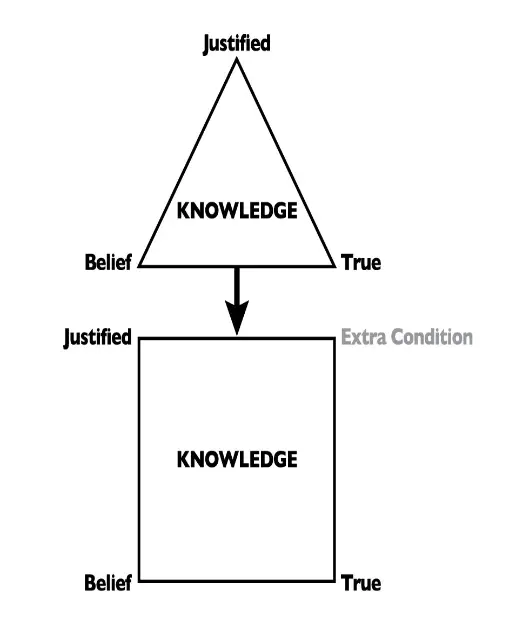
The Gettier problem launched a new research program in epistemology: the search for what this missing condition might be. Is it that the justification can't be based on a false belief? Or that there can't be any "defeaters"—other truths that, if known, would undermine the justification? We will touch on these attempts in a future lesson.
Test your understanding!
The best way to understand the structure of a Gettier problem is to try creating one. Think of a simple, everyday scenario and see if you can construct a case where someone has a justified true belief but does not have knowledge.
Try to identify these three parts in your story:
- The initial, justifying evidence (which is somehow flawed or misleading).
- The true belief that is formed based on this evidence.
- The unrelated, coincidental fact that makes the belief true.
Show an example answer
Here's a sample Gettier case:
Maria looks at her email inbox and sees a new message with the subject line "Your Amazon.com order of The Great Gatsby has shipped!" She had, in fact, ordered that book yesterday.
- Justifying Evidence: The email notification. This is good evidence that her book has shipped.
- Belief: Maria forms the belief, "My copy of The Great Gatsby has shipped."
- The Twist: The email she saw was actually the shipping confirmation for a different copy of The Great Gatsby that her brother, using their shared Amazon account, had secretly bought for her as a gift. However, by complete coincidence, the book she ordered for herself also shipped at the exact same time, generating a separate email she hasn't seen yet.
Conclusion: Maria has a justified true belief that her book has shipped, but her justification points to the wrong order. She doesn't truly know her book has shipped; she just got lucky that it was true for a different reason.
Conclusion
In this lesson, we've examined how Gettier problems successfully dismantled a 2,000-year-old philosophical consensus. By constructing clever scenarios involving justified true beliefs that are true merely by luck, Gettier demonstrated that the classical analysis of knowledge was incomplete.
Key Takeaways:
- A Gettier problem is a counterexample showing that Justified True Belief (JTB) is not a sufficient condition for knowledge.
- In a Gettier case, a person's justification for their belief is disconnected from what makes that belief true.
- The truth of the belief is ultimately dependent on a form of epistemic luck.
- The legacy of Gettier's paper was to show that a "fourth condition" might be needed to successfully define knowledge.
Preview of the Next Lesson:
The intense focus on fixing the JTB model after Gettier raises a more fundamental question: Why do we value knowledge so highly in the first place? Is knowledge really more valuable than having a mere true belief, or even a justified true belief? In our next lesson, we will explore this "value problem" and consider why epistemology isn't just about defining knowledge, but also about understanding its significance.