Hello, and welcome back to our survey of epistemology.
In our last lesson, we saw how Edmund Gettier’s ingenious thought experiments revealed a crack in the very foundation of the classical definition of knowledge. He showed that having a justified true belief (JTB) isn't always enough to have knowledge, because a person could simply "luck into" being right.
This realization forces us to ask a more fundamental question. If a justified true belief that falls short of knowledge (like in a Gettier case) can still be true and guide us to success, what exactly is the extra value in having "real" knowledge? Why do philosophers spend so much time trying to define it perfectly?
Today, we will explore this very question, known in philosophy as the value problem. Our goal is to discuss why knowledge has historically been considered more valuable than mere true belief.
The Heart of the Problem: Larissa and the Espresso Machine
At first glance, the answer seems obvious: knowledge is valuable because it helps us achieve our goals. If you know the restaurant is open, you won't waste a trip. But is it that simple?
Let's start with a short video that introduces the original framing of this puzzle, which comes from Plato's dialogue, the Meno.
PHILOSOPHY - Epistemology: The Value of Knowledge [HD]
This video from Wireless Philosophy clearly explains Socrates's original challenge using the famous 'traveler to Larissa' example.
Watch the first three minutes (from the beginning to 03:04). The key idea here is that if a lucky guess and genuine knowledge both lead you to the same destination, it's not obvious why knowledge is better.
As the video explains, if you are trying to get to Larissa and correctly guess which road to take, you will arrive just as successfully as someone who actually knew the way. Both true belief and knowledge led to the same practical outcome. This is the core of the value problem.
To make this even more intuitive, contemporary philosopher Linda Zagzebski developed a memorable analogy.
The Value of Knowledge - Epistemology Video 3
This next clip, from a lecture by Victor Gijsbers, explains Zagzebski's 'espresso machine' analogy. It's a modern take on Plato's puzzle.
Please watch the segment from 04:00 to 07:10. The analogy poses a simple question: if you are given a perfect cup of espresso (a true belief), does it matter whether it came from a reliable, high-end machine (a good justification)?
These two examples highlight the challenge: if the final product—a true belief—is what gets us what we want, why should the process by which we arrived at that belief add any extra value? The value seems to be "swamped" by the value of the belief's truth.
The Classical Answer: Knowledge is 'Tied Down'
Plato himself offered an answer to the puzzle he posed. He suggested that while true belief is useful, it is also fragile and fleeting. Knowledge, on the other hand, is stable.
His analogy involves the mythical statues of Daedalus, which were said to be so lifelike that they would run away if not tethered to the ground. Given your background in design and art, this image is a particularly powerful way to understand his point.
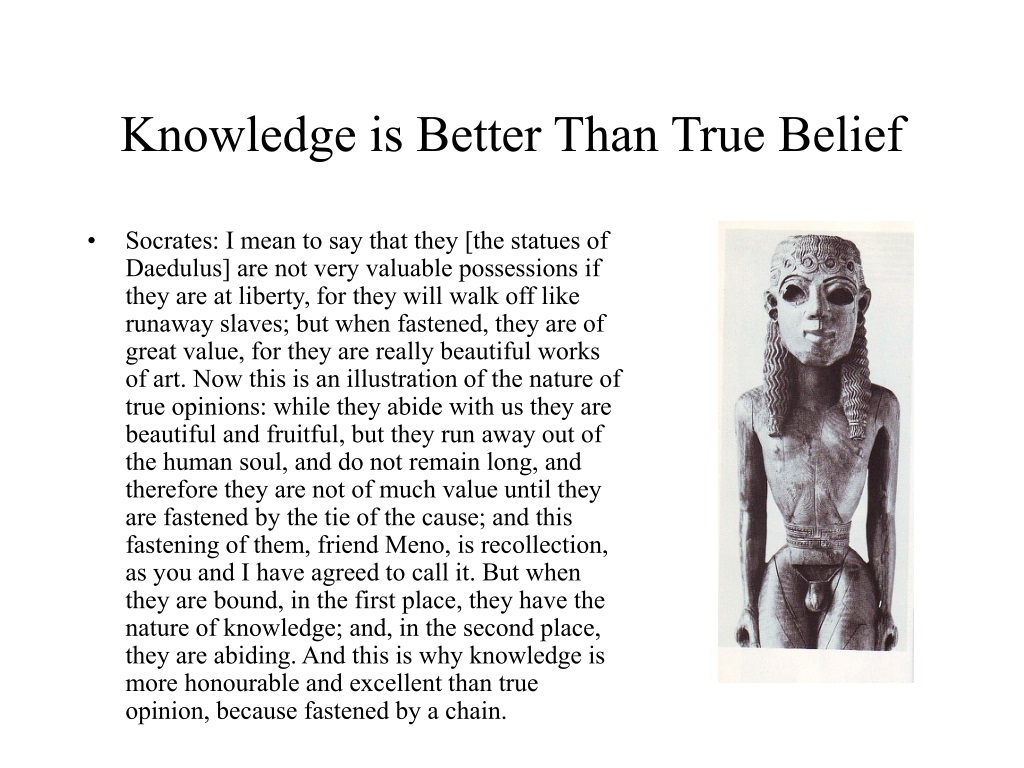
To get the full context of this famous analogy, the following short reading explains the passage in which Socrates makes his argument.
This excerpt from a lecture by Ian Johnston on Plato's Meno focuses directly on the key passage where Socrates explains the Daedalus analogy.
Please read the section that begins 'These statues are very fine...'. It's about four paragraphs long and contains Plato's core argument for why knowledge is more prized than correct opinion.
So, Plato's solution is that knowledge is more valuable because it is stable. It is a true belief that has been "tied down" with a logos—an account, or what we would call a justification. This justification makes the belief secure and prevents you from easily abandoning it.
Modern philosophers like Timothy Williamson have updated this idea. They argue that knowledge is more valuable because it is more resilient in the face of new, potentially misleading evidence.
PHILOSOPHY - Epistemology: The Value of Knowledge [HD]
Let's return to the Wireless Philosophy video to see a modern interpretation of this 'tying down' idea.
Watch the segment from 04:01 to 05:22. The 'burglar' example illustrates how a person with knowledge will persist in their search for truth, whereas someone with a merely true belief might give up easily.
Test your understanding!
Imagine two students, Alex and Ben, who both believe that the Battle of Hastings was in 1066.
- Alex believes this because he vaguely remembers hearing it once.
- Ben believes this because he has studied the Norman Conquest, understands its timeline relative to other events, and can explain the key figures involved.
A friend jokingly tells them, "Are you sure? I thought it was in 1067." How might Alex and Ben react differently, and how does this illustrate Plato's point about stability?
Show answer
Alex, holding a mere true belief, might easily become uncertain. His belief isn't 'tied down' by strong reasons, so a minor challenge could make it 'run away'. He might say, "Oh, maybe you're right."
Ben, on the other hand, has knowledge. His belief is 'tied down' by a web of supporting reasons. He would likely resist the misleading counter-evidence and say, "No, I'm confident it was 1066 because of X, Y, and Z reasons." Ben's belief is stable, and therefore more valuable and reliable over time.
Challenges and Alternative Views
Is stability the full story? While appealing, the stability solution has its own problems. After all, a dogmatic or stubborn person might hold their beliefs very stably, but we wouldn't say their tenacity makes their beliefs more valuable or count as knowledge.
Let's look at a quick critique of the stability argument.
The Value of Knowledge - Epistemology Video 3
Is stability always a good thing? This clip from Victor Gijsbers' lecture explains why stability alone can't be the answer.
Watch the portion from 12:45 to 15:10. He uses the example of a 'tenacious believer' to show the weakness of the stability argument.
This critique opens the door to other ways of thinking about epistemic value. Here are two prominent modern perspectives:
-
Veritism (or Truth-Monism): This view argues that the puzzle is slightly misconstrued. From a purely epistemic (knowledge-related) standpoint, the only thing with fundamental value is true belief. Other things, like justification or having a reliable belief-forming process, are only instrumentally valuable—that is, they are valuable as tools for getting more true beliefs in the long run. On this view, a reliable espresso machine is valuable not because it makes this specific cup of coffee better, but because it's a good tool to have if you want many good cups in the future.
-
Virtue Epistemology: This approach shifts the focus from the belief itself to the person holding it. The idea here is that what is truly valuable is the intellectual character and the virtuous project of earnestly seeking the truth. Knowledge is the successful achievement of this admirable striving. A mere true belief, acquired by luck, is like scoring a point by accident; it doesn't reflect the skill and dedication of the player. We'll explore this theory more in a later module.
Conclusion
Today we've grappled with one of epistemology's more subtle but profound questions. The value problem forces us to consider not just what knowledge is, but why it matters.
Key Takeaways:
- The value problem (or Meno Problem) asks why knowledge is considered more valuable than mere true belief, especially when both can lead to practical success.
- Plato's classic answer is that knowledge is more stable and enduring because it is a true belief "tied down" by reasons or justification.
- This stability helps a belief resist being lost or overturned by misleading counter-evidence.
- However, stability alone isn't a perfect solution, as dogmatic beliefs can also be stable.
- Alternative views suggest the extra value comes from the instrumental benefit of justification (veritism) or from the inherent worth of being a virtuous truth-seeker (virtue epistemology).
Preview of the Next Lesson:
We've now discussed the definition of knowledge, its potential flaws, and its value. But this all presumes we have beliefs to analyze in the first place. Where do our beliefs come from? In our next module, we will begin exploring the primary sources of belief, starting with our most direct connection to the world: perception. This will lead us into the great historical debate between empiricism and rationalism.