Welcome back! In our last lesson, we focused on clarifying what philosophers mean by "knowledge," distinguishing between knowing how to do something, knowing someone by acquaintance, and knowing that something is the case. We concluded that epistemology is primarily concerned with this last category: propositional knowledge.
Today, we will examine the most influential answer to the question, "What is propositional knowledge?" For over two millennia, philosophers have worked with a model that defines knowledge as having three essential ingredients. This lesson will unpack that classical definition, known as the Justified True Belief (JTB) analysis, which serves as the foundation for most epistemological discussions that follow.
The Three Conditions for Knowledge
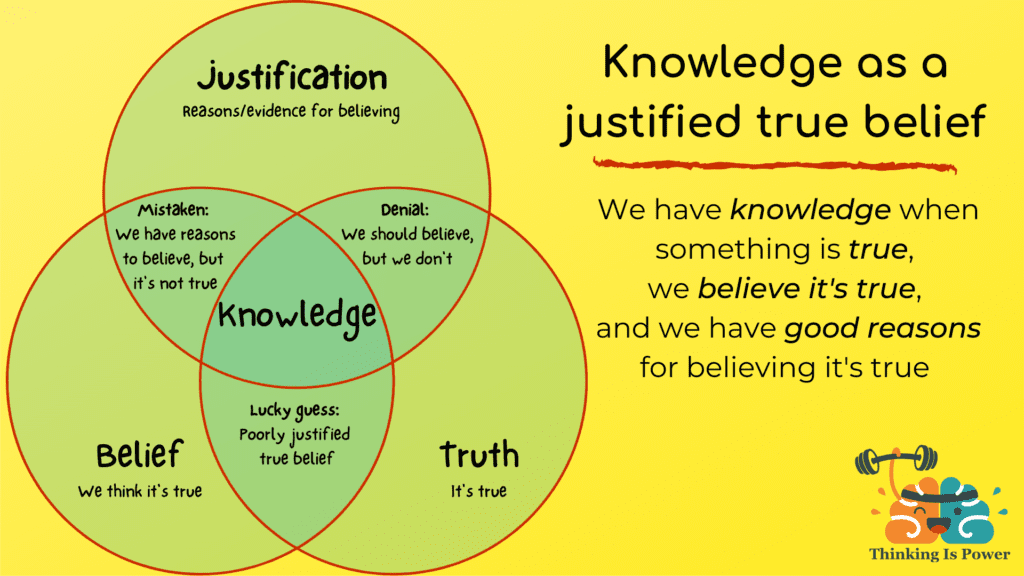
The traditional analysis of knowledge, with roots tracing back to Plato's dialogues, holds that for you to know a proposition (let's call it 'P'), three conditions must be met:
- P must be true.
- You must believe that P is true.
- You must be justified in believing that P is true.
According to this view, these three conditions are individually necessary (if you're missing even one, you don't have knowledge) and jointly sufficient (if you have all three, you have knowledge).
To begin, let's watch a short video that provides a clear and simple overview of these three components and illustrates why each one is considered essential.
Justified True Belief & The Gettier Problem (Epistemology)
The video 'Justified True Belief & The Gettier Problem' from the Philosophy Vibe channel gives a concise explanation of the JTB framework using a straightforward example.
Please watch from 00:46 to 03:43. This segment explains each of the three conditions and then demonstrates what happens when a belief is true but unjustified, or justified but false.
Breaking Down the Components
The video gives us the basic structure. Now, let's take a closer look at each condition using a more detailed philosophical text. This will help clarify some of the nuances and common points of confusion.
The following sections from the online textbook 'Introduction to Philosophy: Epistemology' provide a thorough breakdown of each part of the JTB analysis. It addresses common misconceptions and introduces key terminology.
Please read the three subsections titled 'A. Belief,' 'B. Truth,' and 'C. Justification.' As you read, focus on understanding the specific role each condition plays and the arguments for why it is necessary.
Let's synthesize the key insights from that reading.
1. The Belief Condition
To know something, you must first believe it. This may sound obvious, but it's a crucial starting point. If you do not accept a proposition as true—either because you've never considered it, you actively disbelieve it, or you are undecided (suspending judgment)—you cannot be said to know it. If asked, "Do you know the capital of Mongolia?", and you have no opinion, your honest answer is "I don't know."
As the text points out, we must be careful with "loose talk." When someone says, "I don't believe it, I know it," they aren't claiming to know something without believing it. They are rhetorically emphasizing that their belief is not mere belief; it is a belief that rises to the level of knowledge because it is also true and justified.
2. The Truth Condition
Knowledge must be tethered to reality. You can believe many things, but you can only know the things that are actually true. If you believe the Earth is flat, you don't know the Earth is flat, because that belief is false. You simply have a false belief.
This is why philosophers say that knowledge is factive, meaning it entails truth. If you know that P, then P must be true. This condition separates knowledge from opinion, guesswork, and error.
3. The Justification Condition
This is arguably the most complex and debated condition. It's not enough to have a true belief. To have knowledge, you must have a good reason for your belief. This is what separates knowledge from a lucky guess.
Imagine a hypochondriac who, with no medical evidence, believes they have a rare disease. If it turns out, by sheer coincidence, that they do have that disease, they had a true belief. But we would not say they knew it, because their belief was not based on good reason; it was based on anxiety. They just got lucky.
Plato's analogy of the "tethered statues" is powerful here: a true belief is like a beautiful statue that can run away (it's unstable). Justification is the tether that anchors the true belief, giving it the stability that is characteristic of knowledge.
Importantly, "justification" does not mean your reasons have to be infallible or provide absolute certainty. Most philosophers are fallibilists about justification, meaning they accept that a belief can be justified by good evidence even if that evidence doesn't guarantee the belief is true. For example, your belief that the sun will rise tomorrow is extremely well-justified based on past experience, but it's not logically impossible for it to be false.
A Visual Model of JTB
Given your background in graphic design, this visual model should be a particularly useful way to conceptualize the JTB framework. It shows knowledge as the specific point where all three conditions overlap.
Test your understanding!
Consider the following scenarios. For each one, determine which of the three conditions (Justification, Truth, Belief) are met, and conclude whether the person has knowledge according to the JTB analysis.
- Sarah reads in her horoscope that today is her lucky day and she will come into unexpected money. Based on this, she forms a strong belief that she will win the lottery. She buys a ticket and, against all odds, wins the jackpot.
- An ancient astronomer, using the best available data and complex calculations (which were considered valid at the time), concludes that the sun revolves around the Earth. He fully believes his conclusion.
- Mark is asked what the capital of Australia is. He has no idea, so he guesses "Canberra." His guess happens to be correct.
Show answer
-
Sarah:
- Belief: Yes, she believes she will win.
- Truth: Yes, her belief turns out to be true.
- Justification: No. A horoscope is not considered a good or reliable reason.
- Conclusion: Sarah has a true belief, but not knowledge. This is a "lucky guess."
-
The Astronomer:
- Belief: Yes, he believes the sun revolves around the Earth.
- Justification: Yes, based on the standards and evidence of his time, his belief is well-reasoned and justified.
- Truth: No, the belief is false.
- Conclusion: The astronomer has a justified belief, but not knowledge.
-
Mark:
- Belief: No. Mark doesn't believe it's Canberra; he is merely guessing without committing to the proposition. He lacks the "belief" condition from the start. (Even if we were to grant him a weak belief, he would still lack justification).
- Conclusion: Mark does not have knowledge.
Conclusion
In this lesson, we have dissected the classical definition of propositional knowledge. For centuries, this model provided the standard for understanding what it means to know something.
Key Takeaways:
- The classical analysis defines knowledge as Justified True Belief (JTB).
- The three conditions—Belief, Truth, and Justification—are considered individually necessary and jointly sufficient.
- Belief means accepting a proposition as true.
- Truth means the proposition corresponds to reality. Knowledge is factive.
- Justification means having good reasons for a belief, distinguishing knowledge from a lucky guess.
Preview of the Next Lesson:
The JTB analysis seems neat, intuitive, and robust. It stood as the dominant theory of knowledge for over 2,000 years. However, in 1963, a philosopher named Edmund Gettier published a two-and-a-half-page paper that presented simple counterexamples in which a person has a justified true belief but still does not seem to have knowledge. In our next lesson, we will explore these ingenious "Gettier problems" and see why they threw the world of epistemology into a state of creative turmoil.