Hello! Welcome back to our deep dive into the C++ Standard Template Library.
In our last lesson, we saw how iterator categories and tag dispatching provide a powerful, compile-time mechanism for generic algorithms to achieve maximum performance by adapting to the underlying container's memory layout. Today, we'll explore another cornerstone of modern C++ performance that is absolutely critical when working with STL containers: move semantics.
This lesson will focus on the learning outcome: Apply move semantics with STL containers to efficiently transfer resources and avoid expensive copies. You'll learn how C++ distinguishes between values that can be safely "stolen" from and those that can't, and how this enables containers like std::vector to avoid costly reallocations, dramatically improving performance. This concept is fundamental to writing efficient, modern C++.
The Problem: The High Cost of Copying
From your C background, you know that copying a struct is a simple memory copy. But in C++, objects often manage resources, like dynamically allocated memory. Consider std::vector or std::string; the object itself is small (a few pointers and size variables on the stack), but it owns a potentially large block of memory on the heap.
When you copy such an object, the library must perform a deep copy:
- Allocate a new block of memory on the heap.
- Copy every single element from the old block to the new one.
This is expensive. To see just how expensive, let's consider a simple swap function.
ICS 46 Spring 2022, Notes and Examples: Move Semantics
These notes from a course at UC Irvine provide an excellent visual explanation of why copying is inefficient for resource-managing types. Pay close attention to the myswap example with vectors.
Read the section titled 'Swapping, revisited'. The diagrams visually demonstrate the multiple allocations and element-wise copies that occur when swapping two vectors using a traditional copy-based approach.
As you saw, a simple swap resulted in three deep copies, with multiple heap allocations and deallocations. This is incredibly wasteful. The core problem is that we're often copying an object only to immediately destroy the original, like when a temporary object is returned from a function or when std::vector reallocates its internal buffer.
The Solution: Transferring Ownership
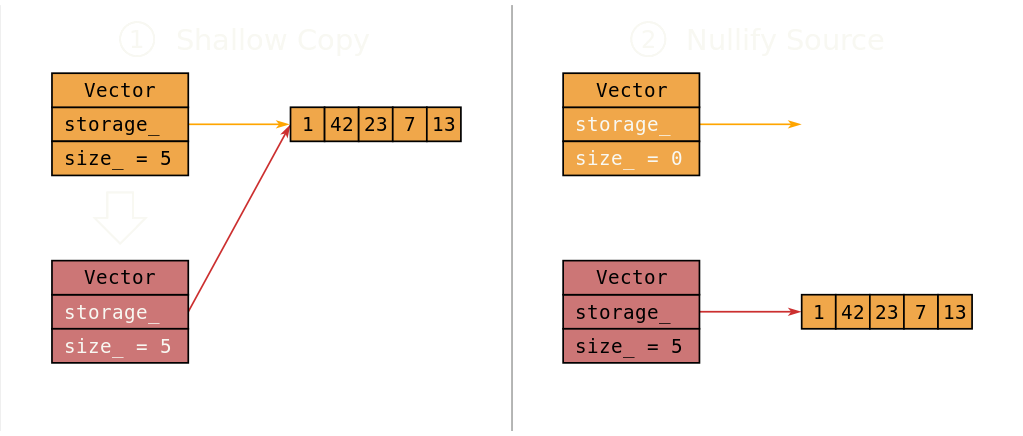
Wouldn't it be more efficient to just transfer the resource? Instead of copying the data, we could just swap the internal pointers and size information. This is the central idea of move semantics.
To get a clear overview of this idea, let's watch the first part of a fantastic CppCon talk by Klaus Iglberger.
Back to Basics: Move Semantics (part 1 of 2) - Klaus Iglberger - CppCon 2019
This video introduces the fundamental problem that move semantics solves. It clearly contrasts expensive deep copies with the efficient 'transfer of content' for temporary objects, using std::vector as the primary example.
Watch from 02:19 to 08:03. Focus on the distinction between copying a named variable (v2 = v1) and transferring content from a temporary (v2 = create_vector()).
The video makes it clear: when the source of an assignment is a temporary object that's about to be destroyed anyway, we should "steal" its resources instead of copying them. But how does the compiler know when it's safe to do this?
The Mechanism: Lvalues, Rvalues, and std::move
To enable move semantics, C++11 introduced a more formal distinction between two types of expressions, building on concepts that have always existed in C/C++:
- lvalue ("left-value"): An expression that refers to a memory location that persists beyond a single expression. It has a name and you can take its address. Think of a variable like
int x;. You can assign to it (x = 5;), so it can appear on the left side of an assignment. - rvalue ("right-value"): An expression that refers to a temporary value that is about to be destroyed. It doesn't have a persistent memory location. Think of literals like
42or the temporary object returned by a function (create_vector()). You can't assign to it (42 = x;is illegal), so it can only appear on the right side of an assignment.
To specifically "catch" rvalues, C++11 introduced the rvalue reference (&&). A function that takes an T&& parameter will be chosen by the compiler only when you pass it an rvalue. This allows us to create special functions—move constructors and move assignment operators—that are only called when it's safe to steal resources from the source.
The next segment of the video explains this mechanism and the true nature of std::move.
Back to Basics: Move Semantics (part 1 of 2) - Klaus Iglberger - CppCon 2019
This section dives into the technical details, explaining lvalues, rvalues, rvalue references (&&), and the crucial role of std::move.
Watch from 08:03 to 17:28. Pay very close attention to the explanation of what std::move actually is: it's not a move, but a static_cast to an rvalue reference. This is a critical 'under the hood' detail.
Key takeaways from that segment:
- Overload resolution distinguishes between lvalues and rvalues.
void func(T&)binds to lvalues.void func(T&&)binds to rvalues.
std::move(x)does not movex. It is an unconditional cast that tells the compiler to treat the lvaluexas if it were an rvalue. It's a promise from you, the programmer, that you are done withxand its resources can be stolen. After usingstd::moveon an object, you should consider it to be in a "valid but unspecified state" and should not use it again without re-initializing it.
The Implementation: Move Constructors and the "Moved-From" State
To make a class movable, you implement a move constructor and a move assignment operator. These take an rvalue reference (T&&) as a parameter. Their job is to transfer ownership of the resources from the source object to *this and leave the source object in a state where it can be safely destroyed.
Back to Basics: Move Semantics (part 1 of 2) - Klaus Iglberger - CppCon 2019
Now let's see how to actually implement a move constructor for a custom class.
Watch from 17:51 to 26:31. Note the two key steps in the move constructor: (1) copy the pointers/handles from the source, and (2) set the source's pointers to nullptr. This second step is vital.
C++'s Non-Destructive Move
A crucial point, given your interest in first principles, is why we have to nullify the source object's pointer. In C++, a move is non-destructive. The moved-from object is not immediately destroyed; its destructor will still be called when it goes out of scope.
This has a profound implication: the moved-from object must be left in a valid state that its destructor can handle. For a pointer member, this means setting it to nullptr, so the destructor doesn't try to delete memory that is now owned by another object (which would lead to a double-free bug).
This is a key design trade-off in C++. For an excellent analysis of this, and how it differs from the "destructive move" model used in a language like Rust, the following article is highly recommended.
C++ Move Semantics Considered Harmful (Rust is better)
This article offers a deep, critical look at the design of C++ move semantics, comparing it to Rust's model. This is perfect for understanding the 'why' behind the implementation details.
Read the sections 'Copy-Deletes and Moves' and 'How Move Is Implemented in C++'. The second section explains the concept of a 'non-destructive move' and why the moved-from object must be left in a valid, destructible state. This directly explains the other.m_str = nullptr; line you saw in code examples.
Move Semantics in Action: std::vector Reallocation and noexcept
Now let's connect all this directly to STL containers. The most significant performance gain comes during the reallocation of a std::vector. When you push_back an element and the vector's capacity is exceeded, it must:
- Allocate a new, larger block of memory.
- Move or copy the existing elements to the new block.
- Deallocate the old block.
The std::vector::push_back method provides a strong exception safety guarantee: if the operation fails (throws an exception), the vector is left unchanged.
Consider what happens if a move constructor could throw an exception. If the vector is moving its elements to a new buffer and the 5th element's move constructor throws, the vector is now corrupted. The first 4 elements are moved (and their originals are now empty), but the rest are not. The original state is lost.
Because of this, if a type's move constructor is not marked as noexcept, std::vector will not use it for reallocation. It will fall back to using the copy constructor, as copying leaves the original elements intact, preserving the strong exception guarantee.
This makes marking your move operations noexcept absolutely critical for performance when using STL containers.
The next two short video clips demonstrate this perfectly. The first explains the theory, and the second shows it in code.
Back to Basics: Move Semantics (part 1 of 2) - Klaus Iglberger - CppCon 2019
Klaus Iglberger explains exactly why noexcept is essential for performance with std::vector due to its strong exception safety guarantee.
Watch from 26:31 to 31:17. This is the most important part of the lesson for understanding the practical application with STL containers. He shows a benchmark with a 60% performance difference.
C++ Weekly - Ep 109 - When noexcept Really Matters
This clip from C++ Weekly provides a live-coded demonstration. You'll see std::vector switch from using copies to moves during reallocation as soon as noexcept is added to the move constructor.
Watch the entire short clip from 03:05 to 04:49. It's a practical and visual confirmation of the theory explained in the previous video.
Test your understanding!
You have a class ResourceHolder that manages a raw file handle (FILE*). You've implemented a move constructor for it. You then create a std::vector<ResourceHolder>. When you push_back enough elements to cause a reallocation, you notice in the debugger that std::vector is calling your copy constructor for each element, not your move constructor, making the process very slow.
What is the most likely reason for this, and how would you fix it?
Show answer
The most likely reason is that your ResourceHolder's move constructor is not marked as noexcept.
std::vector provides a strong exception safety guarantee. If it used a move constructor that could potentially throw an exception, it might leave the vector in a corrupted state if an exception occurred midway through moving elements to a new memory block. To avoid this risk, if the move constructor isn't declared noexcept, std::vector will fall back to using the copy constructor, which is safe but slow.
To fix this, you should ensure your move constructor cannot throw an exception and mark it noexcept:
class ResourceHolder {
    // ...
public:
    ResourceHolder(ResourceHolder&& other) noexcept { // <-- Add noexcept
        // Steal the resource
        // Nullify the source
    }
    // ...
};
This tells std::vector that it can safely use your move constructor during reallocation, unlocking the performance benefits of move semantics.
Conclusion
Move semantics is a C++11 feature designed to solve a very real performance problem. By allowing the efficient transfer of resources from temporary or explicitly "moved-from" objects, it eliminates a huge amount of unnecessary copying, especially within STL containers.
Key Takeaways:
- Copying is expensive for resource-managing types like
std::vectorbecause it involves new heap allocations and element-wise copies. - Move semantics transfers ownership of resources instead of copying them, which is significantly more efficient.
- The mechanism is based on distinguishing lvalues (named objects) from rvalues (temporaries) using rvalue references (
&&). std::move()does not move anything; it is a cast that signals your intent to allow a move.- In C++, moves are non-destructive. The moved-from object must be left in a valid, destructible state (e.g., by nullifying its internal pointers).
- For use with STL containers like
std::vector, it is crucial to mark your move constructor and move assignment operator asnoexceptto enable optimizations during operations like reallocation.
What's Next?
We've now seen two powerful ways the STL achieves performance: through iterator-based compile-time polymorphism and through move semantics to avoid expensive copies. In our next lesson, we will explore another dimension of resource control: implementing a custom allocator for an STL container. This will give you ultimate control over how and where containers like std::vector get their memory, a technique used in high-performance and embedded systems programming.