Hello! Let's continue our journey into the internals of the C++ Standard Template Library.
In our last lesson, we analyzed how std::map and std::unordered_map use vastly different memory layouts—a node-based red-black tree versus a bucket array with linked lists. This raised a fundamental question: if their internal structures are so different, how can a single, generic algorithm like std::find or std::for_each work seamlessly on both?
The answer lies in iterators. Today, we'll explore how iterators provide a brilliant abstraction over these diverse memory layouts. We will focus on the learning outcome: Explain iterator categories (e.g., Input, Forward, Bidirectional, Random Access) and how they enable generic algorithms. You'll discover that iterators are more than just "smart pointers"; they carry compile-time information about their capabilities, which allows the compiler to select the most efficient code for a given task.
The Iterator: A Unified Interface
At its core, an iterator is a generalization of a C pointer. You know how you can use a pointer to traverse an array in C. C++ iterators extend this concept to any container, regardless of its memory layout.
To start, let's watch a segment from a CppCon talk by Nicolai Josuttis, one of the leading experts on the C++ Standard Library. He provides a superb introduction to the core concept of iterators and why they are essential.
Back to Basics: Iterators in C++ - Nicolai Josuttis - CppCon 2023
This video explains the fundamental idea of iterators as an abstraction of pointers, the half-open [begin, end) range convention, and the crucial performance implications for different container types like std::vector and std::list.
Watch from 01:41 to 10:34. Pay close attention to how he connects C-style pointer iteration to C++ iterators and his explanation of why certain operations (like using an index) are efficient for a vector but prohibitively expensive for a list.
As you saw, the key idea is to provide a common interface:
begin(): Gets an iterator to the first element.end(): Gets an iterator to a "past-the-end" position. This is crucial for handling empty containers gracefully (begin() == end()).operator++: Advances the iterator to the next element.operator*: Dereferences the iterator to access the element's value.operator!=/operator==: Compares two iterators.
For a std::vector, begin() might just be a raw pointer to the first element. For a std::list, it's a pointer to the first node, and operator++ involves following that node's next pointer. The beauty is that the code using the iterator doesn't need to know these details.
Why Do We Need Iterator Categories?
The talk highlighted a critical point: while you can increment an iterator on both a vector and a list, you can't efficiently perform random access (e.g., it + 5) on a list. Doing so would require traversing five nodes one by one, an O(N) operation masquerading as an O(1) one. This violates a core C++ design principle: "you don't pay for what you don't use."
To solve this, the C++ standard defines a hierarchy of iterator categories. These categories classify iterators based on the operations they can perform efficiently (in constant time). An algorithm can then declare the minimum category it requires, and the compiler will prevent you from using it with an incompatible iterator.
This diagram shows the hierarchy. Each category inherits the capabilities of the one before it and adds new ones.
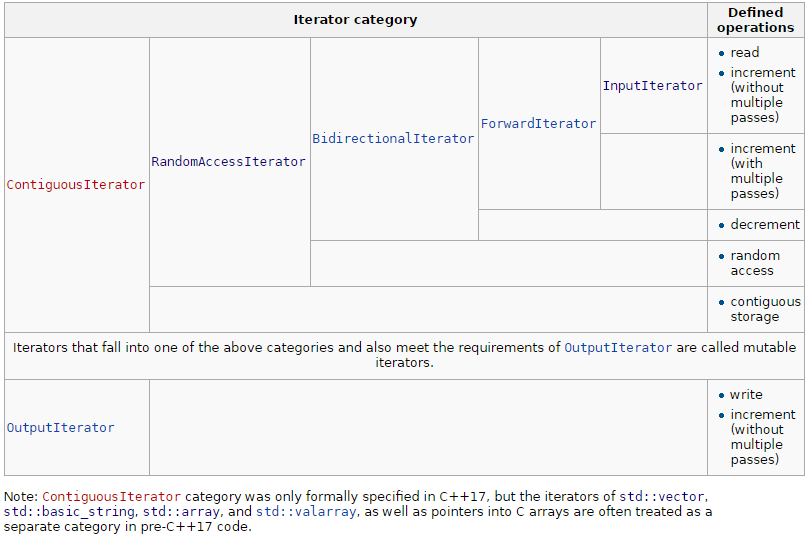
Let's break down these categories. The following reading provides a clear and concise summary of each one.
This section from the CS106L textbook at Stanford provides a detailed breakdown of each iterator category, from Input and Output to Contiguous, listing the operations they support.
Read the section titled 'Iterator Categories'. For each category, focus on the new capability it introduces and think about which container we've studied would provide it (e.g., std::list is bidirectional but not random access).
To summarize:
- Input/Output: The most basic iterators. Input iterators can be read from (like
std::cin), and Output iterators can be written to. They are typically single-pass. - Forward: Can do everything an Input iterator can, but also guarantees you can pass over the same range multiple times.
std::forward_listprovides these. - Bidirectional: Can do everything a Forward iterator can, plus it can be decremented (
--it). This is whatstd::list,std::set, andstd::mapprovide. You can navigate back and forth, but only one step at a time. - Random Access: Can do everything a Bidirectional iterator can, plus it supports pointer-like arithmetic (
it + n,it - n,it[n],it1 < it2). This requires the ability to jump to any element in constant time.std::vectorandstd::dequeprovide these. - Contiguous: A C++17 refinement of Random Access. It guarantees that the elements are actually laid out next to each other in a single block of memory. This is what
std::vector,std::string, andstd::arrayprovide, and it allows for safe conversion to a C-style raw pointer.
How Categories Enable Generic Algorithms
Now for the part that connects directly to your interest in "under the hood" mechanics. How does a generic algorithm use this category information to be efficient?
Let's consider std::advance(it, n), which moves an iterator it forward by n steps.
- If
itis a Random Access Iterator, the most efficient implementation isit += n;. - If
itis only a Bidirectional or Forward Iterator, the only way is to execute++it;in a loopntimes.
The C++ standard library achieves this compile-time optimization through a technique called tag dispatching.
- Every iterator implementation must define its category using a special "tag" type (e.g.,
std::random_access_iterator_tag). These tags are just empty structs. - A generic algorithm, like
std::advance, doesn't perform the logic itself. It calls a helper function, passing along the iterator's category tag. - The library provides multiple overloaded versions of this helper function, each one taking a different tag type as an argument.
- The compiler uses standard overload resolution rules to pick the most specific function. Since
std::random_access_iterator_taginherits fromstd::bidirectional_iterator_tag, an iterator with a random access tag will match the more specialized random-access version of the function, while a bidirectional iterator will fall back to the more general version.
This is pure compile-time polymorphism. There is no runtime overhead, no if statements, no virtual functions. It's a powerful demonstration of how C++ uses its type system to generate highly optimized code.
The following article gives a fantastic explanation of this mechanism.
Tutorial on tag dispatching | Crazy Eddie's Crazy C++
This article, 'Tutorial on tag dispatching', explains the mechanism in detail, using std::advance and iterator categories as the primary example. It's a perfect deep dive into the 'how'.
Read the sections 'Concepts and tags', 'Concept refinement', and 'Tag dispatching'. Focus on how the inheritance hierarchy of the tag structs allows the compiler to resolve the advance function call to the most efficient implementation.
The key takeaway is that the tags turn conceptual capabilities into concrete types that the C++ compiler's overload resolution engine can work with directly. It's an elegant bridge between high-level generic code and low-level machine efficiency.
To see where this tag comes from in practice, the next short video clip shows a developer implementing a custom iterator and adding the necessary type definitions, including iterator_category.
STL C++ Iterators - Writing an iterator from scratch | Modern Cpp Series Ep. 138
This video shows the practical side of defining an iterator. Watch how the author adds the required using declarations, including iterator_category, to make the custom iterator conform to the standard library's expectations.
Watch from 18:12 to 20:57. Notice the use of std::forward_iterator_tag. This is the 'tag' that std::iterator_traits would expose and that the tag dispatching mechanism would use.
Test your understanding!
You need to write a generic function, my_binary_search, that performs a binary search for a value in a sorted range [first, last). What is the minimum iterator category that first and last must belong to for this to be possible? Why?
(Hint: Think about the operations a binary search algorithm needs to perform. It needs to find the middle element of any sub-range.)
Show answer
The minimum category is Random Access Iterator.
A binary search algorithm repeatedly needs to find the middle element of a given range. To do this efficiently, it must be able to calculate a midpoint, like mid = first + (last - first) / 2. The operations of subtracting two iterators to get a distance (last - first) and adding an offset to an iterator (first + ...) are only guaranteed to be constant-time operations for Random Access Iterators.
While you could technically find the middle of a bidirectional range by traversing from both ends, it would be extremely inefficient (O(N)), defeating the purpose of a binary search. Therefore, any practical and efficient implementation requires random access. This is why std::binary_search and std::sort require Random Access Iterators.
Conclusion
Today, we bridged the gap between diverse container implementations and generic algorithms. Iterators provide the glue, but it's their categories that make this connection both safe and performant.
Key Takeaways:
- Iterators are generalized pointers that provide a uniform interface for traversing containers (
begin,end,++,*). - Iterator categories classify iterators based on their efficient capabilities, which are dictated by the underlying container's memory layout. The hierarchy is: Input -> Forward -> Bidirectional -> Random Access -> Contiguous.
- Generic algorithms specify the minimum iterator category they require, ensuring you don't accidentally use an O(N) operation where an O(1) one is expected.
- The C++ library uses tag dispatching—a compile-time mechanism based on function overloading and empty tag structs—to select the most efficient algorithm implementation based on the iterator's category.
What's Next?
We've now seen how the STL is designed for performance, from cache-friendly data structures to the compile-time optimizations enabled by iterator categories. In our next lesson, we will cover another critical performance feature: move semantics. You'll learn how std::move allows containers and other objects to efficiently transfer ownership of resources, avoiding expensive copies, especially during operations like std::vector reallocation.