Hello! In our last lesson, we traced the journey of a stock from its creation in the primary market to its trading life in the secondary market. Now, let's turn our attention to the cast of characters who populate this secondary market.
Today's objective is to identify the different types of market participants and their typical roles. We will categorize investors into four main groups: Retail investors, High Net-worth Individuals (HNIs), Domestic Institutional Investors (DIIs), and Foreign Institutional Investors (FIIs). Understanding who these players are, their motivations, and their relative market power is crucial. For someone with your goal of developing quantitative strategies, this isn't just trivia; it's about understanding the fundamental drivers of market dynamics.
The Two Sides of the Market: Individuals and Institutions
At the highest level, the market is composed of two broad classes of investors: those investing their own money for personal reasons, and large organizations managing pooled funds on behalf of others. This is the fundamental distinction between retail and institutional investors.
This infographic provides a concise summary of their key differences.
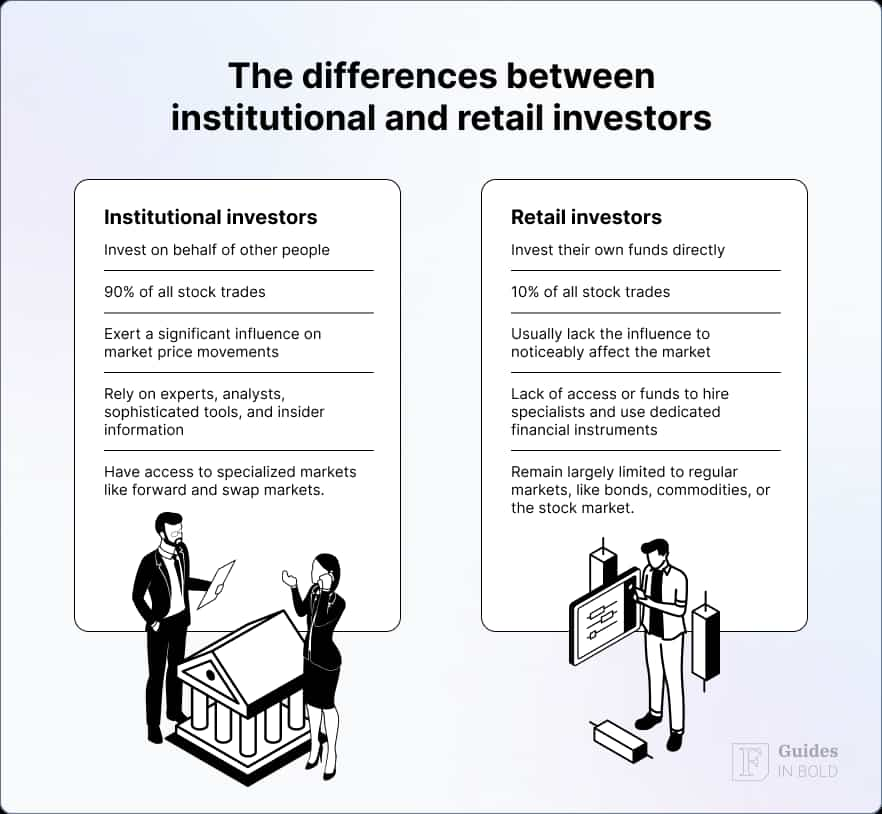
As you can see, the scale of operations, access to resources, and market influence are vastly different. While institutional investors execute massive trades that can single-handedly move markets, the power of retail investors lies in their collective action. Let's now break these categories down further within the specific context of the Indian market.
Defining the Players in the Indian Equity Market
To get a precise understanding of each participant type, we'll use definitions rooted in Indian regulations and market practice. The Zerodha Varsity module on "Introduction to Stock Markets" provides a good initial list.
[PDF] Introduction to stock markets - AWS
This document provides a foundational overview of the Indian stock market. We will use it to list the main categories of participants.
Please read the short section 2.2 - Stock Market Participants (page 9). This section classifies participants into five groups, which we will refine and explore in more detail.
The document you just read lists Domestic Retail Participants, NRIs, Domestic Institutions, Domestic Asset Management Companies, and Foreign Institutional Investors. We can structure these into four main, functionally distinct groups.
1. Retail Investors
These are individual investors, like you and me, who buy and sell securities for their personal accounts. SEBI provides a specific quantitative definition for this category, particularly in the context of IPOs.
Retail VS Institutional Investors
This article from Equirus Wealth clearly defines the various investor categories in India and discusses their evolving roles.
First, read the section Who is a Retail Investor? to understand their definition, especially the SEBI rule involving a ₹2 lakh threshold for IPOs.
The key takeaway is that retail investors trade in smaller quantities. While a single retail investor has negligible market impact, their collective behavior—especially now with the ease of digital trading—has become a formidable force in the Indian markets.
2. High Net-worth Individuals (HNIs)
HNIs are also individual investors, but they operate with significantly more capital. In the context of IPOs, the HNI category (also called Non-Institutional Investors or NIIs) is for individuals who invest more than the ₹2 lakh retail limit. They represent a bridge between the small-scale retail investor and the large-scale institution.
The following map illustrates the geographical concentration of IPO share allotments for both Retail and HNI investors. Notice the similar, but not identical, patterns, reflecting their distinct but related nature.

3. Domestic Institutional Investors (DIIs)
This category includes large Indian organizations that invest pooled funds in the Indian market.
Retail VS Institutional Investors
Let's return to the Equirus Wealth article to define institutional investors.
Read the definitions provided under the section Who are Institutional Investors?. This will introduce you to the two main sub-categories: FIIs and DIIs.
The most prominent DIIs are:
- Asset Management Companies (AMCs): These are the mutual fund houses (e.g., SBI Mutual Fund, HDFC AMC) that collect money from retail investors through schemes like SIPs and invest it in the market.
- Insurance Companies: Firms like Life Insurance Corporation of India (LIC) invest the premiums they collect into the markets.
- Banks and other Financial Institutions: These entities also participate in the market as part of their treasury operations.
4. Foreign Institutional Investors (FIIs)
These are entities based outside of India that invest in the Indian market. They are a critical source of capital but can also introduce volatility. It's important to note that the term Foreign Portfolio Investor (FPI) is now more commonly used, and for our purposes, FII and FPI can be considered interchangeable.
FIIs vs. DIIs: The Big Picture
Understanding the dynamic between FIIs and DIIs is key to analyzing market trends. They are the two largest forces shaping the market's direction. The following video provides an excellent breakdown of their definitions, types, and market impact.
FIIs VS DIIs | How Domestic and Foreign Institutional Investors Impact The Market!
This video from 5paisa clearly explains the distinction between FIIs and DIIs and their respective influence on the Indian stock market.
Please watch the following segments: Definition of FIIs: This part defines FIIs (or FPIs) and categorizes them. Definition of DIIs: This segment breaks down the different types of domestic institutions. Key Differences: Focus on the distinctions based on location, restrictions, and time horizon. Market Impact: This is the most crucial part, explaining how their actions affect market volatility and liquidity.
The Shifting Power Dynamic
Historically, FII flows were the primary determinant of the Indian market's direction. When FIIs bought, the market rallied; when they sold, it fell. However, this dynamic is changing. The rise of domestic investment, particularly through mutual fund SIPs from retail investors, has made DIIs a powerful counterbalancing force.
The Equirus Wealth article you looked at earlier has an excellent section that quantifies this shift.
Retail VS Institutional Investors
Now let's examine the data behind the changing roles of these market participants.
Read the sections titled Percentage of Holding and Future Outlook. Pay close attention to the data comparing the percentage share of FIIs versus the combined share of DIIs and retail investors over time.
The data clearly shows that even when FIIs are selling heavily, strong buying from DIIs and retail investors can support the market, making it more resilient to foreign capital outflows. From a quantitative perspective, this means that models predicting market direction must now weigh domestic flows just as heavily, if not more so, than foreign flows.
Conclusion
We have now dissected the secondary market into its core constituent participants. Each group operates with different resources, constraints, and objectives, creating the complex and dynamic system you aim to analyze.
Here are the key takeaways:
- Four Main Groups: The Indian market consists of Retail investors, High Net-worth Individuals (HNIs), Domestic Institutional Investors (DIIs), and Foreign Institutional Investors (FIIs/FPIs).
- Retail and HNIs: These are individuals investing their own capital. Retail investors are defined by smaller investment sizes (e.g., < ₹2 lakh in an IPO), while HNIs invest larger sums. Their collective action has become a significant market force.
- DIIs: These are Indian institutions like mutual funds and insurance companies. They are often seen as a stabilizing force, channeling domestic savings into the market with a typically longer-term perspective.
- FIIs: These are foreign entities investing in India. They bring large capital flows but can also increase volatility, as their decisions are influenced by global factors and currency risk.
- Interplay: The modern Indian market is characterized by the dynamic interplay between FIIs and DIIs, with domestic investors increasingly acting as a counterbalance to foreign flows.
In our next lesson, we will get even more granular. Now that we know who trades, we'll explore how their trades are processed. We'll examine the T+1 settlement cycle and the role of the demat account, completing our foundational understanding of the mechanics of a stock transaction.