Welcome to your second lesson. In our previous session, we established the institutional framework of the Indian stock market by examining the roles of SEBI, the exchanges, and the depositories. Now, we'll build on that foundation to see how these institutions facilitate the movement of capital.
Today's objective is to map the complete flow of capital, starting from when a company first raises funds from the public to the subsequent daily trading of its shares. We will dissect the financial ecosystem into two core components: the primary market, where new securities are created, and the secondary market, where they are traded. Understanding this distinction is fundamental to grasping how the stock market functions as a whole.
The Life Cycle of a Stock: From Creation to Trading
A company's journey to becoming publicly traded is a structured process driven by the need for capital to fund growth. This process neatly divides the market into two distinct, yet connected, arenas.
To begin, let's watch a short video from Zerodha that provides a clear and concise overview of both the primary and secondary markets. Pay close attention to the analogy of buying a new car versus a used car; it's a simple but effective way to frame the core difference.
What are the Primary and Secondary markets?
This video provides an excellent introduction to the core concepts of this lesson.
Watch the entire video. Focus on: The definition of the primary market and its purpose, as explained in the example of company ABC. The definition of the secondary market and the explanation of its role in providing liquidity from this segment. The direct comparison of the two markets from this section.
The video gives us a high-level map. Now, let's zoom in on each market to understand the mechanics.
1. The Primary Market: Raising Capital
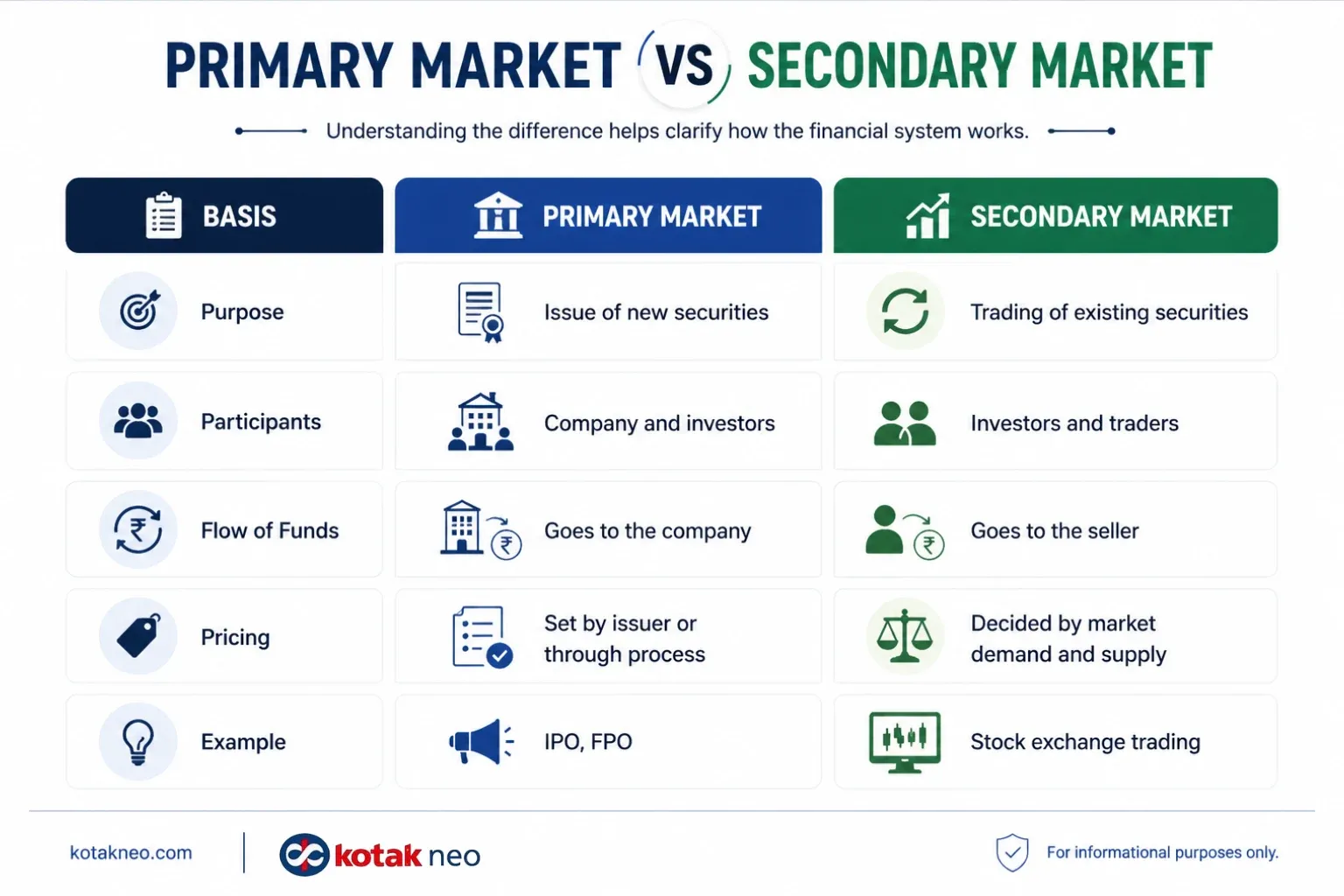
The primary market is the segment of the capital market where a company, for the first time, sells new securities to the public to raise funds. The most common method for this is the Initial Public Offering (IPO). This is the process where a private company transforms into a public one, allowing its shares to be owned by the general public.
The core function of the primary market is capital formation. The money investors pay for these new shares goes directly to the company, which can then use it for expansion, debt repayment, or other corporate purposes.
To understand the detailed, multi-step process of an IPO, let's turn to an excellent article from Zerodha. This will connect directly to the institutions we discussed in the last lesson.
What is IPO? Understanding initial public offerings, types & process
This article breaks down the entire IPO process, from a company's initial decision to the final listing of its shares.
Please read the section titled The IPO journey. As you read, notice how the institutions from our previous lesson play their parts: SEBI: The company must file its Draft Red Herring Prospectus (DRHP) with SEBI for approval. Exchanges (NSE/BSE): The company selects the exchange(s) where its shares will be listed and traded. Depositories (CDSL/NSDL): After the allotment, the shares are credited to the investors' demat accounts, which are maintained by the depositories.
As you can see, an IPO is a highly regulated and complex process that culminates in the company receiving capital and its shares being distributed to investors.
2. The Secondary Market: Trading Securities
Once the IPO is complete and the shares are listed on a stock exchange like the NSE or BSE, they enter the secondary market. This is the market you are likely most familiar with—it's where the daily buying and selling of stocks occurs.
The crucial distinction here is the flow of funds. In the secondary market, transactions occur between investors. When you buy 100 shares of a company on the stock exchange, you are buying them from another investor who is selling them. The money flows from you to the seller, not to the company. The company is not a direct participant in these transactions.
The secondary market provides two essential functions:
- Liquidity: It allows investors to buy or sell securities at any time during market hours, converting their holdings into cash and vice versa.
- Price Discovery: The interaction of buyers and sellers, driven by supply and demand, determines the fair market price of a security. This is a dynamic process where the stock's price reflects the collective sentiment and information available to all market participants.
Primary vs. Secondary Market: A Summary
The relationship between these two markets is sequential. The primary market creates the securities, and the secondary market provides the platform for them to be traded. A healthy secondary market is vital, as the promise of liquidity encourages investors to participate in the primary market in the first place.
This infographic provides a clear, side-by-side comparison of the key characteristics of each market.
Mapping the Complete Flow of Capital
Now, let's visualize the entire journey of capital through the financial system, from the company's need for funds to the ongoing trading of its stock.

Let's trace the path shown in the flowchart:
- A Company needs capital: It decides to issue shares to the public.
- Primary Market: The company launches an IPO. An investor subscribes to the IPO and buys the shares directly. The investor's money goes to the company.
- Listing: The shares are now listed on a stock exchange (e.g., NSE/BSE).
- Secondary Market: The initial investor decides to sell their shares. They place a sell order through their broker.
- Another Investor wants to buy the shares. They place a buy order.
- The Exchange matches the buy and sell orders. The ownership of the shares is transferred from the seller's demat account to the buyer's demat account, and the money is transferred from the buyer to the seller.
This completes the cycle, demonstrating how capital is first raised by the company and then how the ownership of the resulting shares is traded among investors.
Conclusion
In this lesson, we have mapped the entire lifecycle of a stock from its creation to its daily trading. You should now have a clear understanding of the distinct roles of the primary and secondary markets.
Here are the key takeaways:
- Primary Market: This is where new securities are issued. Its main purpose is for companies to raise capital directly from investors. Transactions are between the issuing company and the investors.
- Secondary Market: This is where existing securities are traded. Its main purpose is to provide liquidity and facilitate price discovery. Transactions are between investors, and the company is not directly involved.
- The Flow of Capital: In an IPO (primary market), money flows from investors to the company. In subsequent trading (secondary market), money flows between investors.
In our next lesson, we will delve deeper into the secondary market by identifying the different categories of participants who drive the buying and selling—from small retail investors to large domestic and foreign institutions—and understanding their respective roles.