Hello! Welcome to your first lesson. We're kicking off your journey into the world of finance by building a solid, foundational understanding of the Indian stock market. Think of this first module as learning the architecture of a complex system before you begin writing code to interact with it.
Today, we will focus on the essential building blocks of the market ecosystem. Our goal is to describe the roles of the three key types of institutions that make the market function: the regulator (SEBI), the trading venues (the stock exchanges, NSE & BSE), and the electronic custodians of assets (the depositories, CDSL & NSDL). Understanding who they are and what they do is the first step toward navigating the market intelligently.
1. The Regulator: SEBI
Every organized system, from a computer's operating system to a national economy, needs a set of rules and an authority to enforce them. In the Indian financial markets, this crucial role is played by the Securities and Exchange Board of India, or SEBI. SEBI acts as the market's watchdog, ensuring fairness, transparency, and the protection of investor interests.
To get a clear picture of SEBI's mandate and powers, let's start with a short, informative video from Zerodha.
What is SEBI? Understanding its role in India's stock market
This video, "What is SEBI?", provides an excellent overview of the regulator's purpose, history, and key functions.
As you watch, focus on the answers to these questions: Why was SEBI created? Pay attention to the discussion of the market's state before 1992, from this section. Which entities does SEBI regulate? Note the list of organizations mentioned between 01:33 and 02:08. What are its three primary functions? The video breaks this down clearly starting at this point.
As the video explained, SEBI's authority comes from legal statutes. For a more formal definition of its role, let's look at a brief excerpt from an investor booklet published by CDSL.
This document outlines the legal framework of the Indian securities market.
Read the first page of the PDF. Focus on the paragraph that begins with this text. It formally states SEBI's three-part mandate: protecting investors, promoting market development, and regulating the market.
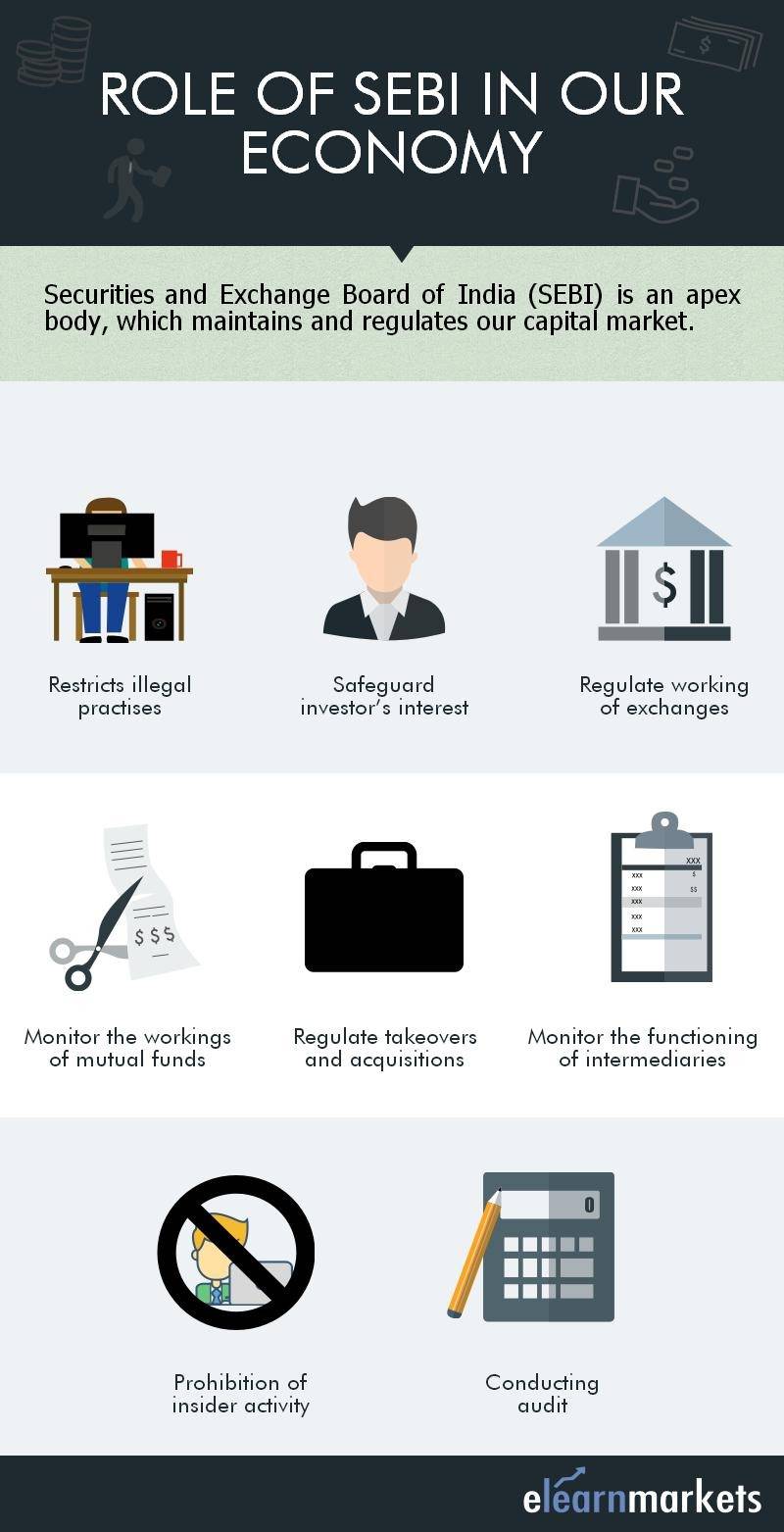
To summarize SEBI's responsibilities, consider the following infographic. It visually lays out the key functions we've just discussed, from preventing illegal practices to safeguarding investor interests.
2. The Marketplaces: Stock Exchanges (NSE & BSE)
Now that we understand the role of the regulator, let's turn to the marketplaces themselves: the stock exchanges. A stock exchange is a centralized, regulated platform where financial instruments like stocks and derivatives are bought and sold. Its core functions are to facilitate efficient price discovery based on supply and demand and to provide liquidity, which is the ability to buy or sell an asset quickly without significantly affecting its price.
In India, the two primary stock exchanges are the National Stock Exchange (NSE) and the BSE Ltd. (formerly Bombay Stock Exchange).
The official SEBI investor portal provides a clear and concise description of what these Market Infrastructure Institutions (MIIs) do.
This article from SEBI's investor portal details the pillars of the financial ecosystem.
On this webpage, please read the sections titled "Market Infrastructure Institutions (MIIs)" and "Part I: Stock Exchanges – Driving Capital Market Efficiency". Pay close attention to the five key roles listed and the descriptions of the NSE and BSE.
As you read, you'll have noted that NSE and BSE are the primary venues for equity trading in India. The NIFTY 50 (on NSE) and SENSEX (on BSE) are the benchmark indices that represent the performance of the largest companies listed on these exchanges, serving as a proxy for the health of the overall market.
3. The Custodians: Depositories (NSDL & CDSL)
So, you've placed an order through your broker, and it has been executed on the NSE or BSE. You are now the owner of, say, 10 shares of a company. But where are these shares actually held?
In the modern electronic era, they aren't stored in a physical vault or with your broker. They are held in a dematerialized (or "demat") form by specialized institutions called depositories. A depository functions like a bank for your securities. It holds your shares, bonds, and other instruments electronically in your Demat account, eliminating the risks associated with physical certificates (like theft or forgery) and enabling rapid, electronic settlement of trades.
India has two main depositories:
- National Securities Depository Limited (NSDL): Primarily promoted by the NSE.
- Central Depository Services Limited (CDSL): Primarily promoted by the BSE.
Let's return to the SEBI article to understand their function.
We will now read the second part of the same SEBI article.
Scroll down to "PART II: DEPOSITORIES – Securing Investor Assets". Read this section to understand the roles of depositories and the descriptions of NSDL and CDSL.
An important point to note is that you, as an investor, do not interact with NSDL or CDSL directly. You interact with them through a Depository Participant (DP). Your stockbroker is typically also your DP. When you open a trading and Demat account with a broker, they are acting as the DP to facilitate the opening and maintenance of your account with either NSDL or CDSL.
The following diagram illustrates this three-way relationship.

Conclusion
In this lesson, we've dissected the core architecture of the Indian stock market. You now know the key entities and their distinct responsibilities:
- SEBI (The Regulator): The government-mandated body that creates and enforces the rules of the market to ensure it is fair, efficient, and safe for investors.
- Stock Exchanges (NSE & BSE - The Marketplaces): The regulated platforms where the actual buying and selling of securities takes place, enabling price discovery and liquidity.
- Depositories (NSDL & CDSL - The Custodians): The institutions that hold securities in electronic (demat) form and manage the transfer of ownership, acting as the secure bookkeepers of the market.
With this foundational map of the market ecosystem in place, we are ready to explore how capital flows through it. In our next lesson, we will distinguish between the primary market, where companies issue new shares to the public for the first time (like in an IPO), and the secondary market, where those shares are traded daily on the exchanges we discussed today.