Welcome to your next lesson. In our previous session, we identified the key participants in the Indian stock market—from individual retail investors to large domestic and foreign institutions. Now that we know who is trading, we will explore the fundamental mechanics of how their transactions are processed.
Today's objective is to explain the mechanics of the T+1 settlement cycle and the function of a demat account. This is the plumbing of the market ecosystem. For your goal of developing quantitative strategies, understanding this operational backbone is not just a formality; it's about knowing how the system that generates your data actually works, from the execution of an order to the final transfer of ownership.
Part 1: Your Digital Vault for Securities
Before the digital era, owning shares meant holding physical paper certificates. This system was slow, inefficient, and fraught with risks like theft, forgery, and damage. The solution was "dematerialization"—the process of converting these physical certificates into an electronic format.
The Demat and Trading Accounts
The cornerstone of modern trading is a pair of linked accounts: the Demat Account and the Trading Account. It is crucial to understand their distinct functions.
- A Demat Account (short for Dematerialized Account) is where your securities (like shares, bonds, and mutual funds) are held in electronic form. Think of it as a secure digital vault or a specialized bank account, but for holding investments instead of money.
- A Trading Account is the facility you use to place buy and sell orders on the stock exchange. It's your interface with the market.
To get a clear understanding of their roles and the history behind them, please watch the following video from Zerodha.
What is a demat account and how does it work?
This video explains the concept of a Demat account, the problems it solved, its benefits, and the crucial distinction between a Demat and a trading account.
Pay close attention to these segments: The introduction to what a Demat account is. The explanation of the pre-Demat era and the problems with physical shares. The distinction between Demat and Trading accounts, which uses a helpful analogy of a savings account and an ATM.
The video you watched highlighted the separate but connected roles of these two accounts. The infographic below provides a concise visual summary of their differences, how they are linked with your bank account, and the lifecycle of a transaction.
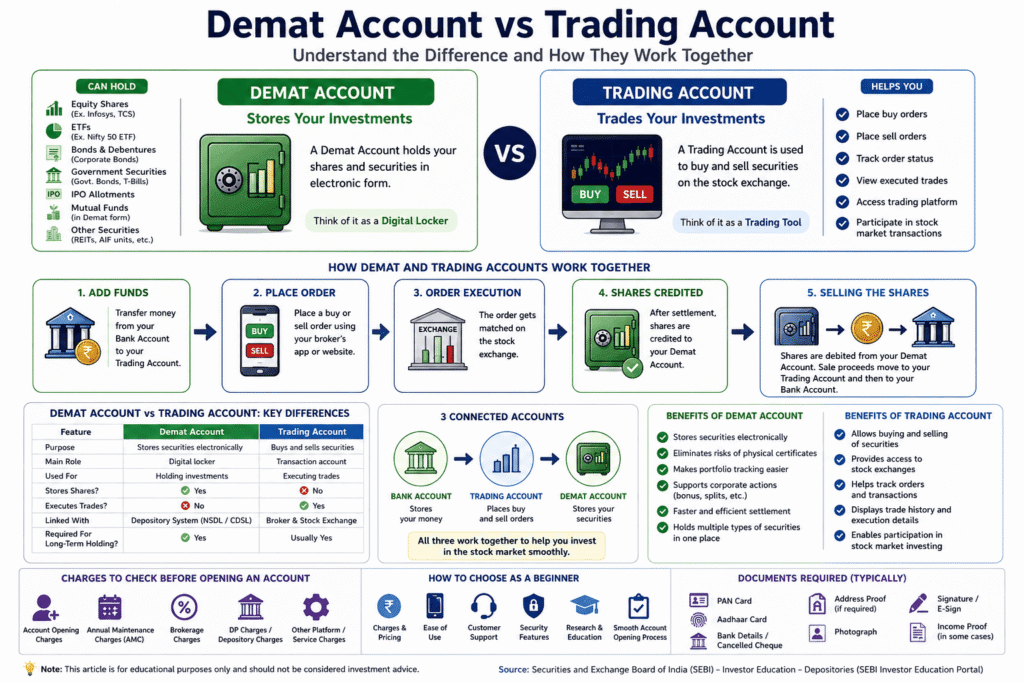
To solidify this, let's look at the formal definitions and the institutions involved. Your broker typically acts as a Depository Participant (DP), which is an agent of one of India's two central depositories: NSDL (National Securities Depository Limited) or CDSL (Central Depository Services Limited). The DP opens and manages your Demat account, which is held with the central depository.
For a more detailed textual explanation of this structure, please review the following section from the Zerodha Varsity module.
[PDF] Introduction to stock markets - AWS
This reading defines the key entities—Depository and Depository Participant (DP)—and explains how your trading account, Demat account, and bank account are interlinked.
In Chapter 3, "Market Participants," find section 3.3. Read the entire section from "Depository and Depository Participants". Focus on the analogy of property papers and how the Demat account functions as a digital vault.
Part 2: The T+1 Settlement Cycle
Now that we understand where shares are stored and how trades are initiated, let's trace the journey of a transaction from execution to final settlement. This process is governed by the settlement cycle.
India operates on a T+1 settlement cycle for equities, which means trades are settled one business day after the trade is executed. This is one of the fastest settlement cycles among major global economies.
To understand the history, mechanics, and key players in this process, the following article provides an excellent overview.
Settlement Cycle in India: T+1, T+0 & What It Means for Your Capital
This article from Razorpay's blog breaks down the settlement cycle, its evolution in India, and the step-by-step process of how a trade is settled.
Please read the following sections: The first section, which defines the settlement cycle and the 'T+1' terminology. The section on the evolution of settlement in India, which highlights the recent shift to T+1 and the pilot for T+0. The detailed breakdown titled "How the Settlement Process Actually Works." This explains the roles of the exchange, clearing corporation, and depositories.
The process you just read about involves a seamless, automated coordination between several entities. Here is a simplified visual representation of the flow of funds and shares in the T+1 cycle.
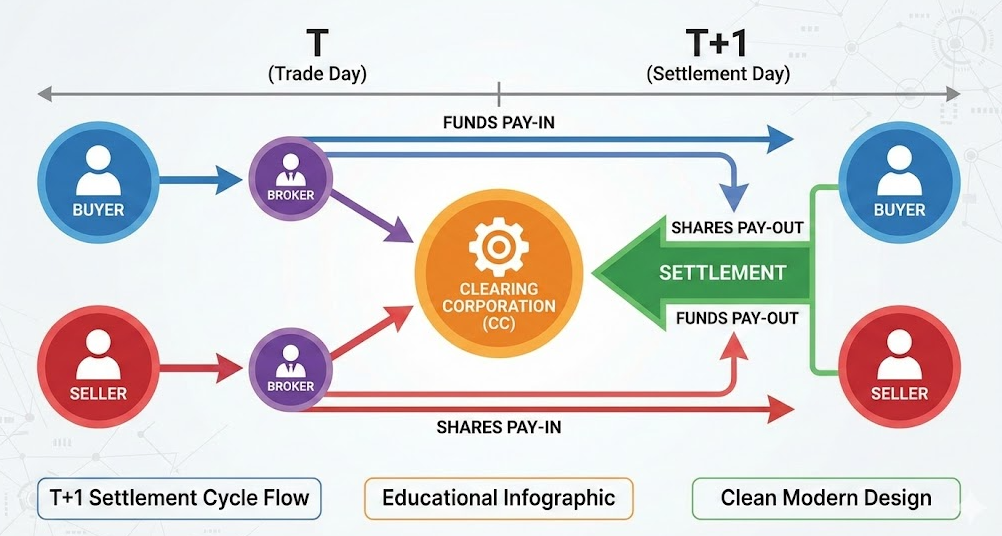
Let's synthesize this into a clear sequence of events for a 'buy' transaction:
-
T Day (Trade Day):
- You place a 'buy' order for a stock through your broker's trading account.
- The Stock Exchange (NSE/BSE) matches your order with a corresponding 'sell' order. The trade is executed.
- Your broker debits the transaction amount from your trading account.
-
End of T Day (Clearing):
- The Clearing Corporation (e.g., ICCL or NSCL) acts as a central counterparty. It calculates the net obligations for every broker, determining who needs to deliver which shares and how much money. This is a critical risk management step, as the clearing corporation guarantees the settlement of all trades.
-
T+1 Day (Settlement Day):
- Pay-in: The seller's broker delivers the shares from the seller's Demat account to the Clearing Corporation. Your broker delivers the funds.
- Pay-out: The Clearing Corporation delivers the shares to your broker, who then credits them to your Demat account. The funds are delivered to the seller's broker.
By the end of T+1, the shares appear in your Demat account, and you are their legal owner. The entire process, which once took weeks, is now completed in about 24 hours.
Conclusion
In this lesson, we've demystified the operational core of the stock market. You now understand the precise roles of the accounts and institutions that facilitate every single trade.
Here are the key takeaways:
- Demat vs. Trading Account: The Demat account is for storing securities electronically (like a vault), while the trading account is for executing buy and sell orders (like a remote control for the market).
- Key Institutions: Depositories (NSDL/CDSL) are the ultimate holders of all dematerialized securities, while Depository Participants (brokers) provide you with access to them.
- T+1 Settlement: This is the process where, one business day after a trade is executed, the legal ownership of shares is transferred to the buyer's Demat account and funds are transferred to the seller's account.
- Central Counterparty: The Clearing Corporation is essential for mitigating risk. It guarantees that the trade will be settled even if one party defaults on its obligation.
Now that we've established how trades are executed and settled, we can turn our attention to the product of this entire process: market data. In our next lesson, we will explore the different types of data generated by the exchange—tick data, Level 2 order book data, and end-of-day (EOD) data. This will be the raw material for the quantitative models you aim to build.