Welcome to our next lesson. In the previous session, we examined the mechanisms exchanges use to manage extreme volatility—circuit limits and trading halts. These are the "rules of the road" that dictate when trading can happen. Today, we shift our focus from the rules of participation to the costs of participation. Every transaction you execute, no matter how small, incurs a series of costs that are deducted from your gross profit.
The learning outcome for this lesson is to be able to calculate brokerage, STT, GST, and other transaction costs on Indian equity trades. For someone with your background in software engineering and aspirations in quantitative finance, this is not just an accounting exercise. These transaction costs are a fundamental parameter in any trading algorithm. A strategy that appears profitable on paper can easily become unprofitable once these real-world costs are factored in. Understanding them molecule by molecule is the first step toward building a robust backtesting engine.
The Myth of "Zero Cost" Trading
In the age of discount brokers, you'll often see advertisements for "zero brokerage" trading. While the brokerage fee itself might be zero for certain types of trades, it's a common misconception to think that trading is free. Several other mandatory charges and taxes are levied on every transaction.
To get a quick sense of this, watch the introductory part of the following video from the Labour Law Advisor channel. It effectively debunks the idea that your gross profit from a trade is what you actually take home.
🔴Upstox Vs Zerodha | HIDDEN charges & Brokerage | Zerodha Vs Upstox | Demat a/c कहाँ खुलवाएं
This video discusses the 'hidden' costs beyond brokerage.
Watch the first 40 seconds, where the presenter sets up a simple profit scenario and highlights that the net profit will be lower than expected due to various charges.
As the video points out, a multitude of small charges—levied by the government, the regulator, and the exchanges themselves—collectively create a "cost hurdle" that every trade must overcome to be profitable. Let's now systematically dissect each of these costs.
Deconstructing Transaction Costs
Every trade involves several charges that are calculated based on the transaction's value, or "turnover."
Turnover is the total monetary value of a transaction.
- Buy Turnover = Buy Price × Quantity
- Sell Turnover = Sell Price × Quantity
- Total Turnover = Buy Turnover + Sell Turnover
Most charges are levied as a small percentage of this turnover. An excellent, comprehensive guide to these charges is provided by Angel One. We will use it as our primary reference.
List of all Stock Market Trading Fees and Charges in India
This article from Angel One provides a detailed breakdown of the various fees and taxes involved in trading on Indian stock exchanges.
Please read through the article to familiarize yourself with the names and purposes of the different charges. We will focus on the following sections: Brokerage fees Securities Transaction Tax (STT) SEBI Turnover Fees Stamp Duty Transaction Charges Goods and Services Tax (GST) As you read, pay close attention to the distinction between charges for Equity Delivery and Equity Intraday trading.
Now that you have an overview, let's consolidate this information and organize it from a quantitative perspective. For this, the documentation of a Python brokerage calculator on GitHub is particularly useful, as it presents the information in a structured, programmatic way.
GitHub - tahseenjamal/zerodha_brokerage_calculator · GitHub
This GitHub repository readme provides a concise, tabular summary of all charges and their rates, which is ideal for algorithmic implementation.
Focus on two tables in this document. First, review the Charges Calculated table for a clear description of each component. Then, study the Charge Rates by Segment table, which neatly contrasts the rates for Intraday vs. Delivery trades. This table is a perfect cheat sheet.
The Anatomy of a Trade's Cost
Let's synthesize what we've learned from these resources into a clear structure. The costs can be grouped into several categories. We'll focus on Equity Intraday (buying and selling the same stock on the same day) and Equity Delivery (holding a stock for more than one day).
Here is a breakdown of the key charges for a trade on the NSE:
-
Brokerage:
- Charged by your stockbroker (e.g., Zerodha, Angel One).
- Delivery: Typically ₹0 with discount brokers.
- Intraday: A percentage of turnover (e.g., 0.03%) or a flat fee (e.g., ₹20) per executed order, whichever is lower. This
min(percentage, flat_fee)logic is important for modeling.
-
Securities Transaction Tax (STT):
- A direct tax levied by the central government.
- Delivery: 0.1% on both buy and sell turnover.
- Intraday: 0.025% on the sell side only.
-
Exchange Transaction Charge:
- Charged by the stock exchange (NSE/BSE) for using their platform.
- For NSE, it's approximately 0.00325% on both buy and sell turnover for both intraday and delivery.
-
SEBI Turnover Charges:
- A fee charged by the market regulator, SEBI.
- ₹10 per crore of turnover (which is 0.0001%) on both buy and sell.
-
Stamp Duty:
- A state government tax, now standardized across the country for securities.
- Delivery: 0.015% on the buy side only.
- Intraday: 0.003% on the buy side only.
-
Goods and Services Tax (GST):
- An indirect tax. Crucially, it is not levied on the trade's turnover.
- It is calculated at 18% on the sum of
(Brokerage + Exchange Transaction Charge + SEBI Fees).
-
Depository Participant (DP) Charges:
- This applies only to delivery trades.
- When you sell shares held in your Demat account, a flat fee is charged by the Depository (CDSL/NSDL) and your broker. This is a fixed amount (e.g., ₹13.5 + GST) per company (scrip) sold, regardless of the number of shares or their value. It is charged only on the sell leg.
The output from a typical online brokerage calculator, like the ones shown below, summarizes these charges. Notice how STT is a significant component of the total cost.
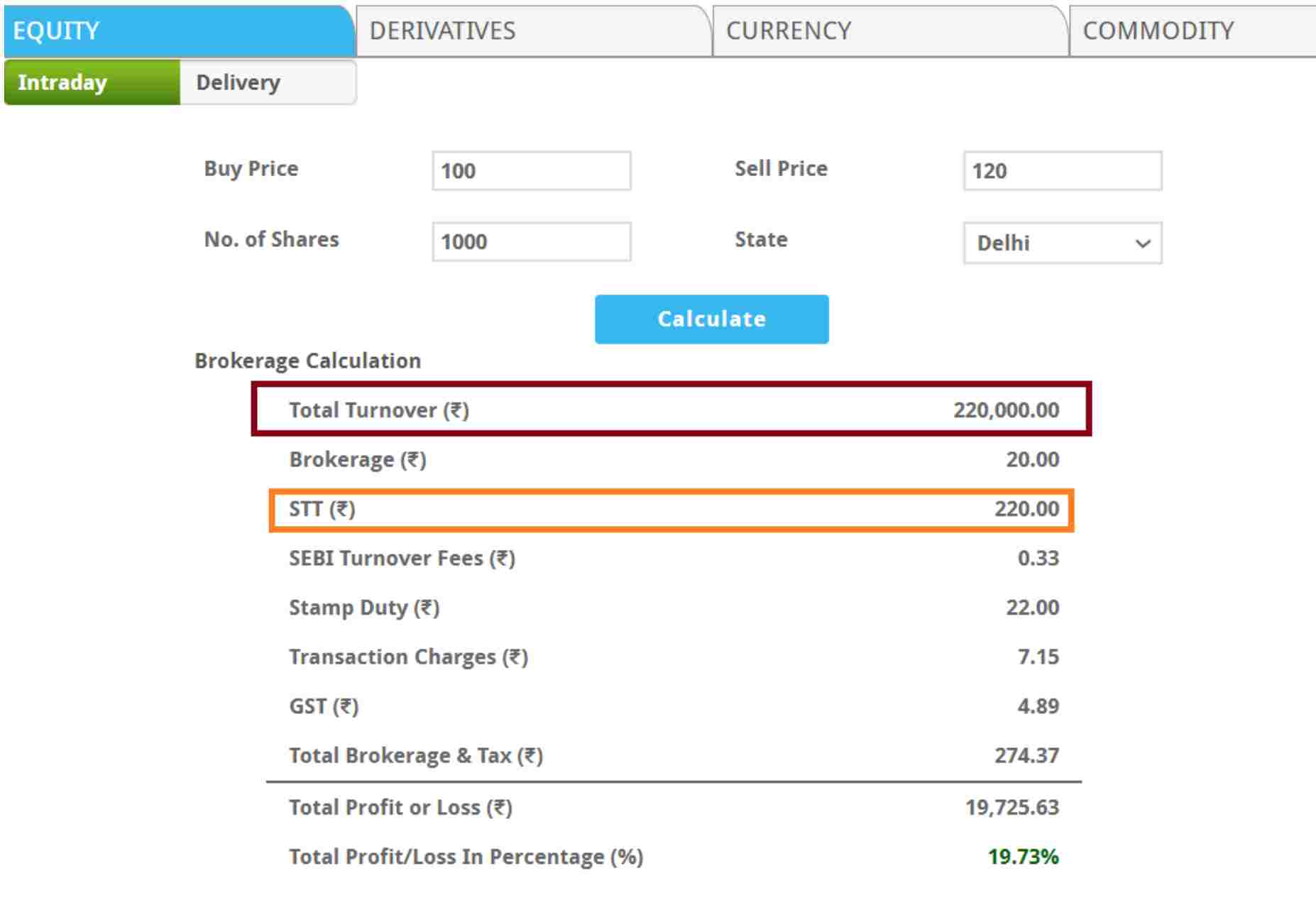
This is an example of a brokerage calculator for an intraday trade. Note the breakdown of costs, including Brokerage, STT, Transaction Charges, and GST.

This example shows the cost breakdown for an equity delivery trade. The charges are calculated on the total turnover and contribute to the final Net P&L.
A Worked Example: Intraday vs. Delivery
Let's solidify this with a concrete calculation. Assume you execute the following round-trip trade on the NSE using a discount broker that charges a maximum of ₹20 for intraday brokerage and zero for delivery.
- Buy: 100 shares @ ₹1,000
- Sell: 100 shares @ ₹1,050
Gross Profit = (₹1,050 - ₹1,000) × 100 shares = ₹5,000
Now, let's calculate the net profit for both intraday and delivery scenarios.
Scenario 1: Intraday Trade
- Buy Turnover: 100 × 1000 = ₹100,000
- Sell Turnover: 100 × 1050 = ₹105,000
- Total Turnover: ₹205,000
| Charge | Calculation | Amount (₹) |
|---|---|---|
| Brokerage | min(0.03% of 100k, 20) on buy + min(0.03% of 105k, 20) on sell |
20 + 20 = 40.00 |
| STT | 0.025% on sell side: 0.00025 * 105,000 |
26.25 |
| Exch. Txn Charge | 0.00325% on total turnover: 0.0000325 * 205,000 |
6.66 |
| SEBI Charges | 0.0001% on total turnover: 0.000001 * 205,000 |
0.21 |
| Stamp Duty | 0.003% on buy side: 0.00003 * 100,000 |
3.00 |
| GST | 18% on (Brokerage + Exch. Txn + SEBI): 0.18 * (40 + 6.66 + 0.21) |
8.44 |
| DP Charges | Not applicable for intraday | 0.00 |
| Total Charges | 84.56 |
Net Profit (Intraday): ₹5,000 - ₹84.56 = ₹4,915.44
Scenario 2: Delivery Trade
- Turnover is the same.
| Charge | Calculation | Amount (₹) |
|---|---|---|
| Brokerage | Zero for delivery | 0.00 |
| STT | 0.1% on total turnover: 0.001 * 205,000 |
205.00 |
| Exch. Txn Charge | 0.00325% on total turnover: 0.0000325 * 205,000 |
6.66 |
| SEBI Charges | 0.0001% on total turnover: 0.000001 * 205,000 |
0.21 |
| Stamp Duty | 0.015% on buy side: 0.00015 * 100,000 |
15.00 |
| DP Charges | Flat fee on sell leg (assuming ₹13.5 + 18% GST) | 15.93 |
| GST | 18% on (Exch. Txn + SEBI): 0.18 * (6.66 + 0.21) |
1.24 |
| Total Charges | 244.04 |
Net Profit (Delivery): ₹5,000 - ₹244.04 = ₹4,755.96
Notice how the cost structure is significantly different. While brokerage is zero for delivery, the much higher STT makes the total cost nearly three times that of the intraday trade.
The Breakeven Point: A Quant's North Star
For a quantitative trader, the most critical derivative of these costs is the breakeven point. This is the minimum price movement required per share just to cover all transaction costs.
Breakeven (per share) = Total Charges / Quantity
- Intraday Breakeven: ₹84.56 / 100 = ₹0.85 per share
- Delivery Breakeven: ₹244.04 / 100 = ₹2.44 per share
This means for your intraday trade to be profitable, the stock must move by at least ₹0.85 in your favor. Any trading strategy you design must have an expected profit per share (alpha) that is consistently greater than this breakeven cost. If not, the strategy has a negative statistical edge and is doomed to fail.
Conclusion
In this lesson, we have meticulously unpacked the various costs associated with executing an equity trade in India. You can now see that a trade's profitability is determined not just by the entry and exit prices, but by a fixed and variable cost structure that must be overcome.
Here are your key takeaways:
- Costs are multi-faceted: Trading costs are a combination of brokerage, government taxes (STT, GST, Stamp Duty), and fees from the exchange and regulator.
- Intraday vs. Delivery: The cost structure differs significantly between these two trading styles, primarily due to different rates for STT, Stamp Duty, and the applicability of DP charges.
- GST is a tax on services: It applies to brokerage and other fees, not the value of the shares traded.
- Net Profit is what matters: Gross profit is a vanity metric; net profit, after all costs are deducted, is the only number that counts.
- Breakeven is the hurdle: Every trade must clear a breakeven price point, dictated by transaction costs, before it can become profitable. This is a non-negotiable input for any trading algorithm.
Having established the costs of executing a trade, a natural next question arises: how much capital is required to initiate the trade in the first place? In our next lesson, we will explore the role of margin in equity trading, which addresses precisely this question.