Welcome to the final lesson of our first module. In our previous session, we deconstructed the various transaction costs that chip away at gross profits, establishing the critical concept of a trade's breakeven point. You now understand that every trade must overcome a cost hurdle before it becomes profitable. Today, we address the other side of the capital equation: how much capital you need to initiate a trade in the first place.
This lesson will explain the role of margin in equity trading. We will explore how margin enables leverage, but also serves as a fundamental risk management tool for the entire market. For someone with your mathematical and engineering background, thinking about margin as a dynamic, risk-based system—rather than just a simple deposit—is key. Understanding its components is essential for appreciating the constraints within which any quantitative trading strategy must operate.
What is Margin? The Power of Leverage
At its core, margin is the portion of the total trade value that you must pay from your own funds. It's not a fee; think of it as a good-faith deposit that allows you to control a position much larger than your initial capital would otherwise permit. This amplification is known as leverage.
For instance, if the margin requirement for a stock is 20%, you only need ₹20,000 of your own capital to buy ₹1,00,000 worth of that stock. The remaining ₹80,000 is effectively funded by your broker. This is often offered through a Margin Trading Facility (MTF), which is essentially a loan from your broker.
The following video from Zerodha Varsity provides a clear, practical explanation of how MTF works, including the crucial aspect of interest costs on the borrowed amount.
What is Margin Trading Facility(MTF)?
Watch the initial segment of this video to grasp the core idea of MTF.
Pay close attention to the definition of MTF as a facility and then follow the concrete example using Reliance stock, which breaks down how the margin and interest are calculated.
While MTF is a facility offered by brokers, the concept of margin itself is a foundational principle of market structure, designed to ensure stability. Why is this so important?
Microsoft Word - Understanding margin.doc
This document from NSE and BSE explains the fundamental 'why' behind margin requirements from a risk management perspective.
Read the section Why margins exist and the subsequent paragraphs that illustrate how a price drop can create a notional loss greater than the initial margin. This section perfectly illustrates why simply taking a deposit isn't enough to secure the system.
As the document explains, margin exists to manage counterparty risk. For every buyer, there is a seller. The margin system ensures that both parties can fulfill their obligations, even if the price moves drastically against them between the time of the trade and the settlement. It prevents a default by one party from cascading through the system.
The Double-Edged Sword: Margin Calls
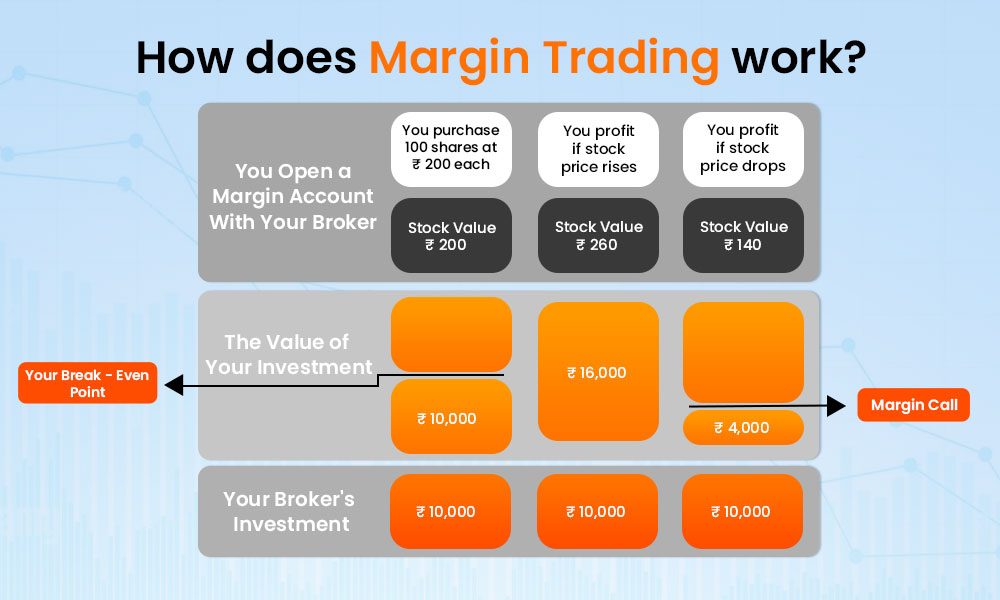
Leverage magnifies profits, but it also magnifies losses. A small percentage drop in the stock price can translate to a much larger percentage loss on your invested capital (the margin).
Let's revisit the MTF example:
- Total Position: ₹100,000
- Your Margin (25%): ₹25,000
- Broker's Funding: ₹75,000
If the stock value drops by 10% to ₹90,000, the broker's ₹75,000 is still owed. The entire ₹10,000 loss is deducted from your capital. Your initial ₹25,000 is now just ₹15,000—a 40% loss on your investment from a mere 10% drop in the stock.
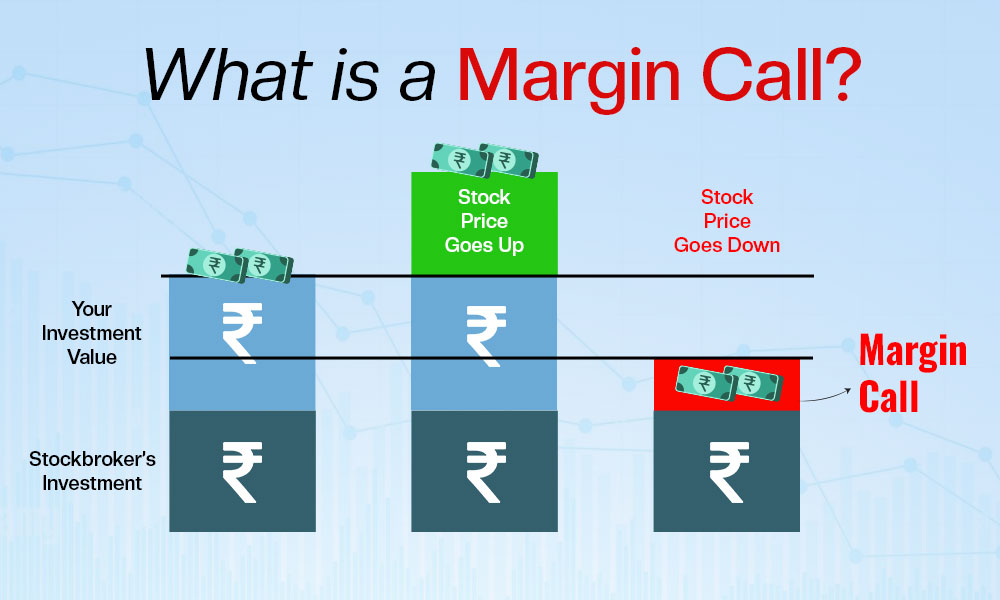
If the price continues to fall, your broker will issue a margin call, demanding that you deposit additional funds to bring your margin back up to the required level. If you fail to do so, the broker has the right to liquidate your position—selling your shares at the current market price—to recover their loan.
These two images visually represent how margin works and the trigger for a margin call.
The Anatomy of Margin Calculation
The margin percentage isn't an arbitrary number. It is a sophisticated, risk-based calculation mandated by SEBI and the exchanges. The total upfront margin for a trade in the cash segment is primarily composed of two parts: Value at Risk (VaR) Margin and Extreme Loss Margin (ELM).
- Value at Risk (VaR) Margin: This is the main component. It is a statistical measure that estimates the maximum potential loss a stock could experience on a single day, calculated with a 99% confidence level. The calculation uses the stock's historical volatility. Highly volatile stocks will naturally have a higher VaR margin.
- Extreme Loss Margin (ELM): This acts as a second line of defense. It is intended to cover losses that might occur in situations beyond the 99% probability covered by VaR (i.e., "black swan" events).
- Mark-to-Market (MTM) Margin: This isn't part of the initial upfront margin, but is a crucial daily process. At the end of each trading day, all open positions are "marked to market." If your position has an unrealized loss, you must pay that loss amount in cash by the next day. This prevents losses from accumulating over time and ensures the system remains solvent daily.
The following document from NSE/BSE provides a rigorous yet clear explanation of these components. Given your mathematical inclination, you will find the logic behind the formulas insightful.
Microsoft Word - Understanding margin.doc
This document details the core components of margin calculation in the cash market.
Focus on the sections that define the three main types of margins. Then read the explanations for VaR Margin, the Extreme Loss Margin, and finally the MTM Margin. Pay attention to how VaR and ELM are added together to form the total initial margin.
The New Era: Peak Margin Rules
Historically, margin requirements were calculated based on positions at the end of the day. This allowed brokers to offer high intraday leverage, which created systemic risk. To curb this, SEBI introduced the Peak Margin framework.
Under these rules, clearing corporations take at least four random snapshots of a broker's client positions during the trading day. The highest margin required across any of these snapshots becomes the "Peak Margin" for the day. This margin must be available before placing a trade.
This video provides an excellent summary of the peak margin rules and their implications for traders.
New Peak Margin Rules Explained | End of Intraday Leverage | Old vs. New Peak Margin Requirements
This video explains the shift to the peak margin regime and what it means for leverage.
Watch from the explanation of the new rules to understand the shift from end-of-day to real-time margin collection. Pay attention to the impact on using funds from sold shares and the effect on intraday profits. Finally, note the section that discusses the new minimum margin and the resulting maximum leverage (5x) for intraday equity trades.
The key consequence of the peak margin rule is the standardization and reduction of leverage. For intraday equity trades, the maximum leverage is now effectively capped at 5x (corresponding to a 20% margin), as VaR + ELM must be collected upfront.
Fulfilling Margin Requirements
Finally, it's useful to know that margin obligations don't always have to be met with cash. Active traders with existing portfolios often use their stock holdings as collateral.
You can fulfill your margin requirement using:
- Cash: The most straightforward method.
- Pledged Securities: You can pledge shares from your demat account to the broker. These shares remain in your ownership but are locked. The exchange applies a "haircut" to the value of these shares (e.g., a 10% haircut means ₹100 worth of stock provides only ₹90 of margin) to account for potential price volatility. This process is detailed in the NSDL presentation on Margin Requirements.
This mechanism allows you to use your long-term investments to generate the margin needed for short-term trading, without having to liquidate them.
Conclusion
This lesson concludes our initial exploration of the Indian equity market ecosystem. We've seen that margin is a sophisticated mechanism that serves a dual purpose: it provides traders with leverage but, more importantly, it acts as the bedrock of risk management for brokers, exchanges, and the entire financial system.
Here are the key takeaways:
- Margin enables leverage: It allows you to control a large position with a smaller amount of capital, amplifying both potential profits and losses.
- Risk of Margin Calls: If a trade moves against you, you may be required to add more funds or face forced liquidation of your position.
- Margin is risk-based: The required margin (VaR + ELM) is calculated based on the statistical risk profile of a stock, primarily its volatility.
- Daily Settlement: MTM margins ensure that all notional losses are settled daily, preventing the accumulation of unmanageable risk.
- Peak Margin rules: SEBI's recent regulations have standardized margin collection throughout the day, effectively capping intraday leverage at around 5x for equities.
We have now covered the key entities, processes, costs, and constraints of trading in the Indian market. In the next module, we will shift our focus from the mechanics of trading to the fundamentals of what is being traded. Our first lesson will be "Interpret the components of a company's balance sheet," where we'll start to deconstruct the financial health of a company, laying the groundwork for quantitative analysis.