Hello! Welcome to your second lesson.
In our first lesson, we explored the unique physical and chemical properties of gold and silver. Through a process of elimination, we saw why their stability, density, and workability made them stand out from nearly all other elements as potential forms of money.
Today, we will build directly on that foundation by examining one of those properties—scarcity—from a geological and historical perspective. Your learning outcome for this lesson is to explain how the geological scarcity and distribution of gold and silver contributed to their initial value. We will investigate where these metals come from, how their rarity is a fundamental feature of our planet's geology, and how their uneven distribution shaped the destinies of the earliest civilizations.
The Cosmic Lottery: Why Precious Metals are Rare
In the last lesson, we saw data showing that gold and silver are incredibly rare in the Earth's crust. Let's start with a clear visualization of this fact.
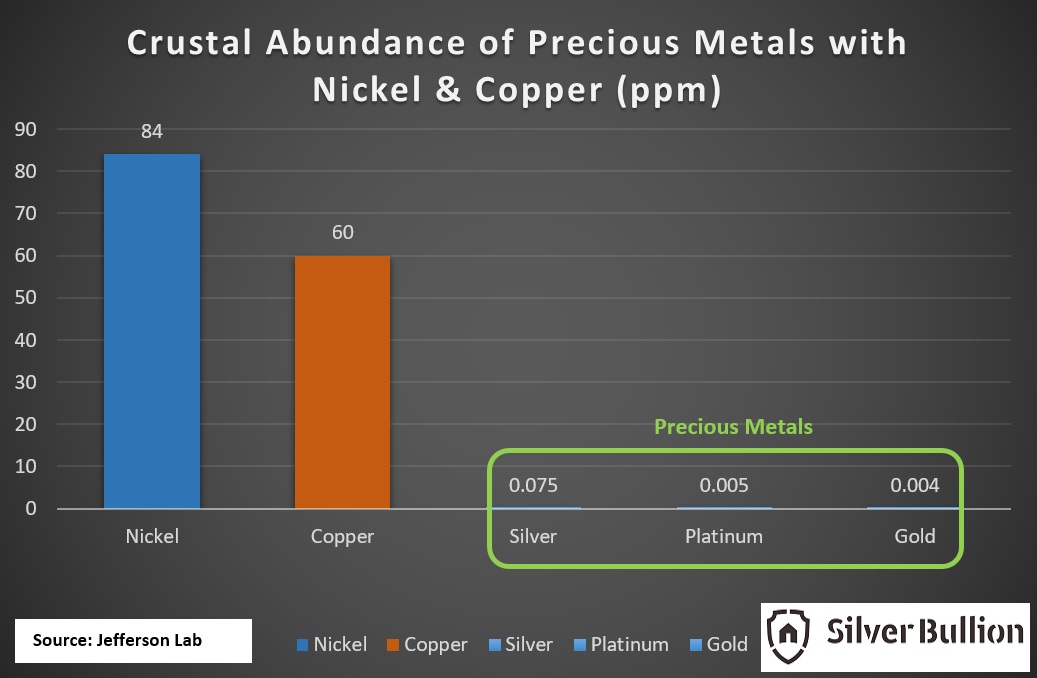
This extreme rarity isn't an accident; it's a result of planetary formation. Most of the Earth's native heavy elements, including gold and silver, sank to the core during the planet's molten phase billions of years ago. The vast majority of the gold and silver accessible to us in the crust arrived later, delivered by asteroid impacts after the surface had cooled.
This cosmic origin story has two profound consequences:
- Overall Scarcity: The total amount of these metals in the accessible crust is minuscule.
- Concentrated Deposits: They are not spread evenly like sand on a beach. Instead, they are concentrated in veins and deposits at the sites of these ancient impacts or where geological processes (like volcanic activity and water flows) have gathered them together.
This combination of absolute rarity and concentrated distribution is the geological starting point for their value.
From Earth to Hand: The Geology of Extraction
The way gold and silver are found in the ground dictated the technologies needed to extract them and, consequently, their early paths in human history.
Gold: Placer and Lode Deposits
Gold is primarily found in two types of deposits:
- Placer Deposits: These are concentrations of gold found in rivers, streams, and ancient riverbeds. As mountains containing gold veins erode over millennia, tiny flakes and nuggets of this very dense metal are washed downstream. Water currents naturally sort the material, and the heavy gold settles in gravel beds. Early humans could extract this gold with minimal technology—panning, sluicing, or simply picking it up. The earliest gold discoveries were almost certainly from placer deposits.
- Lode (or Hard Rock) Deposits: This is gold that is still embedded in its original rock matrix, typically quartz veins. Extracting it requires organized mining: digging shafts, quarrying the rock, crushing it, and then separating the gold. This is far more labor-intensive and technologically demanding.
The accessibility of placer gold meant that it could be discovered and utilized by relatively small, non-stratified societies. For example, the earliest known large-scale gold artifacts come from the Varna culture in modern-day Bulgaria, dating back to 4500 BCE.
A History Of Gold And Silver In The Ancient Era
This article, 'A History Of Gold And Silver In The Ancient Era' by Brian D. Colwell, provides excellent historical context. Let's examine its description of the Varna culture to see how access to local gold influenced an early society.
Please read the section titled 'The Dawn of Gold Working.' Focus on the description of the Varna Necropolis and the distribution of gold artifacts within the graves. Note how the concentration of gold in specific burials points to its early role as a marker of status.
As the Varna findings show, the geological happenstance of local gold deposits allowed this culture to use the metal as a primary marker of social hierarchy, long before it became money. The simple fact that it was rare, beautiful, and required effort to accumulate gave it inherent status and value.
Silver: The Metallurgist's Challenge
Silver's geology presented a different set of challenges. While it can be found in a pure state, it is most commonly locked away in lead-bearing ores like galena.
This meant two things:
- It was less likely to be found by chance in a stream bed.
- Extracting it required a sophisticated metallurgical process called cupellation. This involves heating the ore to over 900°C to separate the silver from the lead.
This technological hurdle meant silver's widespread use came later than gold's and was pioneered by civilizations with more advanced furnace technology.
A History Of Gold And Silver In The Ancient Era
Let's return to the Colwell article to understand the distinct history of silver extraction.
Read the section titled 'The Parallel Story of Silver.' Pay close attention to the discussion of Anatolian civilizations developing cupellation around 3000 BCE and the unusual situation in Egypt, where silver was initially more valuable than gold due to its local scarcity.
The fact that silver required this extra step of refinement made its supply even more constrained by technology, not just by its natural rarity. This added to its production cost and, therefore, its value.
Distribution and the Rise of Empires
The uneven geographical distribution of these metals was a defining factor in the history of ancient economies. Control over a major gold or silver mine was equivalent to controlling a firehose of wealth and power.
-
Egypt and Nubia: Ancient Egypt itself had some gold in its Eastern Desert, but its status as the "golden civilization" was cemented by its control over the gold-rich lands of Nubia (modern-day Sudan). Pharaonic expeditions and military campaigns were explicitly launched to secure these mines. The wealth from these geological assets funded the Egyptian state, its monumental building projects, and its armies for centuries.
-
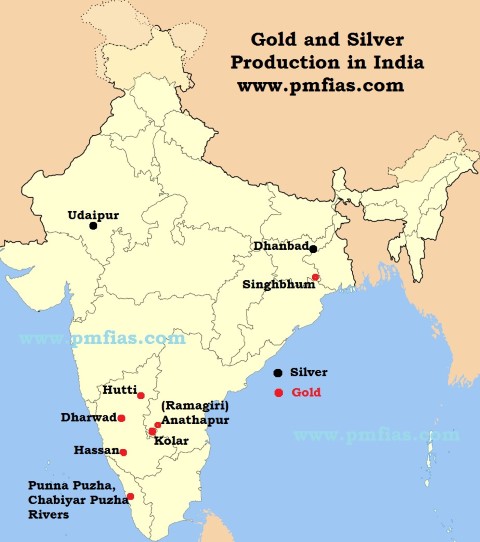
India's Deposits: As you requested, understanding the local sources within India is key. While India became a massive sink for the world's precious metals through trade, it also possessed its own native deposits.
- Athens and Laurion: The power of classical Athens was funded in large part by a single geological windfall: the discovery of massive silver veins at the mines of Laurion around 483 BCE. The silver from these mines paid for the fleet of 200 triremes that defeated the Persian navy at the Battle of Salamis, arguably saving Western civilization.
Scarcity as an Economic Feature
With your background in economics, you can appreciate that this geological reality—rarity, uneven distribution, and high extraction costs—creates a very specific set of supply-side dynamics. The market's spontaneous selection of gold and silver was not just about their physical beauty or durability; it was a choice rooted in these supply constraints.
[PDF] The Preeminence of Gold and Silver as Money
This paper, 'The Preeminence of Gold and Silver as Money' by Noureddine Krichene and Hassan Ghassan, provides a strong economic argument for why these metals were chosen. It frames their geological properties in economic terms.
Please read the section titled '3. Money is gold and silver.' Focus on the arguments connecting the natural qualities of the metals to their suitability as money. In particular, note the emphasis on scarcity not as a drawback, but as the essential feature that provides stability of value.
As the paper argues, "The market chose gold and silver as money essentially because of their scarcity." This scarcity, a direct result of geology, ensures that the supply of new money grows slowly and predictably. Unlike a commodity that could be produced in vast quantities, the high cost of finding and extracting gold and silver put a natural brake on supply inflation. This difficulty of production established a high and stable "cost floor," ensuring the existing stock of metal retained its value over long periods.
Conclusion
In this lesson, we've established the crucial link between geology and value. The initial worth of gold and silver was not arbitrary but was grounded in the hard realities of their formation and distribution in the Earth's crust.
Here are the key takeaways:
- Fundamental Scarcity: Gold and silver are cosmically and geologically rare, thousands of times less abundant than metals like copper.
- Concentrated Distribution: They are found in specific, localized deposits, control of which conferred immense economic and political power to early civilizations (e.g., Egypt's control of Nubian gold).
- Different Extraction Paths: Accessible placer gold was gathered early on, while silver required more advanced metallurgy (cupellation), influencing their respective historical timelines.
- Economic Stability: This geological scarcity and the high cost of extraction created a slow and predictable supply growth. This "hardness" of production is what made gold and silver a stable foundation for value.
In the previous lesson, we saw what made them physically suitable. Today, we've seen where they come from and how that scarcity anchored their value. In our next lesson, we will synthesize these ideas and formally define the economic principles of sound money—durability, portability, divisibility, fungibility, and scarcity—to create a complete framework for why gold and silver succeeded where other commodities failed.