Hello! Welcome to the first lesson of your course on the history of gold and silver.
Your goal is to understand the complete picture of how these two metals became the world's most famous commodities. To start, we need to go back to basics—before economics, before empires, before money itself. We need to look at the fundamental nature of matter.
This first lesson addresses a simple but profound question: Out of all the materials available on Earth, why gold and silver? We'll achieve this by contrasting their key physical properties—like density, resistance to decay, and ease of use—against other metals such as copper and platinum. Think of it as a process of elimination, starting with all 118 known elements, to discover what makes gold and silver so special from a purely physical and chemical standpoint.
This foundation will be crucial for all subsequent lessons, where we will build upon these properties to understand their economic and historical significance.
The Great Elemental Elimination
To understand why gold, let's first understand why not everything else. The periodic table of elements is our list of candidates for a physical form of money. A fun and insightful way to start this investigation is by listening to a story from NPR's Planet Money, where the hosts do exactly this with a chemist.
Why Gold? : Planet Money - NPR
This resource from NPR's Planet Money, titled 'Why Gold?', takes a systematic approach to finding the perfect element for money. It's a great narrative that walks through the key criteria that a monetary asset must have.
Please read the first part of the transcript. Start from the beginning and read until the hosts have eliminated the gases, the highly reactive elements, and the radioactive elements. The section ends with the line '...should not kill you if you hold it in your pocket.' This process will help you understand the first few crucial filters for any potential commodity money.
As you've just read, we can quickly disqualify a huge portion of the periodic table. To serve as a reliable store of value and medium of exchange, a substance must be:
- Solid and stable: You can't have your money floating away (like helium) or decaying into another element (like uranium).
- Non-reactive: You also don't want your money to burst into flames (like lithium) or corrode into dust. Gold's remarkable resistance to corrosion is one of its most celebrated properties—a gold coin lost at sea for centuries can be recovered almost pristine.
This initial filtering leaves us with a group of metals in the center of the periodic table, often called the "transition metals" and "post-transition metals." But even within this group, most are unsuitable.
The "Goldilocks" Zone: Finding the Right Balance
Now that we have a smaller pool of stable, non-lethal, solid metals, we need to apply a few more filters. These are more economic in nature, relating to scarcity and usability.
Let's continue with the NPR transcript to see how rarity and the ability to work with a metal further narrow our choices.
Why Gold? : Planet Money - NPR
Let's return to the 'Why Gold?' transcript to explore the next set of criteria.
Please read the rest of the transcript, starting from where you left off. Focus on three key arguments: (1) Why common metals like copper are problematic, (2) why extremely rare metals like osmium are also unsuitable, and (3) the crucial differences in melting point and appearance between gold and platinum.
This brings us to the core of our comparison. A successful monetary metal can't be too common or too rare, and it must have been workable with the technology available throughout most of human history.
- Scarcity: If a metal is too common, like copper or iron, you need enormous quantities to store significant value. The 43-pound Swedish copper coin is a perfect example of poor portability and a low value-to-weight ratio.
- Workability (Melting Point): If a metal is too difficult to melt and shape, you can't easily turn it into standardized coins, bars, or jewelry. Platinum, despite its stability, has a melting point of 1768°C (3215°F), which was far beyond the reach of ancient furnaces. Gold (1064°C) and silver (962°C) were much more accessible.
- Identifiability: Gold's unique, rich yellow color makes it instantly recognizable. Platinum, by contrast, is a silvery-white metal that looks similar to many less valuable materials, making it harder to verify without sophisticated tools.
Let's look at some hard data to visualize these differences.
A Head-to-Head Comparison
The properties we've discussed can be quantified, which helps in making a direct, objective comparison.
Scarcity
The rarity of these metals in the Earth's crust is a primary determinant of their intrinsic value.

Physical & Thermal Properties
Now let's compare the metals across several key metrics. This article provides some excellent, concise data points.
Key Differences Between Gold, Silver, Platinum, and Palladium
To get precise data for our comparison, please review this brief article from Verified Investing.
Read the sections on 'Physical Properties Of Precious Metals' and 'Quick Facts of Precious Metals.' Pay close attention to the tables and lists comparing malleability (hardness), density, and reactivity.
The table below on melting points further illustrates the workability challenge posed by platinum.
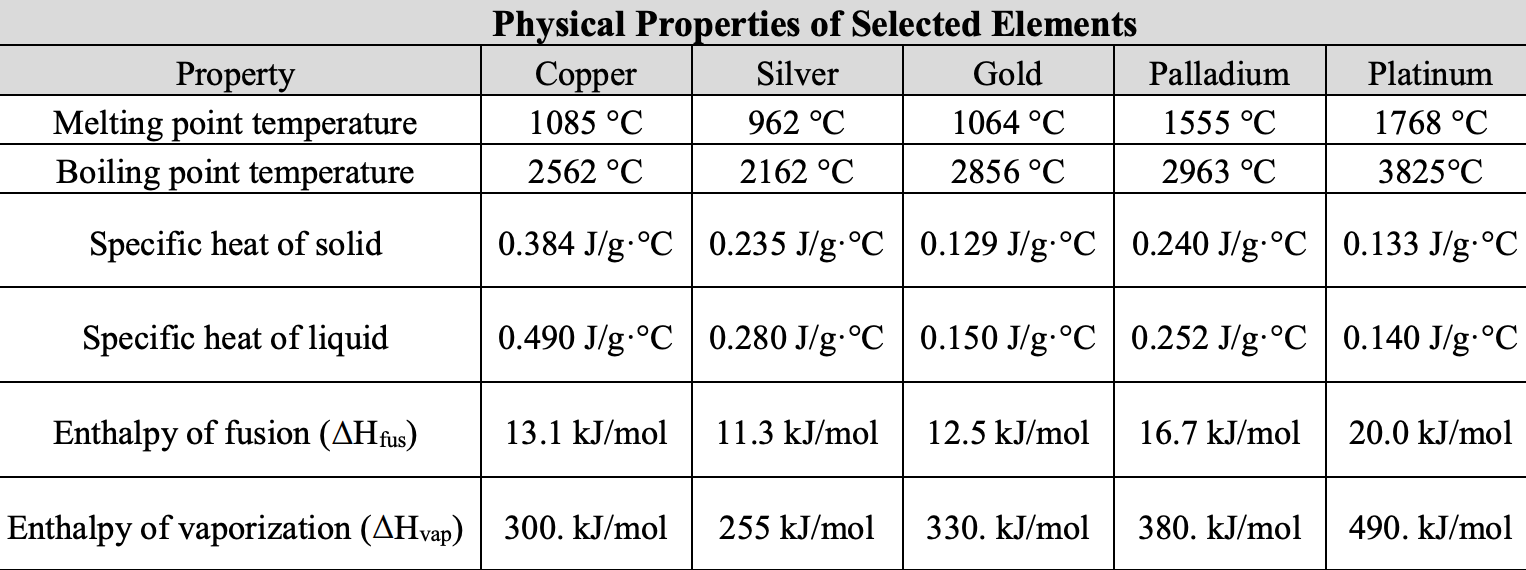
Summary Table: Contrasting the Contenders
Let's consolidate everything into a single table. This clearly contrasts why gold and silver emerged as the winners, with copper serving a secondary role and platinum being a non-starter for most of history.
| Property | Gold (Au) | Silver (Ag) | Copper (Cu) | Platinum (Pt) |
|---|---|---|---|---|
| Corrosion Resistance | Excellent. Chemically inert; doesn't rust or tarnish. | Good. Stable, but tarnishes by reacting with sulfur in the air. | Poor. Readily oxidizes (patinates) to a green color. | Excellent. The most corrosion-resistant of all metals. |
| Scarcity (ppm) | Very Rare (0.004) | Rare (0.075) | Common (60) | Very Rare (~0.005) |
| Density (g/cm³) | Very High (19.3). Excellent for portable value storage. | High (10.5). Good, but about half as dense as gold. | Moderate (9.0). Poor value-to-weight ratio for wealth storage. | Extremely High (21.5). The best for portable value. |
| Melting Point (°C) | 1064. Accessible with pre-modern technology. | 962. Very accessible. | 1085. Accessible. | 1768. Extremely difficult to melt until modern times. |
| Malleability/Hardness | Very Malleable (Mohs 2.5). Easy to mint into coins and work. | Very Malleable (Mohs 2.5). Also very easy to work with. | Malleable (Mohs 3.0). Relatively easy to work with. | Less Malleable (Mohs 4.6). Much harder and tougher to work. |
| Appearance | Unique golden color. Instantly identifiable. | Unique white luster. Distinctive but less unique than gold. | Reddish-brown. Common appearance. | Silvery-white. Difficult to distinguish from other metals. |
The Verdict:
- Gold is the near-perfect monetary metal. It uniquely combines extreme rarity, corrosion resistance, high density, workability, and a distinctive appearance.
- Silver is an excellent monetary metal, but a runner-up to gold. It is less rare, less dense, and it tarnishes. This made it ideal for smaller, everyday transactions while gold was used for larger settlements and wealth storage.
- Copper is too common and corrodes too easily to be a primary store of value, but its properties made it suitable for low-value token coinage.
- Platinum, despite its appealing density and stability, was eliminated by its extremely high melting point and non-distinct appearance, making it technologically and practically unusable as money for most of human history.
Conclusion
In this lesson, we established that gold and silver's rise to prominence was not an accident of history. It was a direct consequence of their unique combination of physical and chemical properties. Through a process of elimination, we've seen that they occupy a "sweet spot" of rarity, durability, density, and workability that no other elements could match with the technology available through the ages.
You now have a solid understanding of the physical foundation of these metals. In our next lesson, we will build upon the concept of scarcity by exploring the geological distribution of gold and silver. We'll examine how and where these metals are found in the Earth's crust, which played a critical role in shaping their initial value and the history of their extraction.