Welcome back! In our previous lesson, we went through the fundamental process of deriving the distance formula from the Pythagorean theorem. You saw that it's not just a rule to memorize but a logical extension of geometry onto the coordinate plane.
Today, we'll put that formula into practice. Our goal is to become proficient in applying it, especially in situations that involve negative coordinates—that is, when points are located in different quadrants. Mastering this computational skill is essential for the GRE and for the more complex geometric problems we'll tackle later in this course, such as classifying triangles and working with circles.
Applying the Formula with Negative Coordinates
Let's quickly recall the distance formula we derived:
The process is straightforward: find the horizontal change (), find the vertical change (), square both, add them, and take the square root.
When negative coordinates are involved, the logic doesn't change, but it does require careful arithmetic. Let's look at an example.
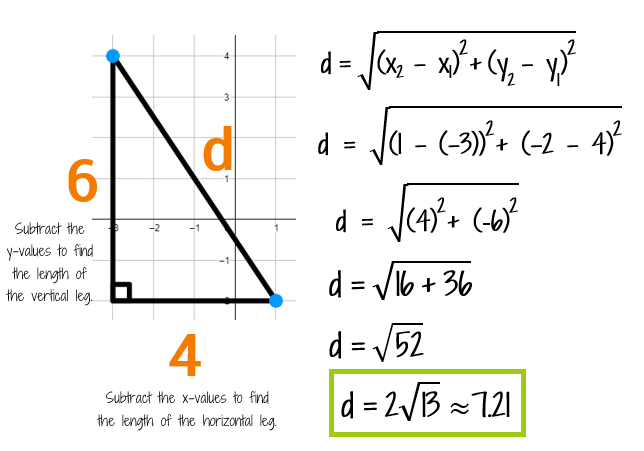
Let's break down the calculation in the image:
-
Identify the coordinates: Let's set and . So, .
-
Calculate the differences in coordinates:
- The horizontal change () is .
- The vertical change () is .
-
Square the differences:
- . Notice that squaring the negative number gives a positive result. This is crucial—the squared components of the distance are always positive, representing the squared lengths of the triangle's legs.
-
Sum and take the square root:
The distance is , which can be simplified to or approximated as 7.21.
The most common error in these calculations is mishandling the signs during subtraction. Always be methodical, especially with expressions like (number) - (-another number).
More Worked Examples
To see this process again with another set of points, the following video provides a great walkthrough. It emphasizes the connection to the underlying right triangle, which is key to the intuitive understanding you're aiming for.
Distance formula | Analytic geometry (video)
Watch this segment from a Khan Academy video on the distance formula. The instructor works through an example with points in Quadrants III and I.
Pay close attention to the calculation from the second example, finding the distance between (-6, -4) and (1, 7). Notice how he calculates the change in x and change in y with negative coordinates.
For a more direct, procedural approach with several examples, this next video is also very effective.
This video by The Organic Chemistry Tutor provides a quick and clear guide to using the formula.
Watch the second example presented, which calculates the distance between points (5, -16) and (-2, 8). This is another excellent demonstration of handling negative numbers, available from this timestamp.
Practice for Yourself
Now, try one on your own. Find the distance between the points A = (-4, -1) and B = (1, -7).
...
Let's check your work.
- Coordinates: and .
- Differences:
- Square, sum, and root:
The distance is , which is approximately 7.81. Note that it doesn't matter which point you designate as or . If we swapped them, the differences would be and , which, when squared, yield the same values of 25 and 36.
Using the Formula Algebraically
Your background in algebra allows us to explore a deeper application of the distance formula. Instead of just calculating a distance, we can use a known distance to find a missing coordinate. This is a common problem type on standardized tests like the GRE.
Imagine you are given two points, but one of their coordinates is an unknown variable, like k. You are also given the total distance between the points. To find k, you would:
- Set up the distance formula with all the known values.
- Square both sides of the equation to eliminate the square root.
- Solve the resulting equation for the unknown variable. Since the variable is squared in the formula, this often leads to a quadratic equation, which may have two possible solutions.
The following resource provides a clear, step-by-step example of this exact scenario.
Distance Formula - Math Steps, Examples & Questions
This guide from Third Space Learning includes several worked examples. We're going to focus on one that uses algebra to solve for a missing coordinate.
In the document, locate the section "How to use the distance formula" and find Example 5. Read through this problem carefully. It demonstrates how to find a missing y-coordinate k when the distance is known. Notice how squaring both sides simplifies the problem and how it leads to two possible answers for k, one of which is selected based on the problem's constraints.
This type of problem reinforces that the distance formula is not just a calculation tool but an algebraic equation that describes a fixed relationship between points.
Conclusion
In this lesson, you have moved from theory to practice, applying the distance formula to a variety of scenarios.
Key takeaways from today include:
- The distance formula is applied in the same way regardless of which quadrant the points are in.
- Special care must be taken with arithmetic when subtracting negative coordinates.
- Because the changes in x and y are squared, the distance is always a non-negative value, aligning with our geometric intuition.
- The distance formula can be used algebraically to solve for an unknown coordinate when the distance is given.
You now have a solid command of calculating distances on the coordinate plane. In the next lesson, we will derive and apply the midpoint formula, another essential tool for analyzing line segments and solving geometric problems.