Welcome to the first lesson of your course on coordinate geometry. Your goal is to move beyond simply memorizing formulas for the GRE and to build a deep, intuitive understanding of the concepts. We'll start that journey today by exploring one of the most fundamental tools in this field: the distance formula.
This lesson is designed to show you that this formula isn't something to be memorized blindly. Instead, you'll see how it emerges directly from a theorem you're likely already familiar with—the Pythagorean theorem. By the end of our session, you will be able to derive the distance formula yourself by applying the Pythagorean theorem to two points on the coordinate plane. This foundational understanding will be crucial for everything that follows, including our later work with circles and classifying geometric shapes.
The Pythagorean Theorem: More Than Just Triangles
Before we place anything on a coordinate plane, let's start with the core principle. You probably remember the Pythagorean theorem from geometry, which describes the relationship between the sides of a right-angled triangle.
Algebraically, it's stated as:
where and are the lengths of the two legs (the sides that form the right angle), and is the length of the hypotenuse (the side opposite the right angle).
Your goal is to understand the "why," so let's not just state the theorem but also briefly look at a proof. This helps build the intuition that mathematical formulas have logical origins.
The Pythagorean distance formula - A complete course in algebra
This resource from TheMathPage provides a concise review of the Pythagorean theorem and includes a classic, elegant proof.
First, read the introductory section to refresh your memory on the theorem's statement. Start from the beginning and read down to the first set of problems. Then, to satisfy your curiosity about the "why," scroll to the bottom of the page and read the section titled A proof of the Pythagorean theorem. Notice how it cleverly uses the concept of area to prove the relationship between the side lengths.
From Triangles to Coordinates
Now, how does help us find the distance between two points on a graph? Let's visualize it.
Imagine any two points on the coordinate plane, let's call them with coordinates and with coordinates . The straight-line distance between them is the length we want to find.
We can draw a horizontal line through one point and a vertical line through the other. Where they intersect, they form a right angle. By connecting our original two points, we create a right-angled triangle, with the distance between the points serving as the hypotenuse.

The lengths of the legs of this triangle, a and b, are simply the differences in the coordinates:
- The length of the horizontal leg (
a) is the difference between the x-coordinates: . - The length of the vertical leg (
b) is the difference between the y-coordinates: .
We use absolute values because length must be a positive quantity.
Now, we can substitute these expressions back into the Pythagorean theorem:
where is the distance (our hypotenuse).
Since squaring any number (positive or negative) results in a positive number, the absolute value bars become redundant. For example, and . So, we can simplify the equation to:
To solve for the distance , we take the square root of both sides. Since distance can't be negative, we only consider the positive root. This gives us the final distance formula.
The Distance Formula
The process we just walked through leads directly to the distance formula. For a more dynamic explanation of this derivation, the following video is quite helpful.
The Distance Formula - Deriving the Formula from Pythagorean Theorem
In this video, "The Distance Formula - Deriving the Formula from Pythagorean Theorem," Patrick JMT provides a clear, step-by-step derivation.
Watch the segment from this section, where he sketches two points on a plane and uses the Pythagorean theorem to arrive at the distance formula, just as we did above.
The result of this derivation is the general formula for the distance between any two points and :
This formula is a cornerstone of coordinate geometry.
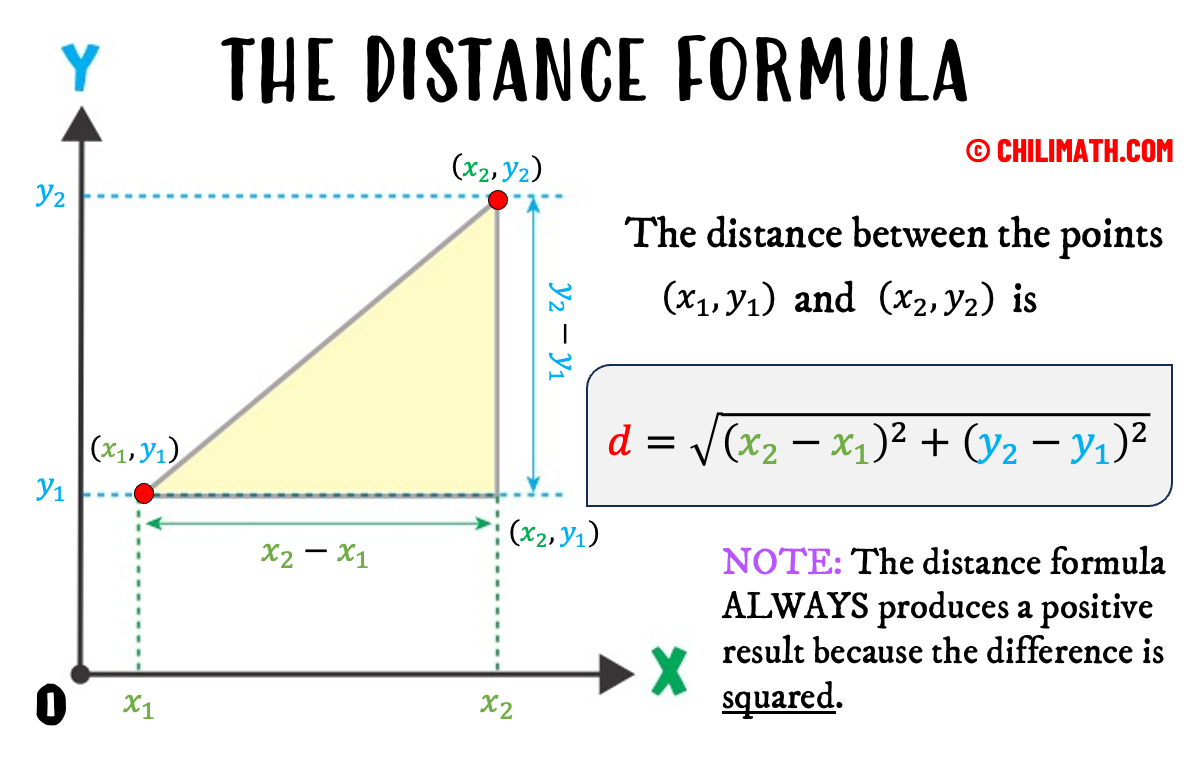
To see the derivation laid out one more time in a clear, graphical format, the following resource is excellent. It neatly presents the entire logical flow from start to finish.
Derivation of Distance Formula | ChiliMath
This article from ChiliMath provides a concise, visual walk-through of the derivation. It's a great way to consolidate your understanding.
Read the entire short article, from top to bottom. Pay attention to how each diagram builds on the last, from plotting the points to calculating the lengths of the legs.
As a final note on terminology, you may sometimes see the differences in coordinates represented by the Greek letter delta (). For instance, and . Using this notation, the distance formula can be written compactly as . This is just a different way of writing the same thing.
Let's quickly apply this to find the distance between the points and .
- Identify your coordinates: and .
- Calculate the differences:
- Plug them into the formula:
- Solve:
Notice that the legs of our triangle have lengths 3 and 4, and the hypotenuse is 5. This is a classic "3-4-5" right triangle, which reinforces the direct connection between the distance formula and the Pythagorean theorem.
Conclusion
In this lesson, we established a critical foundation for your study of coordinate geometry. We didn't just learn a formula; we derived it from first principles.
Here are the key takeaways:
- The distance formula is not an arbitrary rule but a direct application of the Pythagorean theorem to the coordinate plane.
- The distance between two points can be visualized as the hypotenuse of a right triangle.
- The legs of this triangle are the horizontal and vertical distances between the points, found by subtracting their respective coordinates ( and ).
You've successfully taken the first step toward building an intuitive grasp of these concepts. In our next lesson, we will put this formula into practice by applying it to solve problems involving points in different quadrants. Afterward, we will use similar logic to derive and apply another essential tool: the midpoint formula.