Welcome to our third lesson. In our previous sessions, we derived the distance formula from first principles using the Pythagorean theorem and then practiced applying it in various scenarios, including solving for unknown coordinates. This process of moving from derivation to application is central to building the deep, intuitive understanding you're aiming for.
Today, we'll continue exploring the properties of line segments on the coordinate plane. Our focus will be on the midpoint formula. We'll start by deriving it, seeing how it logically follows from the concept of an average. Then, we will apply it not only to find the midpoint between two points but also to work backward to find a missing endpoint, a common problem-solving twist you might see on the GRE.
What is a Midpoint? The Intuition of "Average"
At its heart, a midpoint is the point on a line segment that is exactly halfway between the two endpoints. But how do we find the coordinates of this point? The intuition is simpler than you might think: the midpoint is simply the "average" of the two endpoints.
To see what this means visually and conceptually, the following Khan Academy video provides an excellent breakdown. It deconstructs the problem into two separate, one-dimensional questions: finding the average of the x-coordinates and finding the average of the y-coordinates.
Midpoint formula | Analytic geometry | Geometry | Khan Academy
Watch the video "Midpoint formula" from Khan Academy.
Pay close attention to these parts: The x-coordinate: Sal explains why the midpoint's x-coordinate is simply the average of the two endpoint x-coordinates. The y-coordinate: He applies the same logic to the y-coordinate. The formal formula: Notice how the final formula is just a formalization of this averaging concept.
As the video makes clear, for two points and , the midpoint is found by averaging the x-values and averaging the y-values separately. This gives us the midpoint formula:
This formula is powerful because it's intuitive. You don't need to memorize it as an arbitrary rule; you just need to remember to "average the coordinates."
A Deeper Dive: Geometric Derivation
Since your goal is a deep understanding, let's go beyond the intuitive "averaging" explanation and derive the formula with a bit more geometric rigor. We can use the concept of similar triangles, which is a cornerstone of geometry.
The following resource provides a proof using this method. While the notation in the article is a bit dense, the underlying idea is beautiful. It constructs two right triangles using the endpoints and the midpoint, and then shows these triangles must be congruent.
Question Corner -- Why The Midpoint Formula Works
This reading is from the University of Toronto's Math Department. It provides a formal proof for the midpoint formula.
Focus on the section titled Another approach. Study the diagram and the logic that follows. The key insight is that the line segment from the first point to the midpoint creates a triangle that is congruent to the one created by the line segment from the midpoint to the second point. Don't worry if the algebraic manipulation at the end seems complex; focus on understanding the geometric setup with triangles PMB and MQA. The argument shows that because B is the midpoint of the horizontal segment PR, its x-coordinate must be the average of the x-coordinates of P and R. A similar logic applies to the y-coordinate.
This derivation solidifies the connection between the algebra of the formula and the geometry of the plane, reinforcing that coordinate geometry is precisely where these two worlds meet.
Applying the Formula: Finding the Midpoint
Now, let's put the formula to work. The process is a straightforward application of the averaging principle we've just discussed.
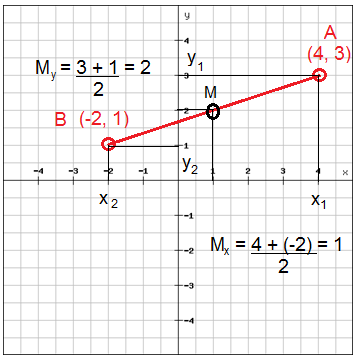
Consider two points, A = (4, 3) and B = (-2, 1). Let's find the midpoint, M.
- Average the x-coordinates:
- Average the y-coordinates:
So, the midpoint is M = (1, 2).
Two Methods for the GRE
For the GRE, having multiple ways to solve a problem can be invaluable. The next video demonstrates a GRE-style question and offers two methods for finding the midpoint.
- The Algebraic Method: The averaging formula we've been using.
- The Visual/Journey Method: Thinking about the "journey" from one point to the other in terms of horizontal and vertical distance, and then traveling half that distance.
GRE Quant Ep 3: Coordinate Geometry
Watch this segment from the video "GRE Quant Ep 3: Coordinate Geometry".
The presenter solves the same problem in two different ways. First, watch Method One, which is the algebraic averaging we've discussed. Then, watch the visual method. This "half the journey" approach can be very intuitive and quick, especially with simple numbers.
The presenter notes that the journey method is more flexible for finding points that aren't the midpoint (e.g., a point one-third of the way along a segment), which is a nice preview of more advanced ratio problems. For now, mastering both methods for the midpoint will serve you well.
Working Backwards: Finding a Missing Endpoint
A common test question flips the problem around: you are given one endpoint and the midpoint, and you must find the other endpoint. This tests your understanding of the formula as an algebraic equation, not just a calculation.
Let's say point A is (2, 5) and the midpoint M is (3, 1). We need to find the other endpoint, B, with unknown coordinates .
We use the midpoint formula, but now we solve for the unknowns.
For the x-coordinate:
For the y-coordinate:
So, the missing endpoint B is (4, -3).

The following resource provides more worked examples of this type of problem.
What is the Midpoint Formula & how does it work?
This article from Purplemath provides several examples.
Scroll down to the examples. You can skim the first couple that just find the midpoint. Focus your attention on the problems titled Find the value of p and Find the coordinates that make (1, 1) the midpoint. Follow the logic of how they set up two separate equations (one for x, one for y) and solve for the missing variables.
Conclusion
In this lesson, we have thoroughly examined the midpoint formula. You've seen that what might seem like another rule to memorize is actually a direct and intuitive application of finding an average.
Here are our key takeaways:
- The midpoint formula, , is derived from the concept of averaging the respective coordinates of the endpoints.
- We can prove this geometrically using congruent triangles, connecting the algebra back to the underlying geometry.
- The formula can be applied directly to find the center point of a segment.
- It can also be used algebraically to solve for a missing endpoint when the midpoint and one endpoint are known.
You are now equipped with two essential tools for analyzing line segments: the distance formula and the midpoint formula. In our next lesson, we will combine these tools to tackle more complex problems, such as classifying triangles (as isosceles, equilateral, or right-angled) and other polygons based solely on the coordinates of their vertices.