Welcome to your sixth lesson in the "Foundations of Critical Thinking" module. In our last session, we engaged with Russell's Teapot to understand the burden of proof, focusing on why claims made without evidence—especially unfalsifiable ones—can be dismissed without evidence. We applied this to filter out pseudoscience in bra marketing and unsubstantiated personal advice.
Today, we transition from evaluating claims about what is to dissecting arguments about what ought to be. Our focus is Hume's Guillotine, also known as the is-ought problem. Your learning objective is to apply this principle to distinguish descriptive facts from prescriptive norms, both in the standards of the lingerie industry and in societal expectations surrounding relationship structures. This tool is fundamental for separating objective reality from value judgments, a skill essential for both a statistician and a social researcher.
The Is-Ought Problem: A Gap in Logic
David Hume, a pivotal figure of the Scottish Enlightenment, observed a subtle but profound flaw in many moral and philosophical arguments. Writers would spend pages describing the world as it is—making factual, descriptive statements—and then suddenly, without justification, pivot to declaring how the world ought to be, making value-laden, prescriptive statements.
Hume argued that you cannot logically derive an "ought" from an "is." A conclusion containing a value judgment cannot be reached solely from premises that are purely factual. There is a missing link: a hidden value premise.
To grasp this concept fully, please watch the following video. It provides a clear and concise explanation of Hume's Guillotine.
Hume's is/ought problem? (L3 - Is Ought Problem - Hume)
This video from the Mr Moffat Philosophy channel introduces the is-ought problem, using simple examples to illustrate the logical gap between facts and values.
Watch the video in its entirety. As you watch, focus on these key points: The initial examples of arguments about eating meat (at the start). The formal explanation of the logical error: the jump from description to prescription. The alien mugging analogy, which separates the observable facts from the value of "wrongness". How arguments that seem to bridge this gap rely on hidden, unstated value premises.
The crucial insight is that facts describe reality, while values express our ideals, goals, or moral judgments about that reality. An argument that jumps from one to the other is making an assumption. Your task, as a critical thinker, is to spot that jump and identify the hidden value premise that enables it.
Application 1: Deconstructing Lingerie Industry Standards
The world of fashion, and particularly lingerie sizing, is a prime example of the is-ought fallacy in action. An industry takes descriptive data and uses it to establish powerful prescriptive norms.
The "Is" of Body Data
First, consider the raw, descriptive facts. A sizing survey, for instance, provides a statistical snapshot of a sample population.

This is where your statistical background is invaluable. You understand that this data describes a specific sample and has a certain distribution. But what does the industry do with such data? The history of sizing reveals a consistent leap from "is" to "ought."
The following video documents how early, flawed descriptive data became the foundation for prescriptive sizing standards that persist today.
From bustles to bras, a short history of sizing
This video from Jessica Kellgren-Fozard, titled "From bustles to bras, a short history of sizing," details the messy history of clothing standardization.
Please watch the following segments: First, watch the section covering the US government's 1939 sizing study, from "over in the USA". Pay close attention to who was measured versus whose data was used. Next, watch the segment on "vanity sizing," which begins around "enter the era". Finally, watch the part discussing the modern Size USA study from "Technology Corporation".
Let's apply Hume's Guillotine to what you've just seen:
-
The 1939 Study:
- Is: A government-funded study measured a sample of women, but the resulting sizing chart was based on data from undernourished white women.
- Fallacious Leap to "Ought": This specific, non-representative body type ought to be the standard that all women's clothing is designed for.
- Hidden Value Premise: The bodily proportions of this specific demographic are ideal or universally applicable. This is a value judgment, not a fact.
-
Vanity Sizing:
- Is: A garment has a physical circumference of 30 inches at the waist.
- Fallacious Leap to "Ought": The label ought to say "Size 6" instead of "Size 10," because customers should feel good about fitting into a smaller size.
- Hidden Value Premise: A smaller size number is more desirable than a larger one.
-
The Size USA Study:
- Is: Only 8% of American women have the "hourglass" shape.
- The Implied "Ought": This is an example of using a new
isto challenge an oldought. The argument is: given this fact, the industry ought to stop designing clothes as if the hourglass shape were the norm. This is a valid prescriptive argument, but it's important to recognize it is a prescriptive argument, not a purely logical deduction. The hidden value premise is that clothing should fit the bodies that actually exist.
This entire dynamic is summarized powerfully in a Vogue article that reflects on the fashion industry's role in enforcing these norms.
What's Changing—and What Isn't—About Fashion's Relationship to ...
This article explores the social and psychological costs of the fashion industry's narrow beauty ideal.
Please read the first three paragraphs, ending with the commitment to do better. Then, skip to the section that begins "Nicholson, Hammam, and Elsesser..." and read to the end of the paragraph with the quote "the system needs to change."
The statement "I don’t need to change; the system needs to change" is the perfect encapsulation of a person armed with Hume's Guillotine. It rejects the prescriptive "ought" that has been fallaciously derived from a flawed and limited "is."
Application 2: Navigating Relationship Expectations
The is-ought problem is just as prevalent in social dynamics. In your work as a social researcher, you are trained to observe what is. But in our personal lives, we are constantly bombarded with oughts about how our relationships should be.
Let's return to the Vee relationship of Alex, his wife Bella, and her partner Charles.
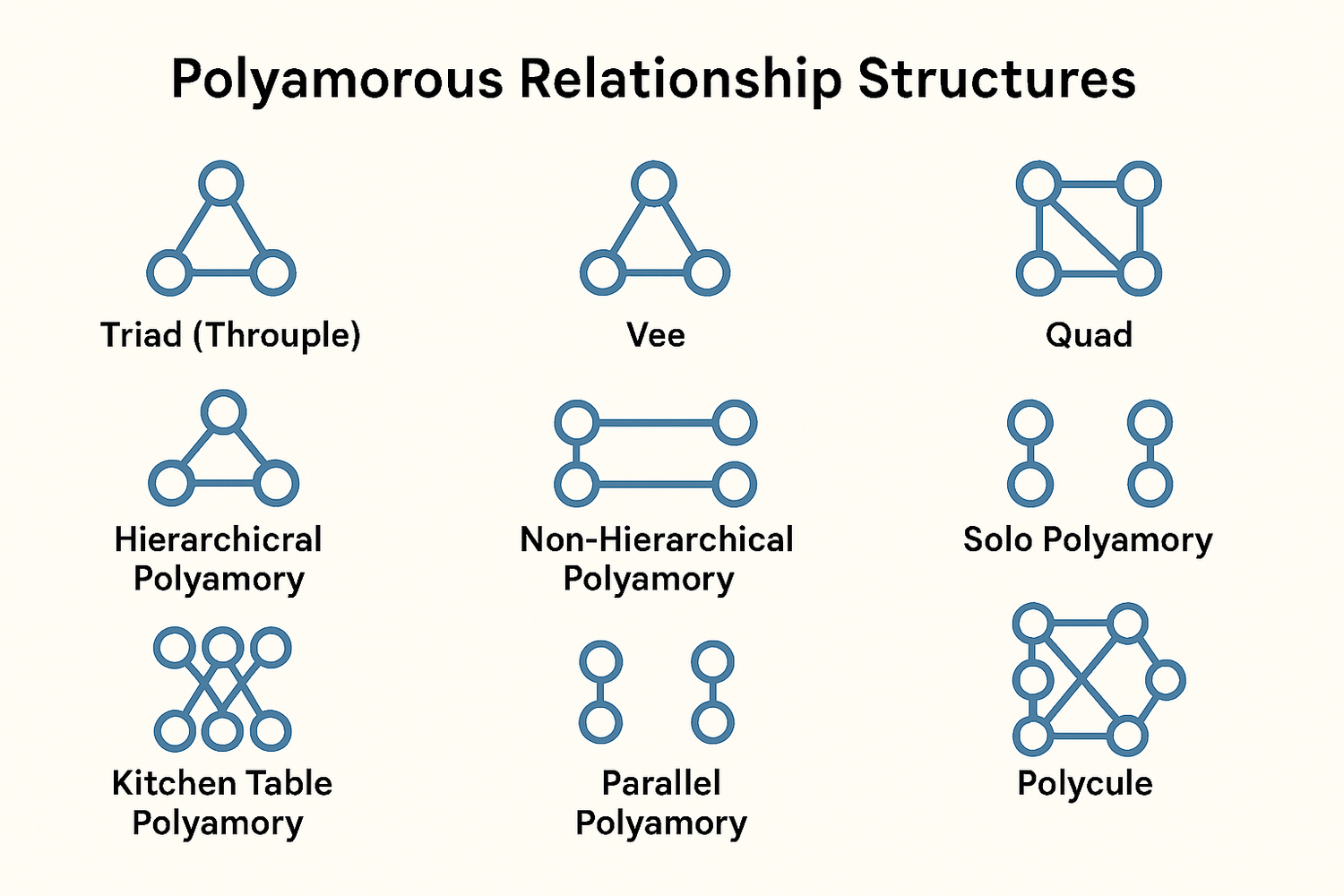
The key to navigating a non-monogamous structure is to consciously separate the descriptive reality of the relationship from the prescriptive rules—both those imposed by society and those created internally. A fantastic resource on this comes from the non-monogamy community itself, which has developed language to make this distinction explicit.
Descriptive Versus Prescriptive Non Hierarchy
This article from The Monogamy Experiment breaks down two approaches to structuring non-hierarchical relationships that map directly onto the is-ought distinction.
Please read the introduction and the sections titled "Descriptive Non Hierarchy" and "Prescriptive Non Hierarchy." Then, read the three examples under the heading "Real world scenarios."
As the article makes clear:
- Descriptive Non-Hierarchy ("Is"): This approach focuses on observing and describing the relationship as it actually unfolds. Time spent, emotional closeness, and logistical realities are acknowledged as they are. Decisions emerge from this ongoing observation.
- Prescriptive Non-Hierarchy ("Ought"): This approach establishes a set of rules or guidelines for how the relationship ought to function to ensure fairness or stability.
Let's apply Hume's Guillotine to the Vee relationship:
-
External Societal "Oughts":
- Is: The majority of relationships in Western society are monogamous.
- Fallacious Leap to "Ought": Therefore, Alex and Bella's marriage ought to be monogamous. Bella ought to end her relationship with Charles.
- Hidden Value Premise: Monogamy is the only morally correct or valid relationship structure.
-
Internal Relationship "Oughts":
- Is: Bella spent three nights with Charles last week and two nights with Alex.
- Potential Leap to "Ought": Therefore, Bella ought to spend three nights with Alex this week to make things "equal."
- Hidden Value Premise: Equal time is the best or only measure of fairness and emotional investment.
Hume's Guillotine doesn't say that prescriptive rules are bad. A "prescriptive" relationship agreement can provide immense security and clarity. The point is to recognize that these "oughts" are choices based on the partners' values (e.g., a value for perfect time-equality, or a value for flexibility). They are not logical necessities derived from the facts of the situation.
For Alex, Bella, and Charles, this tool is vital. It allows them to:
- Identify and dismiss external societal "oughts" that are based on values they don't share.
- Consciously create their own internal "oughts" (agreements, rules) based on their shared values.
- Continually check if their chosen "oughts" are producing a desirable "is" (i.e., are the rules actually making them happier and the relationship healthier?).
Conclusion
Hume's Guillotine is a razor-sharp tool for cleaving facts from values. It exposes the unjustified leaps in logic that underpin many of society's most powerful norms, from beauty standards to relationship models. By recognizing that you cannot derive an "ought" from an "is," you can better question the prescriptive claims that demand your conformity.
Key Takeaways:
- The Is-Ought Gap: There is a logical gap between descriptive statements (what is) and prescriptive statements (what ought to be).
- Hidden Value Premises: Arguments that jump this gap always rely on unstated value judgments.
- Application in Industry: Sizing standards in lingerie often create a prescriptive "ought" (an ideal body) from a descriptive "is" (data from a biased sample), a logically fallacious move.
- Application in Relationships: It is crucial to distinguish the descriptive reality of a relationship from prescriptive expectations. This allows partners to consciously choose the "oughts" (rules and agreements) that align with their own values, rather than blindly adopting those of society.
In our next lesson, we will confront the Münchhausen Trilemma. This thought experiment will push our critical thinking even further by questioning how we can truly justify any belief, building upon the foundational tools we've explored this week.