Welcome to your seventh lesson in the "Foundations of Critical Thinking" module. In our previous session, we used Hume's Guillotine to dissect the leap from factual "is" statements to value-laden "ought" statements. You learned to spot hidden value premises in arguments about both lingerie standards and relationship models.
Today, we take a step back and question the very bedrock of our "is" statements. How can we be certain of any fact or claim? This brings us to the Münchhausen Trilemma, a profound thought experiment that explores the limits of justification. Your learning objective is to apply this trilemma to identify these limits when you need to defend a design choice to a client or justify a relationship agreement to a skeptic. This will equip you to understand not just how to build an argument, but where all arguments must ultimately find their footing—or lack thereof.
The Problem of Ultimate Proof
The name of this trilemma comes from a fictional German nobleman, Baron Munchausen, who was famous for telling tall tales. In one story, he claimed to have saved himself from drowning in a swamp by pulling himself up by his own hair.

This act is, of course, physically impossible. It perfectly illustrates the core problem of justification: to prove something, you need solid ground to stand on. But what if there is no solid ground? The Münchhausen Trilemma posits that any attempt to provide an ultimate, certain proof for a claim will inevitably fall into one of three unsatisfying traps.
To understand these three "horns" of the trilemma, let's start with a foundational reading.
Münchhausen trilemma - Wikipedia
This Wikipedia article provides a concise and clear overview of the trilemma, its origins, and its three components.
Please read the introduction to understand the core concept and the three options: the circular argument, the regressive argument, and the dogmatic argument. Also, read the section on the origin of the name and the section "Albert's formulation," which details why each attempt at justification fails.
As the article explains, whenever we are challenged to justify a belief by a series of "Why?" questions, we are forced down one of three paths:
- Infinite Regress: Each proof requires a further proof, which requires another proof, and so on, forever. You never reach a final foundation.
- Circular Reasoning: The justification for a claim eventually loops back to rely on the claim itself. A is true because of B, and B is true because of A.
- Dogmatic Argument (Axiom): The chain of justification stops at a belief that is accepted without proof. It is treated as self-evident, a fundamental principle, or an article of faith.
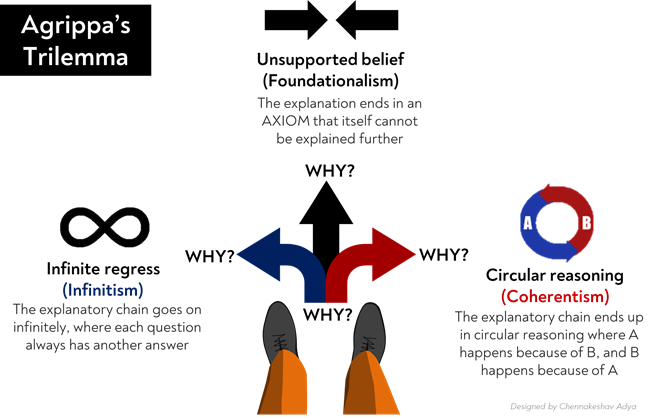
With this framework in mind, let's apply it to your specific contexts.
Application 1: Defending a Lingerie Design Choice
Imagine you've designed a premium bra with a three-part seamed cup. A client, accustomed to seamless molded cups, questions your choice.
Client: "I'm not sure about all these seams. My other bras are smooth. Why is this one built this way? Is it really better?"
Your task is to justify your design. Let's trace the conversation:
You (Initial Justification): "This three-part cup offers superior support and a more projected, natural shape for your bust size compared to a molded cup. The seams act as structural elements."
Client: "Why do seams create better support?"
You (Second Justification): "Because they are made from non-stretch material and are precisely angled to distribute the weight of the breast tissue, lifting it against gravity. A molded cup, made of a single piece of heat-shaped foam, relies only on its uniform curvature and has less capacity to lift and separate."
Client: "Okay, but why is that method of weight distribution considered superior?"
Here, you are at the edge of the trilemma. You have three ways to go:
- Infinite Regress: You could continue down a rabbit hole of physics (stress-strain curves of fabric), engineering (load-bearing structures), and anatomy (physiology of breast tissue ligaments). Each explanation would invite another "why," leading to an impractical and endless technical lecture.
- Circular Reasoning: "This construction provides superior support because superior support is defined by the very lifting and shaping action that this construction provides." This statement is true but unhelpful; it doesn't advance the client's understanding because the reason and the conclusion are effectively the same.
- Dogmatic Argument (Axiom): You stop the regress by appealing to a foundational principle. "It's a fundamental axiom of bespoke tailoring and structural engineering that complex shapes are best supported by combining multiple, strategically placed components. This principle has been proven over centuries of corsetry and bra design." Or, more simply: "At a certain point, it comes down to foundational principles of garment engineering. This method is the established best practice for achieving this specific goal."
In a practical setting like a client consultation, the third option—the dogmatic or axiomatic argument—is the only viable one. You are asking the client to accept a foundational principle, either from the industry ("this is how it's done") or from your own expertise ("trust my professional judgment"). You have reached the limit of practical justification.
Application 2: Justifying a Relationship Agreement
Now, consider the Vee relationship involving Alex, his wife Bella, and her partner Charles. A skeptical family member confronts Alex, who supports the relationship.
Skeptic: "I still don't understand why you're okay with this. A marriage is supposed to be between two people. Why would you agree to a structure that seems designed to fail?"
Alex must justify the foundation of his marriage agreement.
Alex (Initial Justification): "Our agreement is based on a commitment to each other's individual happiness and growth. We believe a strong relationship supports partners in becoming their fullest selves."
Skeptic: "But why should 'individual happiness' override the security of exclusivity? Isn't marriage about sacrifice and creating a single unit?"
Alex (Second Justification): "We believe that true security comes from trust and open communication, not from rules that restrict personal experience. For us, a 'single unit' is stronger when its individual parts are thriving."
Skeptic: "That sounds nice, but why do you believe that? It goes against everything society teaches us about love and commitment."
Like the designer, Alex is now at the trilemma's crossroads.
- Infinite Regress: He could delve into moral philosophy (utilitarianism vs. deontology), psychology (attachment theory, the nature of compersion), and sociology (historical evolution of marriage). The skeptic can keep asking "why" at every level.
- Circular Reasoning: "We believe in this structure because it makes us happy, and our definition of a good relationship is one that brings happiness." The justification presupposes its own conclusion about what constitutes a "good relationship."
- Dogmatic Argument (Axiom): He must state a core, unprovable value. "Ultimately, we hold individual autonomy and the pursuit of personal fulfillment as foundational values. We believe these are self-evident goods. Our entire relationship structure is built upon that axiom."
This final statement doesn't prove the skeptic wrong; it declares the fundamental starting point of Alex and Bella's philosophy. It's the equivalent of a mathematician stating an axiom. You can't prove that parallel lines never meet in Euclidean geometry; you simply accept it as a starting rule. Similarly, Alex is stating the unprovable "rule" from which their relationship's logic is derived. He has hit the limit of justification and revealed the core belief his entire argument rests upon.
Living with the Trilemma
The realization that no belief can be justified with absolute certainty can be unsettling. However, it does not have to lead to intellectual paralysis or the conclusion that all beliefs are equally valid. Philosophers and scientists have developed pragmatic ways to operate within these limits.
How is the Münchhausen trilemma not the biggest problem in meta ...
This discussion on Philosophy Stack Exchange moves from the theoretical problem to practical responses. It shows how thinkers accept the trilemma's conclusion without abandoning the pursuit of knowledge.
Read the first answer provided by user J D. Focus on the two key positions he outlines: reliabilism, which focuses on the process, and fallibilism, which accepts that our beliefs are never conclusive. Then, read the answer by user alanf, which introduces an alternative approach: critical rationalism, which abandons the search for justification in favor of a process of criticism and error-correction.
The key takeaways from these practical approaches are:
- Fallibilism: We accept that our foundational beliefs (our "axioms") might be wrong. We hold them provisionally, ready to revise them in the face of new evidence or better arguments. The bra designer is open to a new material science breakthrough; Alex and Bella are open to the possibility that their relationship structure may need to change if it stops leading to happiness.
- Pragmatism/Reliabilism: We don't need absolute certainty. We need justifications that are good enough for the task at hand. The justification works if it leads to a reliable outcome—a well-fitting bra or a stable, happy relationship.
- Critical Rationalism: We shift our focus from trying to prove our beliefs true to trying to find where they are false. An idea's strength lies not in its impossible proof, but in its ability to withstand rigorous criticism.
Conclusion
The Münchhausen Trilemma reveals that the quest for ultimate, certain justification is a journey with no final destination. Every chain of reasoning must end somewhere, either by looping back on itself, trailing into infinity, or stopping at a foundational belief that is itself unproven. Recognizing this is a core competency of advanced critical thinking.
Key Takeaways:
- Three Dead Ends: Any attempt at ultimate proof leads to one of three outcomes: infinite regress, circular reasoning, or a dogmatic (axiomatic) assertion.
- Justification Has Limits: There is a point in any argument where you must rely on a foundational principle or value that cannot be further proven, only stated.
- Application is Axiomatic: In both technical design and personal philosophy, defending your position ultimately requires appealing to these core axioms—be they principles of engineering or fundamental human values.
- The Pragmatic Escape: We navigate this by embracing fallibilism, accepting that our foundations are provisional and that our goal is not absolute certainty but rather practical success and the continuous elimination of errors.
In our next and final lesson of this module, we will explore the Socratic Method. This is a powerful conversational technique designed specifically to do what the trilemma challenges us to do: examine the strength, consistency, and implications of our foundational beliefs and those of others.