Welcome to the first lesson in our second module, "Cognitive Biases in Perception and Judgment." We've just completed our exploration of critical thinking frameworks, culminating in the Socratic Method—a powerful tool for collaboratively examining our foundational beliefs. We saw how asking the right questions can lead to shared understanding, whether in a bra fitting or a relationship negotiation.
Now, we shift our focus from the process of sound thinking to the predictable errors our minds tend to make. This module explores the cognitive biases that can unconsciously shape our perceptions and decisions. Our first subject is Maslow's Hammer. Formulated by psychologist Abraham Maslow, it's famously summarized as: "I suppose it is tempting, if the only tool you have is a hammer, to treat everything as if it were a nail."
In this lesson, you will apply this concept to identify and analyze the consequences of over-relying on a single, familiar method in both lingerie design and relationship dynamics.
The Allure of the Familiar Tool
Maslow's Hammer, also known as the law of the instrument, describes our tendency to approach diverse problems with the same solution, simply because it's the one we know best. For a quick overview, please read the definition provided by The Decision Lab.
Law of the instrument - The Decision Lab
This article provides a concise definition of Maslow's Hammer.
Please read the brief section titled What is the Law of the Instrument?. Pay attention to how it frames this bias as a consequence of acquiring a new skill.
As a statistician, you can likely see parallels in modeling. It’s akin to a researcher applying linear regression to every dataset out of familiarity, even when the underlying relationships are clearly non-linear or when other models (like logistic regression for binary outcomes or time-series analysis for temporal data) would be far more appropriate. The comfort of the "hammer" overrides the need for the correct tool.
Application 1: The One-Technique Bra Designer
Your experience in lingerie design will make this first application intuitive. A bra is a complex piece of engineering, requiring a wide range of techniques to accommodate different body shapes, tissue types, and aesthetic goals. A designer who falls prey to Maslow's Hammer might become an expert in one specific construction method and apply it universally, with poor results.
Scenario: Imagine a designer who has perfected the art of creating smooth, seamless bras using pre-molded foam t-shirt cups. This is their "hammer."
- Client A has firm, self-supporting breast tissue and wants a smooth silhouette under a knit top. The designer's hammer is a perfect fit for this nail. The molded cup works beautifully.
- Client B has softer, more pendulous breast tissue and wants significant lift and a forward projection to look her best in a tailored blazer. She wants to flaunt her cleavage.
For Client B, the molded t-shirt cup is the wrong tool. It's likely to create gapping at the top, fail to provide adequate lift from below, and may even push the tissue outwards instead of forwards. The correct tool would likely be a multi-part seamed cup, which uses carefully angled seams to lift, shape, and support the breast tissue from multiple directions.
The designer, over-relying on their familiar hammer, might try to force the molded cup to work—adding bulky inserts ("cookies"), aggressively tightening the band, or making other adjustments that compromise comfort and fit. They are treating a screw (a problem needing a different tool) like a nail.
This is a common pitfall. The video below on custom bra pattern drafting implicitly argues against Maslow's Hammer. The creator repeatedly emphasizes that pre-existing patterns (a type of tool) often fail and that true fit comes from constant adaptation and creating "many, many mock-ups."
Pattern Construction Underwire BRA (detailed) sup.1.1.5
This video by Katerina Ivanova demonstrates the iterative and highly customized process of drafting a bra pattern from scratch.
Please watch two key segments: The introduction, from the beginning, where she explains why she makes her own patterns and the need for "many, many mock-ups." Her concluding thoughts, from the conclusion, where she stresses that "everything kind of depends" and that all bodies are different. Notice how her entire philosophy is about selecting and refining the right tool for a unique problem, rather than relying on a single, universal solution.

Expert designers learn to fight this bias. They embrace a mindset of resourcefulness, as described in the following article about bag design.
How to Design a Bag, According to Designers (with Aaron Puglisi)
This article from Carryology features a designer who explicitly discusses Maslow's Hammer and how to overcome it in a design context.
Please read two sections: In the "Goldilocks" section, focus on the paragraph that flips Maslow’s Law around, advocating for resourcefulness over perfectionism. In the "My Precious" section, read the paragraph beginning with "Every sample is a hammer..." This shows the mental shift required to treat methods and prototypes as disposable tools for learning, not as cherished outcomes.
The antidote to Maslow's Hammer in design is not just having more tools, but cultivating a diagnostic mindset that correctly matches the tool to the problem—even if it's just fabric scraps and a stapler.
Application 2: The Default Conflict Resolution Pattern
This bias is just as prevalent in relationships, where a person’s preferred communication or conflict style becomes their hammer for every interpersonal issue. As a social researcher, you're likely familiar with the destructive patterns that emerge when partners' "hammers" are misaligned.
Scenario: Let's return to Alex, Bella, and Charles. Imagine Alex's default "hammer" for dealing with conflict is intellectual analysis. When a problem arises, he is quick to deconstruct it logically, identify root causes, and propose a rational solution. This tool serves him well when the "nail" is a logistical challenge, like coordinating schedules.
However, a different problem arises: Bella feels a pang of jealousy when Alex mentions a fun outing with a friend. She expresses her feeling to him, seeking emotional connection and reassurance. Alex, reaching for his familiar hammer, responds by "solving" the problem: "Logically, your jealousy is unfounded. My friendship is purely platonic and poses no threat to our relationship. Therefore, you shouldn't feel jealous."
He has treated her emotional experience as a nail to be hammered flat with logic. The tool is completely mismatched to the task. What was needed was a different tool from the emotional toolbox: empathy, validation ("I hear that you're feeling jealous, that sounds painful"), or reassurance ("I love you and you are the center of my life"). His application of the wrong tool makes Bella feel dismissed and unheard, escalating the conflict.
This often leads to a well-documented dynamic known as the Pursuer-Distancer cycle. One partner, feeling a lack of connection (the Pursuer), uses their "hammer"—escalating bids for connection and confrontation. The other partner, feeling overwhelmed (the Distancer), uses their "hammer"—withdrawing to create space and de-escalate. Both are using the only tool they feel comfortable with, but the tools are diametrically opposed, creating a feedback loop of frustration.
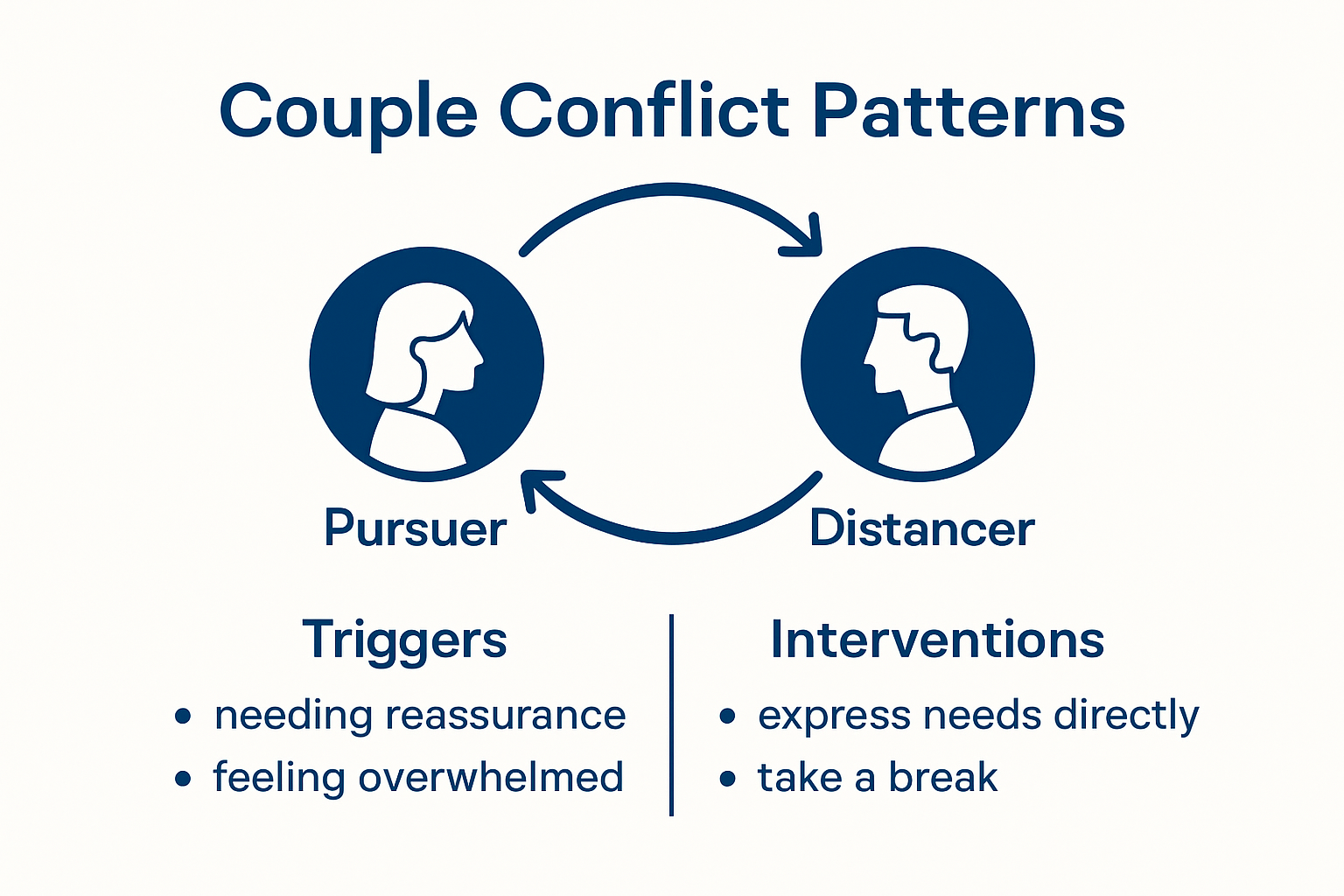
In this diagram, the "Triggers" are the nails, and the "Pursuer" and "Distancer" roles are the hammers. The tragic irony is that each partner's attempt to solve the problem with their preferred tool only makes it worse for the other. The key to breaking the cycle, as noted under "Interventions," is to consciously choose a different tool that better suits the situation and the other person's needs. For the Vee of Alex, Bella, and Charles, this means building a shared toolbox of communication strategies, recognizing that the tool for negotiating boundaries is different from the tool for offering comfort, which is different from the tool for celebrating compersion.
Conclusion
Maslow's Hammer is a subtle but powerful bias that encourages us to stick to the comfortable and familiar, even when it's ineffective. Recognizing this tendency is the first step toward consciously building a more versatile toolkit.
Key Takeaways:
- Maslow's Hammer is the cognitive bias of over-relying on a familiar tool or method, treating every problem as if it were amenable to the same solution.
- In lingerie design, this manifests as forcing a single construction technique to work for all body types and aesthetic goals, leading to poor fit. The solution is an iterative, experimental approach and a broad repertoire of techniques.
- In relationships, this bias appears as using a default communication or conflict style for all situations, often leading to misunderstanding and cyclical conflicts like the pursuer-distancer dynamic. The solution is developing emotional agility and a range of interpersonal tools.
In our next lesson, we will explore a related but distinct cognitive bias. While Maslow's Hammer is about misapplying a skill you possess, the Dunning-Kruger Effect is about failing to recognize your own lack of skill. We will apply it to scenarios where a client overestimates their bra-fitting knowledge and where a partner overestimates their readiness for the complexities of polyamory.