Welcome to your next lesson in the "Foundations of Critical Thinking" module. Last time, we explored Chesterton's Fence, a principle urging us to understand the purpose of an existing structure before we alter or remove it. We applied this to deconstructing bra components and relationship boundaries. Today, we shift our focus from evaluating what is to scrutinizing what is claimed to be, especially when a claim seems designed to be impossible to disprove.
Our topic is Russell's Teapot, a famous philosophical analogy that addresses the burden of proof. Your learning objective is to apply this principle to two scenarios: evaluating a novel bra design claim and challenging an unfalsifiable assertion about relationships. This tool will help you identify who is responsible for providing evidence in a discussion and give you the confidence to dismiss claims that don't meet this basic standard.
The Unfalsifiable Claim and the Burden of Proof
At its heart, Russell's Teapot is a simple but powerful thought experiment. It illustrates who should carry the "burden of proof" when a claim is made. The core idea is that the person making a positive assertion is responsible for supporting it with evidence, especially if the claim is extraordinary or cannot be proven false.
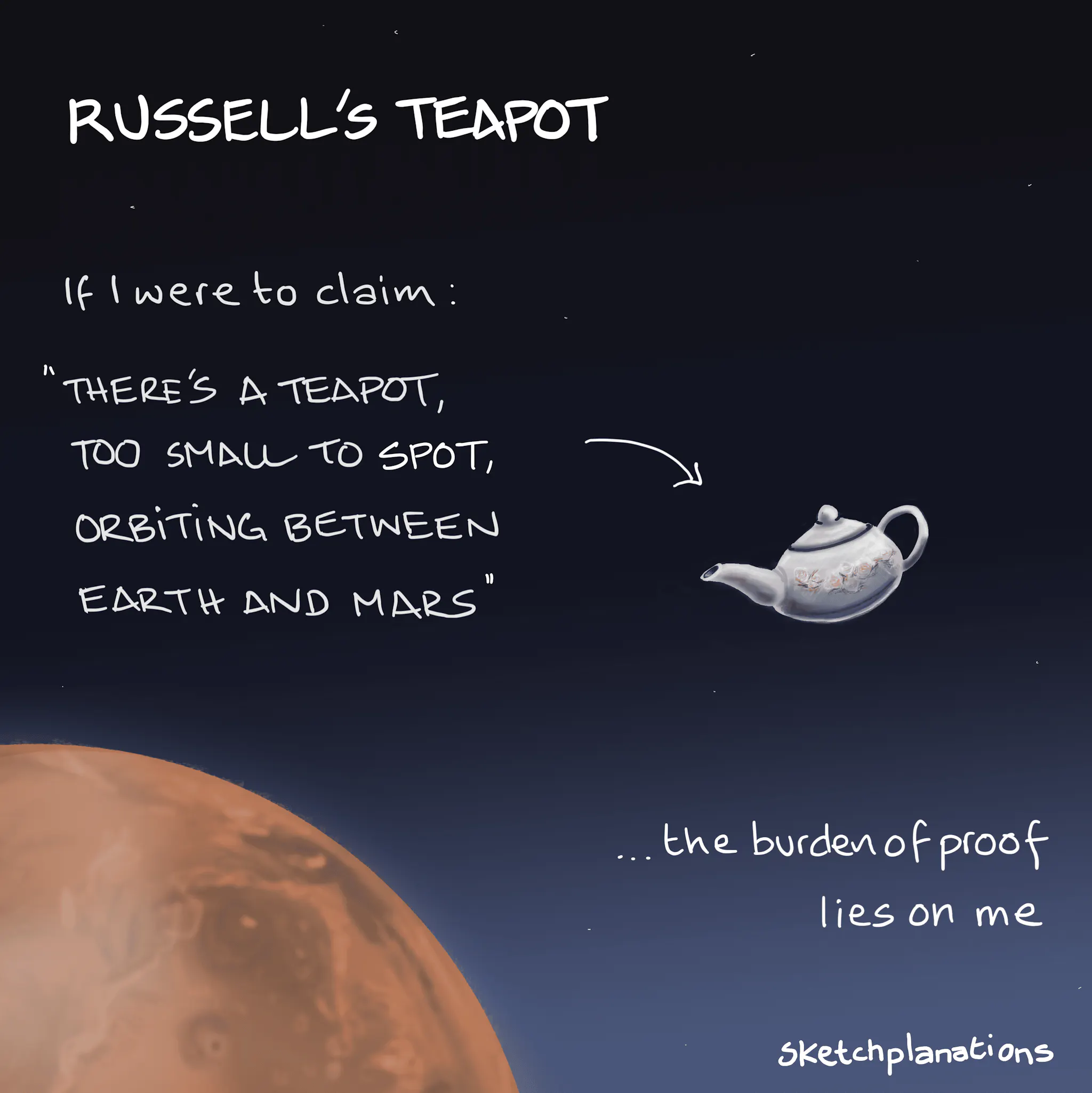
The following short video provides a crisp explanation of the analogy and its implications for rational discussion.
Russell's Teapot (explained in 3 minutes)
This video from the Bebeflapula channel explains Russell's Teapot in just three minutes, clearly laying out the core argument and its consequences.
Please watch the entire video. Focus on how it answers these questions: What is the central analogy of the teapot? Who holds the responsibility to provide justification for a belief? What happens when someone shifts the burden of proof onto the disbeliever?
As the video shows, if someone makes a claim and then demands that others disprove it, they are trying to shift their evidentiary burden. This move is a logical fallacy. To solidify this, let's turn to a brief reading that places Russell's Teapot within the formal context of the burden of proof.
The Burden of Proof: Why People Should Support Their Claims
This article from Effectiviology provides a thorough breakdown of the burden of proof, its fallacies, and key examples. We will focus on the introduction and the section detailing Russell's Teapot.
First, read the introduction to understand the formal definition of the concept. Then, navigate to the subsection "Examples of the burden of proof fallacy." In that section, please read the part that begins with the heading "Russell’s teapot," which presents the original text from philosopher Bertrand Russell.
The key takeaway is this: making a claim that is unfalsifiable—structured in a way that it cannot be tested or proven false—does not make it valid. It simply places the entire burden of proof on the claimant. This connects directly to Hitchens's Razor, which we discussed earlier: "What can be asserted without evidence can also be dismissed without evidence." Russell's Teapot gives us a memorable image for why this is the case.
Application 1: Evaluating a Novel Bra Design Claim
Let's imagine a scenario in your field of lingerie design. A new, high-end brand launches a product called the "Aura Bra." The marketing campaign makes a bold claim.
Scenario: The Aura Bra's fabric is allegedly woven with a special, proprietary fiber that emits "bio-resonant frequencies." The brand claims these frequencies subtly align the wearer's posture and improve their sense of well-being over time. When pressed for technical data, the company states that the frequencies are "a form of subtle energy not detectable by conventional scientific equipment."
How do you, as a designer and a critical thinker, evaluate this?
- Identify the Claim: The bra provides posture and wellness benefits through undetectable "bio-resonant frequencies."
- Assign the Burden of Proof: The claim is positive, extraordinary, and—most importantly—unfalsifiable by its own definition ("not detectable by conventional equipment"). This is a textbook Russell's Teapot. The burden of proof lies 100% with the Aura Bra company. It is their responsibility to provide credible evidence for their claim, not on consumers or competitors to prove the frequencies don't exist.
- Evaluate the Evidence: The company has provided no evidence and has, in fact, built a defensive wall around their claim by deeming it untestable.
- Form a Conclusion: Using the principle of Russell's Teapot, you can dismiss the "bio-resonant frequencies" claim as baseless marketing. Your professional evaluation of the Aura Bra should ignore this unsupported assertion and focus entirely on its tangible, verifiable characteristics: the quality of the materials, the construction, the fit, the actual support it provides, and its aesthetics. The teapot in this case is the "subtle energy," and you are under no obligation to believe in it.
Application 2: Challenging an Unfalsifiable Relationship Assertion
Now, let's apply the same logic to the complexities of personal relationships. We'll return to our Vee scenario involving Alex, his wife Bella, and her partner Charles.
Scenario: Bella is having lunch with a longtime friend, Diana, who is skeptical of their non-monogamous relationship. Diana says, "I'm worried about you, Bella. I just have this strong gut feeling that living this way is fundamentally eroding your 'feminine essence.' It's a kind of spiritual damage you can't see or feel now, but it's happening, and it will hollow you out in the end."
This statement, though likely coming from a place of concern, is a classic unfalsifiable claim.
- Identify the Claim: The Vee relationship is causing invisible "spiritual damage" to Bella's "feminine essence," which will lead to future unhappiness.
- Assign the Burden of Proof: The concepts of "feminine essence" and "spiritual damage" are vague, subjective, and not defined in any testable way. The claim is unfalsifiable. The burden of proof is therefore on Diana to explain what "feminine essence" is, how she knows it's being "eroded," and provide some rational basis for her prediction of future misery beyond a "strong gut feeling."
- Evaluate the Evidence: Diana provides no evidence, only an appeal to intuition and nebulous, emotionally charged concepts. Her claim is a teapot orbiting Bella's relationship—impossible for Bella to disprove. Does Bella feel hollowed out? No. Is her relationship with Alex suffering? No. Is she unhappy? No. The claim exists entirely independent of any observable reality.
- Form a Conclusion: Bella does not need to accept Diana's framing or get drawn into an argument about her "feminine essence." She can recognize that Diana is making an assertion without evidence. Bella is not required to prove that her soul is not being damaged. She can confidently state that her own lived experience—her happiness, the health of her relationships, her personal growth—is the evidence she relies on. She can dismiss Diana's claim, not necessarily out of disrespect, but because it provides no rational basis for discussion.
Conclusion
Russell's Teapot is a crucial tool for maintaining intellectual hygiene. It provides a clear standard for when a claim is worthy of consideration and when it can be summarily dismissed. By forcing the burden of proof onto the claimant, it prevents us from wasting energy trying to disprove every unsubstantiated idea we encounter, from marketing pseudoscience to well-intentioned but baseless personal advice.
Key Takeaways:
- The Burden of Proof: The person making a positive claim, especially an extraordinary or unfalsifiable one, is responsible for providing evidence.
- Unfalsifiable Claims: Claims designed to be untestable (like an undetectable teapot) are not arguments; they are mere assertions.
- Application in Design: Evaluate products based on their measurable, verifiable qualities. Dismiss marketing claims that rely on untestable "subtle energies" or pseudoscience.
- Application in Relationships: You are not obligated to disprove vague, intuitive, or spiritual assertions about your life or relationships. The burden lies with the person making the claim to provide a rational basis for it.
In our next lesson, we will explore Hume's Guillotine. This principle introduces another fundamental distinction in critical thinking: the gap between "is" statements (what is factually true) and "ought" statements (what we should do). This will move us from evaluating claims about reality to dissecting arguments about morality and action.