In our last session, we used the Ishikawa Diagram to brainstorm a comprehensive map of potential causes for complex problems. This approach ensures we don't overlook possibilities. However, with a long list of potential causes, the practical question becomes: where do you begin your investigation? This lesson introduces a principle for exactly that.
Our objective is to apply Sutton's Law to focus your diagnostic effort on the most likely cause of a bra fitting problem and to address the most probable source of recurring tension in a vee relationship. This law provides a strategic filter, helping you move from a broad list of possibilities to a targeted and efficient starting point for problem-solving. It's the logical next step after laying out all the factors with a fishbone diagram.
Sutton's Law: Go Where the Money Is
Sutton's Law is famously, if apocryphally, attributed to bank robber Willie Sutton, who, when asked why he robbed banks, supposedly replied, "because that's where the money is." In a diagnostic context, it means you should prioritize investigating the cause that has the highest probability of being the correct one. Instead of running through a long, routine checklist, you go straight for the most likely explanation.
This principle originated in medicine, where it was used to justify proceeding directly to the diagnostic test most likely to provide a conclusive answer. To understand its origins and its modern, more nuanced interpretation, please read the following article from the Permanente Journal.
Sutton's Law: A Lesson in Decision-Analysis from the Past…and ...
This paper provides a fantastic history and analysis of Sutton's Law, tracing its origins and its evolution into a principle of modern decision analysis.
First, read the introduction and the section titled INTRODUCTION to grasp the story behind the law. Next, read Dr. Dock's own account of applying the law in the section beginning "Dock:". Notice how a single piece of information—the patient's connection to Puerto Rico—dramatically adjusted his assessment of probabilities, guiding him "where the money is." Finally, and most importantly for your statistical background, read the section where Dr. Dock proposes an expanded and evolved version of Sutton's Law. He frames it in terms of Formal Medical Decision-Analysis (FMDA), connecting it to concepts like pre- and post-test probability and likelihood ratios. This reframes Sutton's Law from a simple aphorism to a strategy of probabilistic prioritization: embrace tests and questions that will most significantly shift your confidence toward or away from a diagnosis.
The key takeaway is that Sutton's Law is about diagnostic efficiency. After brainstorming all possibilities, you start with the one that is most common, most potent, or most likely to yield a definitive answer. Let's apply this.
Application 1: Diagnosing a Bra Fitting Problem
In your work as a lingerie designer, you constantly face fit issues. The previous lesson's Ishikawa diagram helped us map the myriad causes for a digging underwire. Now, let's take a different common complaint and use Sutton's Law to diagnose it efficiently.

Problem: A client complains that her bra straps are constantly slipping off her shoulders.
From experience and fitting guides, we know there are several potential causes: straps are too loose, the band is too big, the client has narrow shoulders, or the bra style is a mismatch for her body. Where do you start?
Sutton's Law directs you to "go where the money is." In bra fitting, the vast majority of support and fit issues originate from the band. Therefore, the most probable cause of slipping straps is an ill-fitting band.
The National Breast Cancer Foundation's Bra Fit Guide provides an excellent, practical application of this principle.
[PDF] Bra Fit Guide - National Breast Cancer Foundation
This guide offers clear, problem-oriented advice that implicitly uses Sutton's Law.
In the PDF, navigate to page 10 and read the sections Concern #1: Straps Slipping Off Shoulders and Concern #2: Band Riding Up The Back. Notice how for "slipping straps," the first and primary suspect is the band size.
The guide confirms our application of Sutton's Law. Here is the diagnostic workflow:
- Prioritize the Highest Probability Cause: The most likely reason for slipping straps is that the band is too large. When the band is too big, the entire architecture of the bra is compromised, and the straps are positioned too far apart for the wearer's frame.
- Test the Hypothesis: Check the band. Is it snug and level across the back, or does it ride up? Can you fit more than two fingers underneath it?
- Analyze the Result:
- If the band is indeed too loose: You have likely found your root cause. The solution is to go down a band size and up a cup size (e.g., from a 36C to a 34D) to maintain cup volume while correcting the frame.
- If the band fits perfectly: You have ruled out the most probable cause. Only now do you proceed to the next most likely hypothesis: the client has particularly narrow or sloped shoulders. In this case, the solution isn't a size change but a style change—to a bra with more centrally-set straps, a racerback style, or other design features to address her specific anatomy.
By starting with the band, you address the 80% case first, saving time and avoiding unnecessary detours into changing styles when a simple size adjustment would suffice.
Application 2: Addressing Relationship Tension in a Vee
Now let's turn to the vee relationship. The husband and wife are experiencing recurring conflict, which on the surface is about scheduling and time management. The Ishikawa diagram from our last lesson showed this could stem from poor communication, weak boundaries, external stress, or deeper insecurities.
As a social researcher, you know that surface-level conflicts often mask deeper emotional drivers. Sutton's Law advises us to look for the most probable and potent source of the tension first. What is "the money" in this emotional economy?
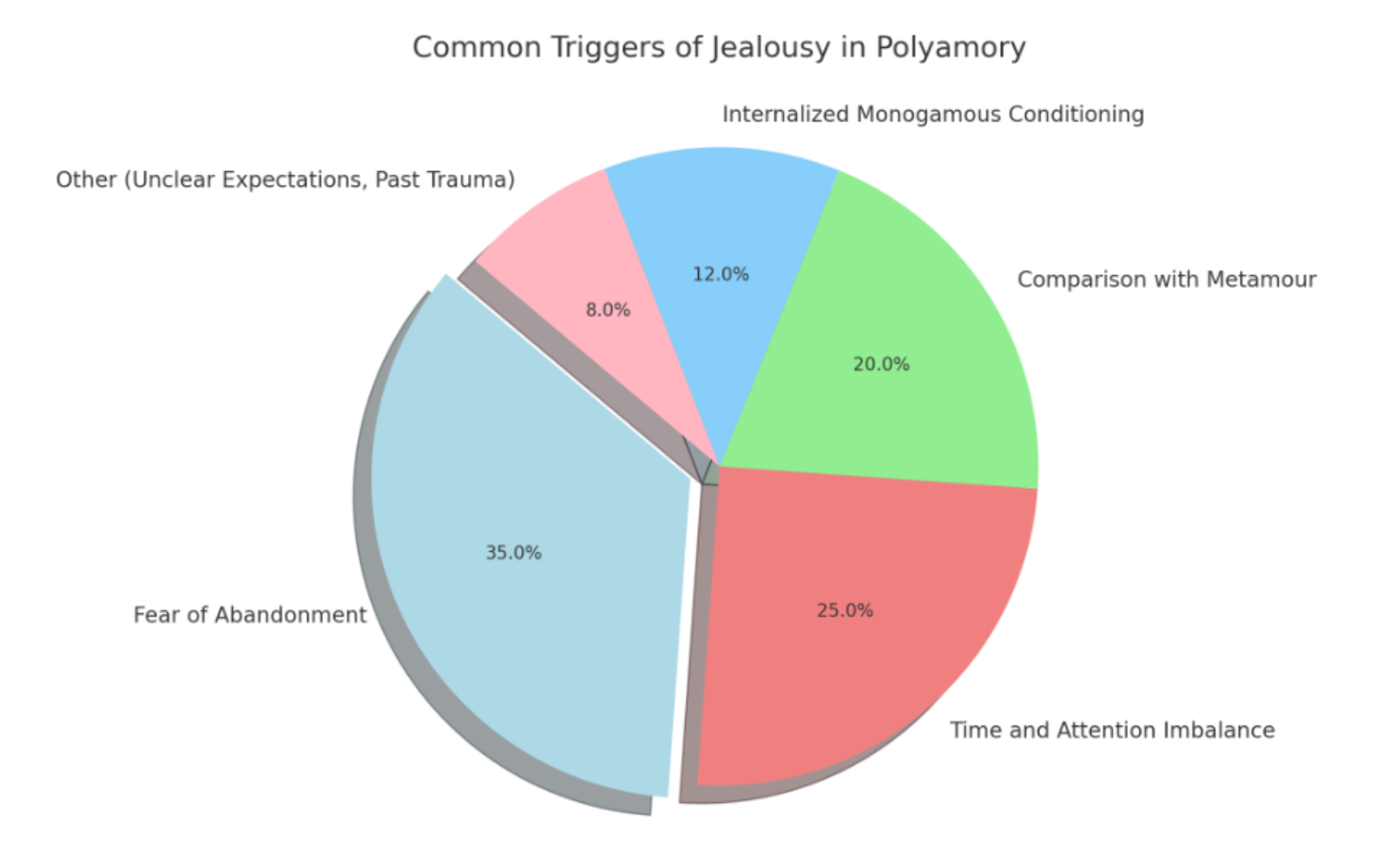
The chart above gives us a data-informed starting point. It suggests that "Fear of Abandonment" (35%) and "Time and Attention Imbalance" (25%) are the two most significant triggers for jealousy and, by extension, conflict. Sutton's Law would therefore guide the couple to start their diagnostic conversation here, rather than with calendar logistics.
Here is the diagnostic workflow for the couple:
- Prioritize the Highest Probability Cause: The arguments about "who spent how much time where" are likely not about the minutes themselves, but about what that time represents. The most probable underlying issues are feelings of insecurity, fear of being replaced, or a perceived imbalance in care and attention.
- Test the Hypothesis: The husband, acting as a facilitator, can steer the conversation away from the symptomatic argument (e.g., "You were late coming home from your date") toward the likely root cause. He could ask questions grounded in this hypothesis:
- "When I feel us arguing about schedules, I wonder if what's really going on is something deeper. For me, it sometimes brings up fears about our connection. Does it do that for you?"
- "Can we talk about how we're each feeling in terms of security and priority in our relationship right now?"
- Analyze the Result:
- If these questions open up a conversation about fear, neglect, or insecurity: The couple has found "where the money is." They can now work on the real issue: providing reassurance, defining what makes each person feel secure, and addressing the fear of abandonment directly. Solving this will likely cause the arguments about schedules to diminish on their own.
- If both partners genuinely feel secure and the issue truly seems to be logistical: They have ruled out the most potent emotional cause and can move on to the next hypothesis—perhaps their scheduling system is simply inefficient, and they need a better shared calendar. But they do so with the confidence that they have already checked for a deeper, more corrosive problem.
By focusing on the most statistically common and emotionally significant triggers, the couple can avoid weeks of fruitless arguments about surface details and begin addressing the core dynamic that is actually fueling their conflict.
Conclusion
Sutton's Law is a powerful principle of efficiency that complements the comprehensive view of an Ishikawa Diagram. While the fishbone diagram asks "What could be the cause?", Sutton's Law asks "What is the most likely cause to investigate first?".
Key Takeaways:
- Sutton's Law advises prioritizing the diagnostic test or line of inquiry that is most likely to yield a conclusive answer.
- In bra fitting, this often means checking the fit of the band first, as it is the foundation of the garment's support and the most common source of problems.
- In relationship dynamics, it means looking past surface-level arguments to address the most probable and powerful underlying emotional drivers, such as insecurity or fear of neglect.
- Applying this law saves time and resources by focusing effort where it will have the greatest impact, a concept that aligns well with probabilistic and statistical thinking.
In our previous lessons, we've learned to define the problem (Kidlin's Law), prioritize it (Eisenhower Matrix), brainstorm its causes (Ishikawa Diagram), and now, select the most likely cause to investigate first (Sutton's Law). But what if the best action is no action at all? Our next lesson will explore Falkland's Law, which states: "If you don't have to make a decision, don't make one." This will provide a crucial counterpoint to the proactive nature of Sutton's Law.