Welcome back. In our previous lessons, we've built a powerful problem-solving toolkit. We learned to map out all potential causes with an Ishikawa Diagram and then, using Sutton's Law, to strategically target the most probable cause first. This creates a highly efficient, action-oriented approach. However, not all situations benefit from immediate action. What if the most probable cause is still highly uncertain, or the cost of a wrong move is catastrophic?
This lesson introduces a crucial counter-principle: Falkland's Law. Its core tenet is, "If you don't have to make a decision, don't make one." We will explore how to apply this law to identify when strategic inaction—deferring a choice—is the wisest course of action in your professional and personal contexts. Specifically, we'll analyze when to postpone a final bra design decision and when to leave a question about your vee relationship's structure open until more information becomes available.
Falkland's Law: The Power of Strategic Inaction
At first glance, Falkland's Law might sound like procrastination or indecisiveness. However, it is a principle of strategic patience. It advocates for consciously pausing when faced with high uncertainty, emotional pressure, or insufficient information, especially when a decision is not truly urgent and has significant, potentially irreversible consequences.
To understand the origins and practical applications of this idea, please read the following article from Mental Zon.
Falkland's Law: When Should You Avoid Making a Decision?
This article provides a clear introduction to Falkland's Law, explaining its psychological basis and offering actionable advice. It elegantly distinguishes strategic inaction from a simple "freeze" response.
Read the article from the beginning to the end. Pay close attention to these key points: The distinction between the involuntary "freeze" response and the conscious choice to delay. The historical analogy of the Falklands War as an example of the dangers of impulsive action. The section on practical application, particularly the points about avoiding emotional decisions and evaluating choices made under uncertainty. The final emphasis on strategic patience.
The article frames Falkland's Law as a heuristic. Your background as a statistician and social researcher might appreciate a more formal framing. In decision theory and consumer psychology, this concept is studied as "choice deferral." Research shows that when people defer a choice, it's often not a failure but a strategy to gather more information to optimize the final decision.
Let's look at a research paper that explores this. You don't need to read the full paper, but a few key sections will provide a solid, evidence-based perspective.
The Impact of Consumers' Choice Deferral Behavior on Their ... - PMC
This study connects choice deferral to better long-term outcomes, providing an empirical backbone to Falkland's Law.
First, read the Abstract. Note the key finding: choice deferral can lead consumers to prefer "larger-longer interests." Next, read the first paragraph of the section "Choice Deferral Behavior." This formally defines the concept as a time interval between the need for a decision and the actual act of deciding. Finally, read the paragraph under "Theoretical Contributions" that begins "Thirdly, this study explored the positive role of choice deferral behavior." This section explicitly refutes the idea that deferral is purely negative, arguing it's a mechanism for making better decisions and avoiding future regret.
The key insight is that deferring a decision is a tool. It creates space to reduce uncertainty. The value of this "information gap" must be weighed against the cost of delay. Falkland's Law applies when the expected value of future information is higher than the cost of waiting.
Application 1: Deferring a Bra Design Decision
Let's apply this to your work in lingerie design.

Scenario: Your company's supplier introduces a revolutionary new microfiber fabric. It's incredibly soft, lightweight, and comes in a unique color palette. The marketing department is pressuring your design team to create a new collection immediately to be the first to market. However, the fabric is so new that there is no long-term data on its durability, how its color holds up to repeated washing, or its elasticity over time.
You face a decision: Do you approve a final design and commit to a full production run now, or do you wait?
Applying Falkland's Law:
This is a classic case where Falkland's Law is invaluable.
- High Uncertainty: You have no data on the fabric's long-term performance.
- High Stakes: A product failure due to pilling, color-fading, or stretched-out bands would be a disaster for brand reputation and would require costly returns.
- No Real Urgency: While being first to market is desirable, it's not essential for the company's survival. The cost of a few weeks' delay is minimal compared to the cost of a product recall.
The law says: "If you don't have to make a decision, don't make one." You don't have to commit to a full production run today.
The Deferred Decision: You decide to postpone the final sign-off on the collection.
Action During the Pause: This is not passive waiting. You use the time to gather critical data:
- Accelerated Wear Testing: Create several prototypes and subject them to accelerated aging tests (e.g., 50 wash-and-dry cycles, stretching them on mannequins for extended periods).
- Seam and Construction Trials: Test how the fabric reacts to different types of stitches and elastics. Does it pucker? Does it hold its shape?
- User Feedback: Provide prototypes to a small group of trusted testers for real-world feedback on comfort and performance.
Outcome: The testing reveals that while the fabric is wonderful, its color fades slightly when exposed to certain common detergents, and it requires a special type of reinforced stitch at stress points to prevent tearing. Armed with this new information, you can now make a high-quality decision. You modify the care instructions and adjust the construction specifications. The final product is robust and successful. By deferring the decision, you avoided a predictable failure.
Application 2: Deferring a Relationship Configuration Decision
Now, let's turn to the personal context of the vee relationship.
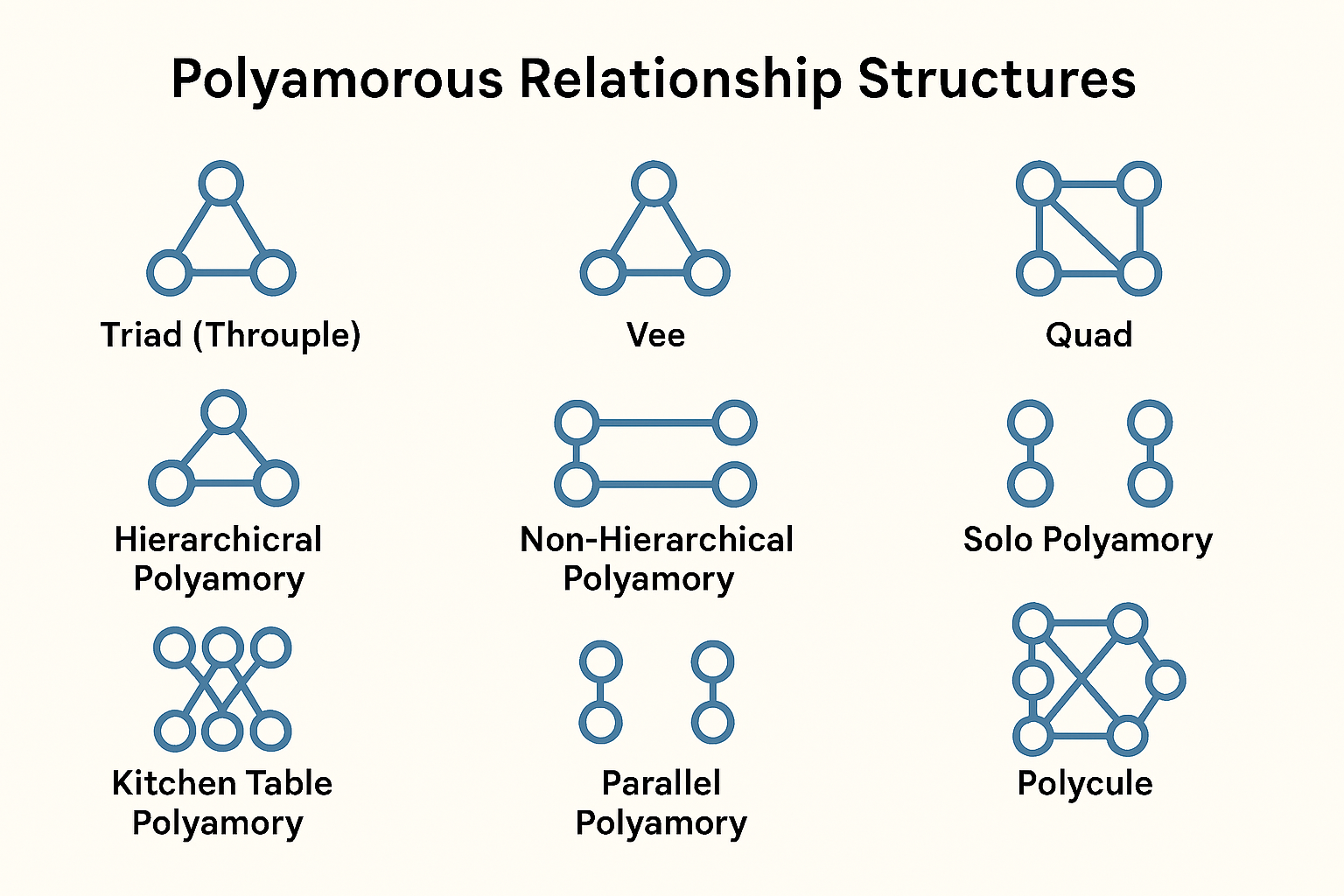
Scenario: The wife and her lover have been dating for several months, and their connection is deepening. They feel ready for the next step and ask the husband if the lover can start staying overnight at the family home. The husband feels a surge of anxiety and pressure to give an answer on the spot. He wants to be supportive, but the idea feels unsettling. He can't immediately articulate why.
He faces a decision: A premature "yes" could ignore his own unprocessed feelings, leading to resentment. A reactive "no" could feel like a rejection to his wife and her partner, causing a crisis.
Applying Falkland's Law:
This is a situation of high emotional stakes and significant personal uncertainty.
- High Uncertainty: The husband is unsure of his own feelings and the practical implications. The triad has no "data" on what co-habiting, even for one night, will feel like for everyone.
- Emotional Pressure: The request creates an immediate pressure to respond, activating a "fight-or-flight" (or "freeze") impulse.
- Irreversibility: Once the boundary of "no overnights" is crossed, it's difficult to go back without it feeling like a punishment or withdrawal.
Falkland's Law provides a path forward: You don't have to make a permanent rule right now.
The Deferred Decision: The husband communicates that he needs time to process this. He proposes they consciously defer making a final decision on a recurring "overnights" rule.
Action During the Pause: The goal is to reduce uncertainty by gathering emotional and practical information.
- Introspection: The husband uses the time to explore his anxiety. Is it about the logistics of the morning routine? Fear of being replaced? The sounds he might hear? Writing these fears down, as per Kidlin's Law, can bring clarity.
- Incremental Exposure: The couple and the lover could agree to "beta test" the situation with lower-stakes steps. For example, the lover could stay much later than usual, or they could try a "trial run" on a night when the husband is away on a business trip.
- Focused Communication: They can now have a more specific conversation based on the husband's identified concerns. Instead of "Can he stay over?", the question becomes "How can we handle the morning bathroom schedule?" or "What reassurances would help me feel secure if he stays over?"
Outcome: After a few weeks of these smaller steps, everyone has more information. They may discover that the husband's primary anxiety was about feeling like a third wheel in his own home in the morning. With this knowledge, they can create a more nuanced and successful agreement (e.g., the lover stays over, but they all agree to have breakfast together as a group to reinforce the husband's place in the family unit). Deferring the big, binary decision allowed a more resilient, tailored solution to emerge.
Conclusion
Falkland's Law is the art of strategic patience. It stands as a vital complement to the decisive action encouraged by Sutton's Law. Where Sutton's Law tells you to act quickly on the highest probability, Falkland's Law tells you to pause when probabilities are unknown and the cost of error is high.
Key Takeaways:
- Falkland's Law is not about avoidance but about consciously deferring a decision to allow for more information to emerge, especially under conditions of high uncertainty and high stakes.
- In a technical field like lingerie design, this means prioritizing data-gathering (testing, prototyping) over speed when quality and brand reputation are on the line.
- In the emotionally complex domain of relationships, it means resisting the pressure to make permanent rules, instead allowing time for introspection and incremental experience to guide the evolution of your agreements.
In our journey through these laws, we have explored how to analyze a problem's causes (Ishikawa), prioritize where to start (Sutton), and now, recognize when to pause (Falkland). But what do you do during that pause when you are faced with two conflicting but valid ideas? Our next lesson will introduce the Hegelian Dialectic, a powerful framework for resolving contradictions by creating a new, more sophisticated synthesis.