Welcome back. In our last lesson, we explored Hamilton's Law, delving into the genetic calculus that can drive altruistic behavior within family systems. We contrasted that with the non-genetic mechanisms, like reciprocal and principled altruism, necessary to sustain cooperation in your chosen polyamorous vee structure. This focus was on the deep why behind our actions.
Today, we pivot to a more pragmatic concern: the how of problem-solving. This lesson introduces Kidlin's Law, a principle that serves as the crucial first step for tackling any complex issue. Your learning objective is to apply Kidlin's Law to demonstrate how writing out a problem clearly—whether a bra fitting issue or a relationship concern—is the key to unlocking its solution.
The Power of Articulation: Kidlin's Law
Kidlin's Law is deceptively simple: If you write the problem down clearly, the matter is half solved. This principle asserts that the primary obstacle in problem-solving is often not the complexity of the solution, but the ambiguity of the problem itself. The act of forcing vague anxieties into precise, written language transforms an amorphous challenge into a structured one.
As a social researcher, you are familiar with the process of operationalizing a vague research question into testable hypotheses. Kidlin's Law applies the same discipline to everyday problems. To understand the mechanics of this, let's look at a short article that breaks down the law's power.
Kidlin's Law: The Key to Solving Your Hardest Project Problems
This article by David Hager provides a practical guide to applying Kidlin's Law in a project management context, which translates well to our scenarios. It explains not just what the law is, but why it works and how to use it.
Begin by reading the introduction to grasp the core statement of the law: the definition. Next, review the section on why it works to understand the cognitive benefits of writing. Finally, study the three steps in the section on applying the law. Pay close attention to the criteria for a strong problem statement: specific, neutral, and outcome-focused.
The process described—moving from a vague feeling to a specific, neutral, and outcome-focused problem statement—is the core of today's lesson. Let's put it into practice.
Application 1: Solving the "Uncomfortable" Bra
Imagine a client comes to you for a fitting. She has purchased a bra from your line before but now reports, "It's just uncomfortable. I don't know why, it just feels wrong."
This is a classic undefined problem. "Uncomfortable" is a symptom, not a diagnosis. Applying Kidlin's Law means we must translate this vague feeling into a clear, written problem statement. A tool like a fitting checklist can provide the structure needed for this translation.

Let's use the checklist to "write down" the problem clearly, moving from the client's vague statement to a specific one.
Step 1: The Vague Problem
- "The bra is uncomfortable."
Step 2: Use a Framework to Ask Clarifying Questions
Instead of just asking "why?", you can use the checklist categories to probe for specifics.
- Bra Straps: "Are the straps digging into your shoulders, or are they slipping off?" (Client: "They dig in a bit.")
- Bra Cups: "Do you notice any gaps where your breasts should be? Or are you spilling out the top or sides?" (Client: "There are some gaps at the top of the cup.")
- Bra Back & Sides: "How does the band feel? Does it dig in? Does it ride up your back?" (Client: "Actually, the band feels fine. It stays in place.")
Step 3: Write the Clear, Actionable Problem Statement
Combining these details, we can now articulate the problem with the specificity Kidlin's Law demands.
- Initial Vague Problem: "The client's bra is uncomfortable."
- Clear, Written Problem: "The client is experiencing strap digging and cup gaping, while the band fit is correct. This suggests the band size is likely appropriate, but the cup volume is too large or the cup shape is a mismatch for her breast shape, causing her to over-tighten the straps to compensate for the loose cup."
This clear problem statement is, as the law suggests, "half the solution." It immediately rules out a band size issue and points directly to two potential root causes to investigate next:
- Incorrect Cup Volume: The client may need a smaller cup size (e.g., a 34D instead of a 34DD).
- Incorrect Cup Shape: The client may need a different style of bra (e.g., a demi-cup instead of a full-coverage cup) that better matches her breast anatomy, even if the volume is technically correct.
The path forward is no longer a mystery; it's a clear diagnostic tree.
Application 2: Articulating a Relationship Concern
Now, let's turn to our Vee relationship. The husband has been feeling a vague sense of unease. He feels disconnected from his wife, but can't pinpoint why. If he says, "I'm just feeling weird about us lately," it's the emotional equivalent of "the bra is uncomfortable." It's a valid feeling, but not an actionable problem.
Applying Kidlin's Law requires him to articulate this feeling clearly. Relationship communication tools serve the same function as the bra-fitting checklist: they provide a structure for clarification.
A simple tool is a conflict resolution script, which forces the user to connect an action to a feeling and a request.
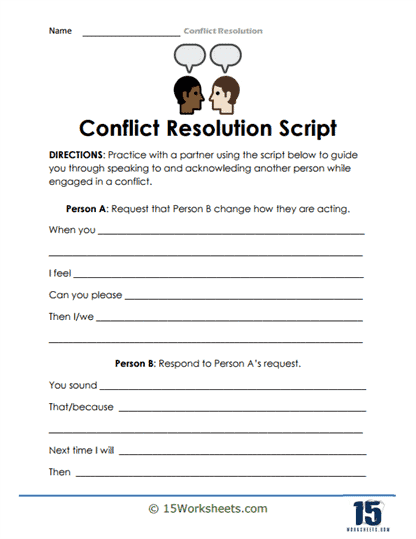
For more complex, recurring check-ins, a formal framework like R.A.D.A.R.S. is even more powerful. It explicitly includes a step for listing discussion topics in writing between meetings to form an agenda.
Relationships R.A.D.A.R.S - HackMD
This document outlines the R.A.D.A.R.S. framework, a structured communication tool adapted from agile project management for relationships. It institutionalizes Kidlin's Law.
Focus on two key parts of the process that embody this principle: The step of "A: Agreeing on Discussion Topics", where partners review a written list of potential issues. The final step, "S: Sharing potential topics as they emerge", which involves explicitly identifying and writing down issues to be discussed later.
Let's walk the husband through this process.
Step 1: The Vague Feeling
- A general sense of "unease" and "disconnection."
Step 2: Use a Framework to Identify the Specifics
The husband reflects, perhaps using the "When you..." prompt from the script. He realizes the feeling intensifies around a specific event.
- What is happening when I feel this? It happens when plans change.
- What specific plans? Our scheduled date nights.
- What is the change? They are sometimes postponed or cancelled because of a spontaneous plan his wife makes with her lover.
Step 3: Write the Clear, Actionable Problem Statement
Using this reflection, he can now formulate a clear statement, either for himself or to add to a shared R.A.D.A.R.S. agenda.
- Initial Vague Feeling: "I'm feeling disconnected."
- Clear, Written Problem (using the script's format): "When our date nights are rescheduled last-minute, I feel like my time with you isn't a priority, which makes me feel disconnected. Can you please work with me to find a way to protect our one-on-one time from last-minute changes? Then I/we can feel more secure in our time together."
This written statement is half the solution. It is:
- Specific: It names the trigger (rescheduling date nights).
- Neutral: It uses "I feel" statements, avoiding blame ("You always cancel on me").
- Outcome-focused: It proposes a goal (protecting one-on-one time).
The problem is no longer an ambiguous cloud of "unease." It is a concrete logistical and emotional issue that the partners can now address directly. They can discuss scheduling policies, confirmation timelines, or ways to reconnect if a change is unavoidable. The path to a solution is clear because the problem itself is clear.
Conclusion
Today we explored Kidlin's Law, a simple but powerful principle for problem-solving. By forcing ourselves to articulate a problem in writing with clarity and precision, we transform it from an intimidating unknown into a manageable task.
Key Takeaways:
- Kidlin's Law: The act of writing a problem down clearly is a significant step toward solving it. The primary hurdle is often ambiguity, not complexity.
- The Process: To apply the law, move from a vague feeling or complaint to a specific, neutral, and outcome-focused problem statement.
- Structured Tools: Frameworks like checklists (for a technical problem like bra fitting) or communication protocols like R.A.D.A.R.S. (for an emotional problem) provide the necessary structure to achieve this clarity. They are practical implementations of Kidlin's Law.
In our next lesson, we will address the logical next question: once you have a list of clearly defined problems, which one do you solve first? We will apply the Eisenhower Matrix to prioritize tasks and relationship needs based on their urgency and importance.