Welcome back. In our last lesson, we navigated the complexities of Briffault's Law, contrasting its rigid principle of benefit-driven association with the more nuanced reality of mutual choice in human relationships. We saw how the perception of benefit can drive behavior in both business and polyamory.
Today, we transition from a social-anthropological model to a biological one. Your learning objective is to apply Hamilton's Law of kin selection to explain altruistic investment in a family business and to contrast this with the non-genetic mechanisms required for altruism in a vee relationship. This law provides a surprisingly powerful mathematical framework for understanding why we are often kinder to our relatives than to strangers.
Hamilton's Law: The Genetic Calculus of Altruism
At its heart, evolution seems to favor selfish behavior. So why does altruism exist at all? In 1964, biologist W.D. Hamilton proposed a solution: kin selection. The core idea is that an individual can pass on their genes not only by reproducing themselves, but also by helping their genetic relatives survive and reproduce. This concept of "inclusive fitness" is governed by a simple, elegant inequality known as Hamilton's Rule:
Where:
- is the coefficient of relatedness (the proportion of genes shared by descent).
- is the benefit to the recipient of the altruistic act.
- is the cost to the altruist.
An altruistic act is evolutionarily favored if the genetic benefit outweighs the individual cost. To formalize this, let's turn to a paper that provides an excellent overview of the concept and its key parameters.
[PDF] Evolutionary Influences on Assistance to Kin: Evidence from the ...
This article by Andrew J. Cherlin uses data from the Panel Study of Income Dynamics to test the predictions of Hamilton's Rule. It offers a clear and concise explanation of the theory.
Please read the section titled Evolutionary Theories. Focus on the distinction between lineal and collateral kinship, the formal definition of Hamilton's rule, and, crucially, the values of the coefficient of relatedness (r) for different relatives (e.g., children, siblings, cousins).
As a statistician and social researcher, you'll recognize the power of this framework. It transforms a qualitative behavior—altruism—into a quantifiable model based on probabilistic relatedness. The values are key:
- Identical twins:
- Parents, children, full siblings:
- Grandparents, grandchildren, half-siblings, nephews/nieces:
- First cousins:
- Unrelated individuals:
With this model, we can now analyze our two scenarios.
Application 1: Inheritance in a Family Lingerie Business
Imagine the founder of a successful lingerie brand is nearing retirement. She must decide who will inherit the company. Her two potential heirs are:
- Her son (), who is a passionate but mediocre designer.
- Her nephew (), who is a brilliant designer and business manager.
From a purely business perspective, giving the company to the nephew is the logical choice. But Hamilton's Law reveals a more complex calculation. The founder's "inclusive fitness" is at stake. The following paper models this exact trade-off.
[PDF] Kin altruism, governance, and inheritance in the family firm
This paper by Thomas Noe develops a theory of family firm governance based on kin altruism. It formalizes Hamilton's concepts into a model of economic decision-making.
First, read the initial paragraphs of the Introduction to understand how the paper applies Hamilton's Rule to family firms. Pay attention to the definition of inclusive fitness and the Hamilton's rule formula. Next, jump to Section 3.1, "Preferences". This section formalizes the concept with a utility function incorporating a kinship scalar, h (which is equivalent to our r). Focus on the equation for utility, which you'll recognize as a direct application of the principle. Finally, read the beginning of Section 8, "Inheritance from the founder". This frames the exact problem we are considering. Read from the start of the section down to where the author describes the founder's dilemma.
Analysis:
The founder's decision is not a simple choice between son and nephew. It's an optimization problem to maximize her own inclusive fitness. Let's apply the rule: .
-
Option 1: Bequeath to the Son.
- The genetic relatedness is high ().
- The son receives the benefit () of owning the company.
- However, because he is a mediocre designer, the company may falter. This reduces the total value of the firm, which in turn reduces the long-term benefits that can flow to the founder's entire genetic lineage.
-
Option 2: Bequeath to the Nephew.
- The genetic relatedness is lower ().
- The nephew's superior skill means the firm will likely thrive, creating a much larger pool of wealth (). This benefit can potentially flow to many family members, including the founder's direct descendants, through dividends or jobs.
- The cost () to the founder is the opportunity cost of not directly enriching her son.
Hamilton's Law suggests a third, more "altruistic" investment strategy. The founder could bequeath control of the company to the more competent nephew, but assign a significant non-controlling financial stake (e.g., shares that pay dividends) to her son.
In this scenario:
- The nephew's competence ensures the benefit () is maximized for the entire family system.
- The son is provided for, satisfying the founder's genetic interest in her closer relative ().
- The cost () to the founder's inclusive fitness is minimized, as both the firm and her direct heir are secured.
This is a "harsh" altruism, as the Noe paper notes. The son's ego or desire to run the company is sacrificed for the greater genetic good of the family line. It's a strategic investment, not a purely emotional one.
Application 2: Altruism in the Polyamorous Vee
Now consider our Vee relationship: a husband, a wife, and the wife's male lover. The husband and lover are genetically unrelated (). Therefore, according to Hamilton's Law, the condition can never be met. Any altruistic act from the husband toward the lover (e.g., giving him advice, offering emotional support, willingly sharing his wife's time) cannot be explained by kin selection.
So, why would it happen? We must look for non-genetic mechanisms.
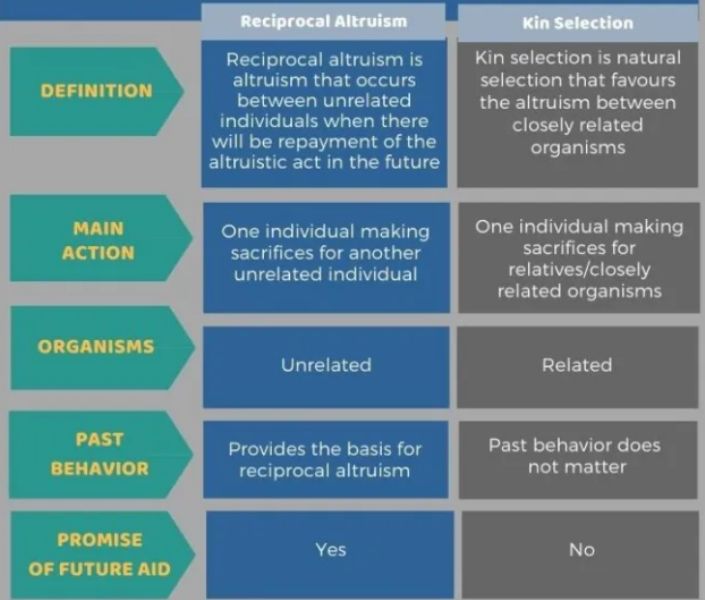
The following video from psychologist Paul Bloom elegantly distinguishes between kin selection and two other powerful drivers of kindness.
Evolution explains kindness—even when it kills us | Paul Bloom
This video provides clear, concise explanations for three distinct evolutionary paths to kindness, only one of which is based on genetics.
Please watch the following key segments: Kin Selection: This will serve as a quick review of the concept we've been discussing. Reciprocal Altruism: This is the primary non-genetic mechanism relevant to our Vee scenario. It's based on the principle of "I'll scratch your back if you scratch mine." Principled Altruism: This third mechanism explains kindness based on abstract moral principles (e.g., the Golden Rule), which is crucial for building stable, ethical relationships with non-kin.
Analysis:
The husband's altruism toward his wife's lover is a perfect illustration of the non-genetic mechanisms Bloom describes.
-
Reciprocal Altruism: This is the most direct explanation. The husband's altruism is not a free gift; it's part of an unspoken (or explicit) exchange.
- The Husband's "Cost" (): He expends emotional energy, tolerates potential jealousy, and gives up time with his wife.
- The Husband's "Benefit" (): In return, his wife is happy, fulfilled, and feels supported, which strengthens their primary relationship. The lover, appreciative of the husband's support, likely treats the wife well and respects the boundaries of the primary relationship. The stability and happiness of the husband's marriage is the benefit he receives from his "altruistic" investment in his metamour.
-
Principled Altruism: The husband may also be acting based on an ethical framework he has consciously adopted. In polyamorous communities, this is often related to the concept of compersion: the feeling of joy in a partner's joy and fulfillment with another person. This is a form of Bloom's "impartial thinking" or "golden rule," applied to relationships. The husband acts kindly not for a direct tit-for-tat return, but because he believes it is the right and ethical way to behave within his chosen relationship structure. This principle guides his actions and helps build a stable, trusting environment for all three individuals.
This contrasts sharply with the family business scenario. The founder's decision is guided by an unconscious genetic calculus. The husband's decision is guided by conscious, negotiated social contracts and abstract ethical principles.
Conclusion
Today we explored Hamilton's Law, a fundamental principle of evolutionary biology that provides a mathematical basis for understanding altruism among relatives.
Key Takeaways:
- Hamilton's Law (): This rule predicts that altruism is evolutionarily favored when the benefit to the recipient (), weighted by genetic relatedness (), exceeds the cost to the altruist ().
- Application to Family Business: In the context of a family firm, this law explains why a founder might make a "harsh" but strategic inheritance decision—such as giving control to a more distant but competent relative—to maximize the long-term success of the firm and, by extension, their own inclusive fitness.
- Contrast with Non-Kin Relationships: In a polyamorous vee where key members are unrelated (), Hamilton's Law does not apply. Altruism in this context must be explained by non-genetic mechanisms like reciprocal altruism (mutual benefit and exchange) and principled altruism (adherence to a shared ethical code like compersion).
We have now seen how deeply complex the motivations behind our decisions can be, whether driven by genetic calculus or conscious ethics. In our next lesson, we will pivot from the why of decision-making to the how of problem-solving. We'll begin a new module by exploring Kidlin's Law, which posits that if you can write a problem down clearly, the matter is already half solved—a crucial first step before any of the complex analyses we've done today can even begin.