Welcome back. In our previous lesson, we examined the structural limits of social networks through the lens of Dunbar's Number, understanding that our capacity for maintaining relationships is finite and layered. We saw how this principle governs the sustainable architecture of both a client base and a polyamorous network.
Today, we shift our focus from the macro-structure of networks to the micro-dynamics of power and influence within individual relationships. Your learning goal is to apply Briffault's Law to critically analyze its claims about female influence on association, applying it to client-retailer loyalty and power dynamics in a modern vee relationship. This law is one of the more provocative and frequently misinterpreted principles in our course, making a critical approach essential.
Briffault's Law: A Contentious Principle
Robert Briffault, a social anthropologist, formulated his law in his 1927 work, The Mothers. It states:
"The female, not the male, determines all the conditions of the animal family. Where the female can derive no benefit from association with the male, no such association takes place."
At first glance, this appears to be a stark, unilateral statement about power dynamics. However, applying it to human relationships requires immediate and significant critical distance. As a social researcher, you are well-acquainted with how models developed in one domain can be problematically overextended to another. Let's start by contextualizing the law with a modern critique.
[PDF] PRESUMPTION OF MALE DISPOSABILITY IS BASED ON FLAWED ...
This article from New Male Studies directly addresses and refutes the common, simplistic application of Briffault's Law to humans.
Please read the section that begins with the claim about women as "gatekeepers." The author introduces Briffault's Law here. The crucial point is the refutation immediately following it: the text clarifies that humans are more accurately described as a "mutual mate choice" species. This concept is the key to critically analyzing the law, rather than just applying it at face value.
The core takeaway is that while Briffault's Law may describe dynamics in certain non-human species, its direct application to human interaction is a fallacy. Humans engage in mutual mate choice, where both parties evaluate, select, and set conditions for association. With this critical framework in place, we can now explore how the spirit of the law—the idea that association hinges on perceived benefit—manifests in your areas of interest, while remembering its limitations.
Application 1: Client Loyalty in a Lingerie Business
Let's model the client-retailer relationship using this law. Here, the client can be seen as the "female" and the lingerie business as the "male" in Briffault's equation. The "association" is the client's continued patronage and loyalty.
A naive application of the law would suggest that the client unilaterally determines all conditions. If she perceives no benefit—if the bra doesn't fit, the quality is poor for the price, or the service is lacking—the association is terminated. She simply takes her business elsewhere. To maintain the association, your business must provide a clear and compelling benefit package:
- Tangible Benefit: A well-fitting, comfortable, and beautiful garment.
- Intangible Benefit: Increased confidence, feeling understood, a positive purchasing experience.
From this perspective, Briffault's Law acts as a blunt reminder of consumer power. The client's perceived benefit is paramount.
However, our critical lens reveals a more complex, mutual dynamic. The business is not a passive entity. You also choose your clients and set conditions:
- Pricing: You determine the cost, which is a primary condition of the association.
- Policies: You set the rules for appointments, custom orders, and returns.
- Client Selection: You might choose to "fire" a client who is consistently abusive to staff, makes unreasonable demands, or fails to respect your time. This is your side of the "mutual choice" equation.
Analysis:
Briffault's Law is useful here not as an absolute rule, but as a hyperbolic corrective to a business-centric viewpoint. It forces the question: "What is the non-negotiable benefit the client must receive for this relationship to continue?" While the association is a two-way street, in a competitive market, the power to exit is often most easily exercised by the customer. The law serves as a stark reminder to remain focused on delivering value as defined by the client.
Application 2: Power Dynamics in a Polyamorous Vee
Now let's turn to the specified Vee relationship, consisting of a husband, a wife, and the wife's lover. The dynamics of power, benefit, and influence are far more intricate here.
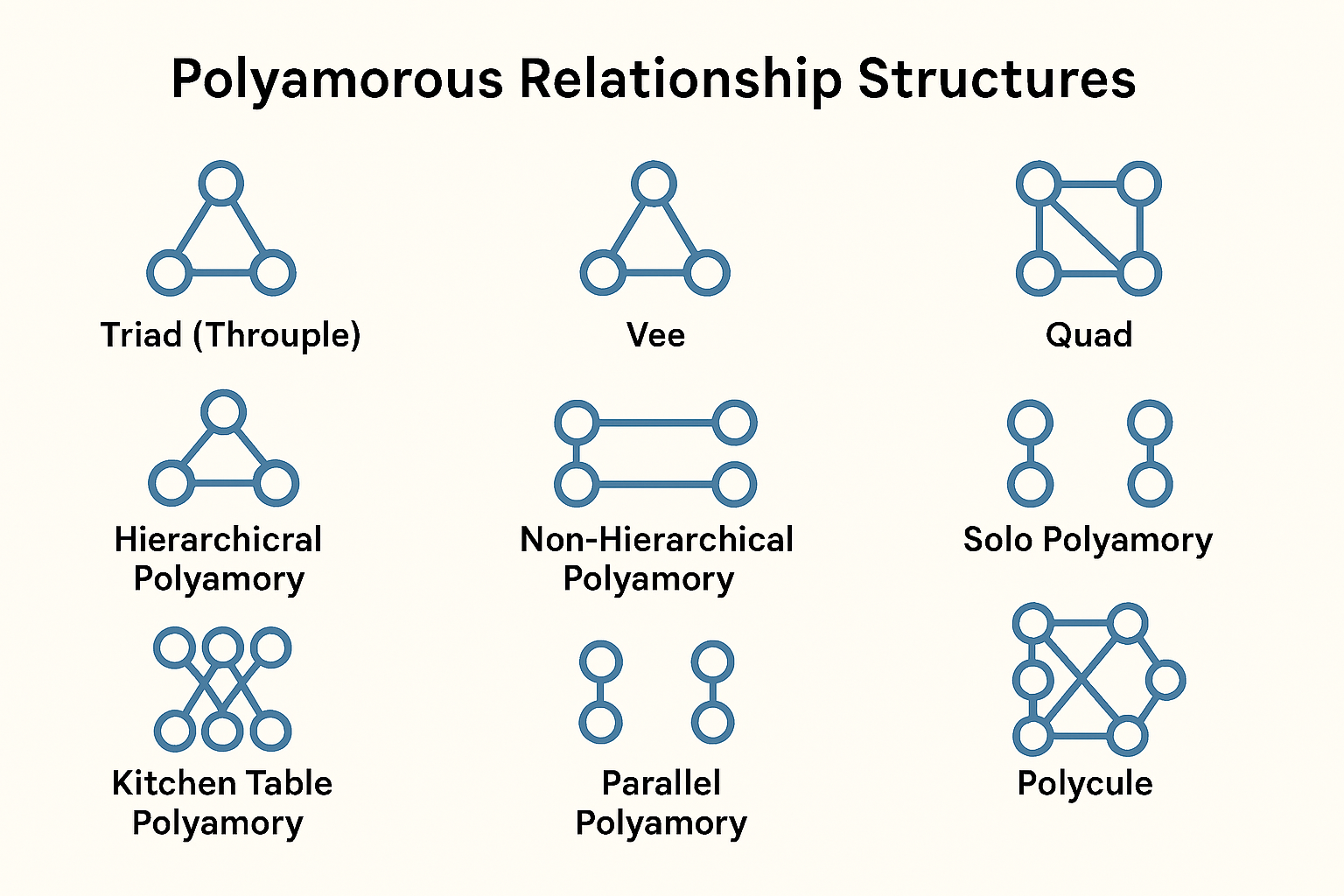
To ground our analysis, we will use a real-world case study from a polyamory discussion forum. It perfectly encapsulates the negotiation of "conditions of association."
Hierarchical vee relationship or not - Polyamory
This forum thread details a Vee relationship where the wife (A) and her new metamour (Terrsha, the secondary partner) are negotiating the structure of their relationships with the hinge partner (J).
Read the initial post from Terrsha. Note how the wife, 'A', initially rejects hierarchy but then requests it, seeking to formalize her primary status. She is attempting to "determine the conditions" of the family. Skim the replies, particularly from 'Inyourendo' and 'GreenAcres'. They highlight that labels can be about control. Read Terrsha's follow-up, where she reveals 'A' wants the power to veto her time with J. This is a direct and powerful attempt to set conditions based on her own need for the "benefit" of security. Finally, read the posts by 'kdt26417' and 'AspiringChill', and Terrsha's conclusion. They discuss how hierarchy is often unavoidable and that the hinge partner, J, is mistakenly aiming for equality where practicalities create inherent inequality.
Analysis:
This case study is a masterful illustration of the tension between Briffault's Law and the principle of mutual choice.
-
The Wife ('A') as a Briffault Figure: 'A' is acting as the classic "female" of Briffault's Law. She is experiencing a deficit of benefit (her emotional security is compromised by jealousy). In response, she attempts to redefine the "conditions of the animal family" by instituting a formal hierarchy and demanding veto power. Her implicit position is that if this benefit is not granted, the entire association (the peaceful functioning of the Vee) is at risk.
-
Mutual Choice in Action: However, her power is not absolute. The husband, 'J', is pushing back. He is exercising his choice, refusing to accept conditions that he feels invalidate his other relationship. Terrsha, the new partner, is also a party to the negotiation. She finds a "benefit" in the secondary role because it provides clarity and reduces her own jealousy, so she agrees to the association under those terms. If she did not find that beneficial, she would exit.
-
"Benefit" is Probabilistic and Subjective: Your background as a statistician gives you a unique lens here. "Benefit" is not a deterministic variable. It's a complex, subjective assessment unique to each person. For 'A', the benefit is security. For 'J', it's the freedom to love multiple people. For Terrsha, it's the connection with 'J' within a structure she finds comprehensible. Briffault's Law collapses this rich matrix of desires into a single, unilateral calculus. The reality, as shown in the forum, is a multi-agent system where each individual is optimizing for their own perceived benefit, leading to complex negotiations, not a simple decree.
Briffault's Law, when applied critically, doesn't give us the answer, but it directs our attention to the right question: Who feels they are not receiving sufficient benefit, and what conditions are they trying to impose as a result? In the Vee, the wife's distress makes her the most active agent in attempting to redefine the system's rules.
Conclusion
Briffault's Law is a powerful but crude instrument. Its value lies not in its literal truth for human relationships, but in its ability to highlight the central role of perceived benefit in the stability of any association.
Key Takeaways:
- The Law and its Rebuttal: Briffault's Law states the female determines the conditions of association based on benefit. However, it was formulated for non-human animals; humans operate under a more complex system of mutual mate choice.
- In Business: The law serves as a potent, if exaggerated, reminder of consumer power. The client's perceived benefit is a critical driver of loyalty, but the business also has agency in setting its own conditions.
- In Polyamory: The law can help identify which partner, feeling a lack of benefit (e.g., security), is attempting to exert influence and change the relationship's rules. It illuminates power dynamics but is insufficient to describe the multi-directional negotiations that characterize real human relationships.
In our next lesson, we will continue exploring the biological underpinnings of social behavior by turning to Hamilton's Law. This will shift our perspective from the anthropological view of association to the genetic calculus of altruism, offering a different but equally compelling model for why individuals invest in some relationships over others.