Welcome to the next lesson in our exploration of eponymous laws and principles. In our last session, we delved into the Peltzman Effect, a counterintuitive concept showing how perceived safety can encourage riskier behavior, sometimes negating the benefits of the safety measures themselves. We saw how this could apply to both a "guaranteed comfort" bra and a detailed polyamorous relationship agreement.
Today, we shift our focus from the management of risk to the architecture of motivation. This lesson introduces the Premack Principle, a powerful tool for behavior change. Your goal is to apply this principle to two distinct challenges: first, to structure a lingerie design workflow to enhance productivity, and second, to facilitate the negotiation of time and responsibilities within a vee relationship by linking less-preferred tasks to desired activities.
The Premack Principle: "Grandma's Rule"
At its heart, the Premack Principle is an elegant formalization of a timeless piece of folk wisdom, often called "Grandma's Rule": "First, eat your vegetables, and then you can have dessert." It suggests that a more probable or preferred behavior can be used as a reinforcer for a less probable or less preferred behavior.
The psychologist David Premack framed this as a "probability-differential hypothesis." From a statistical perspective, you can think of it this way: if we observe an individual in a state of free choice, we can measure the probability of them engaging in various activities. The activities with a higher probability can be made contingent upon the completion of activities with a lower probability to increase the frequency of the latter.

To ground this in its original context, let's look at a study that applied the principle in a workplace setting.
[PDF] Application of the Premack Principle of reinforcement to the quality ...
This research paper provides the formal definition of the Premack Principle and its theoretical underpinnings.
First, read the Abstract to get an overview of the study. Notice how it defines the principle: "for any pair of activities, the more probable or valued one will reinforce the less probable or less valued one." Next, read the section Time-Based Reinforcement. This part explains Premack's "probability-differential hypothesis" and makes a key point: the value an individual places on an activity can be objectively measured by the amount of time they freely choose to spend on it. This provides a clear, empirical basis for identifying potential reinforcers.
The core idea is that rewards don't have to be external things like money or praise. The opportunity to engage in an activity you already enjoy is a powerful, built-in motivator.
Application 1: Structuring the Lingerie Design Workflow
Let's consider your work as a lingerie designer. Your workflow likely contains a mix of tasks that fall into two categories:
- High-Probability Behaviors (The "Dessert"): These are the tasks you enjoy and would readily do. This might include sketching new designs, sourcing beautiful fabrics, creating mood boards, or draping a new silhouette on a mannequin.
- Low-Probability Behaviors (The "Vegetables"): These are the necessary but tedious tasks. This could involve updating inventory spreadsheets, responding to difficult client emails, performing pattern grading across a dozen sizes, or bookkeeping.
Left to our own devices, we naturally drift toward the "dessert" tasks, and the "vegetables" pile up, creating stress and production bottlenecks. The Premack Principle offers a structured way to solve this. You can design a personal workflow where access to a block of high-probability activity is earned by completing a specific low-probability task.
For example:
- "After I complete the pattern grading for the new balconette bra (low-probability), I will spend two hours sketching ideas for the next collection (high-probability)."
- "Once I have cleared my client email inbox to zero (low-probability), I can spend the rest of the afternoon fabric shopping (high-probability)."
To make this systematic, you can use a behavioral contract. This is a formal agreement with yourself (or with a partner, for accountability) that clearly outlines the contingency.
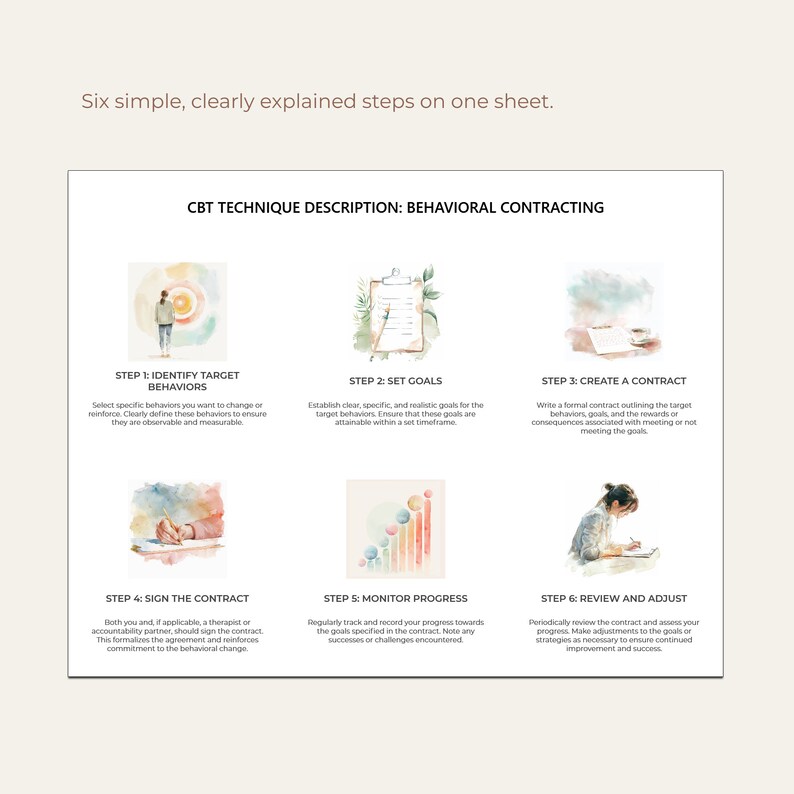
Let's walk through these steps for your design workflow:
- Identify Target Behaviors: The low-probability behavior you want to increase (e.g., "completing weekly inventory audit").
- Set Goals: Make it specific and measurable (e.g., "finish the full audit by Friday at noon").
- Create a Contract: Define the contingency explicitly. "If the inventory audit is completed by Friday at noon, then I will take Friday afternoon to work on my new experimental lace-up bra design."
- Sign the Contract: This small formality increases commitment.
- Monitor Progress: Track your completion of the target behavior.
- Review and Adjust: Assess if the reward is motivating enough or if the goal is realistic. Perhaps the reward needs to be more immediate or more potent.
This approach transforms dreaded tasks from obstacles into gateways for the creative work you love, leveraging your own motivation as a resource. It directly mirrors the intervention in the research paper, where employees earned the right to work at their favorite station by improving quality at a less-favored one.
Application 2: Negotiating Time and Chores in a Vee Relationship
Now, let's apply this principle to the vee relationship, where the wife is in a relationship with both her husband and a lover. A common challenge in polyamorous dynamics is the allocation of time, energy, and household responsibilities. The goal is to ensure all relationships are nurtured and practical life runs smoothly, which can be a source of significant friction.
-
Low-Probability Behaviors: These are the necessary but potentially draining tasks of relationship maintenance. Examples include:
- Household chores (laundry, cooking, cleaning).
- "Life admin" conversations (planning budgets, scheduling appointments).
- Emotionally laborious check-ins, especially when navigating jealousy or insecurity.
- The meta-task of scheduling and negotiating time itself.
-
High-Probability Behaviors: This is the "reward" – the things that actively nurture the connection. Crucially, as the article "Polyamorous Time" explains, this is not just any time spent in proximity, but intentional quality time. This must be defined by the partners but could include:
- A scheduled, phone-free date night.
- A shared hobby or activity.
- A weekend trip.
- Intimate, focused conversation that isn't about problem-solving.
The Premack Principle provides a collaborative, non-coercive framework for negotiation. Instead of chores being a source of resentment, they become the "work" that earns a shared "reward."
Consider the husband and wife (the nesting partners). They could structure their week this way:
- "If we tackle the deep clean of the kitchen together on Saturday morning (low-probability), we'll go on that hike and have a picnic, just the two of us, in the afternoon (high-probability)."
- The husband might find the weekly schedule-sync, which involves discussing his wife's dates with her lover, to be emotionally taxing. They could agree: "Let's have our scheduling talk for 30 minutes on Sunday evening. Once it's done, we'll open that special bottle of wine and watch a movie together."
This links the difficult but necessary conversation to an immediate, relationship-affirming reward. It contains the low-probability task within a structure that leads directly to a high-probability outcome, making the entire process feel more like teamwork and less like a chore.
The following article offers excellent insight into identifying what constitutes "quality time" – the essential reward component for this to work in a relationship context.
Polyamorous Time: Needs and Expectations
This article from readyforpolyamory.com explores the nuances of time management in non-monogamous relationships, which is the perfect foundation for applying the Premack Principle.
First, read the introduction to understand the core challenge of "Polyamorous Time." Next, read the section defining "intentional time." This is critical for identifying the high-probability behaviors that can serve as effective reinforcers. Then, focus on the section for nesting partners. It gives concrete examples of how to schedule and protect quality time, which is the "reward" in your Premack-based negotiation. Finally, review the summary points under the final heading. These are actionable steps that align perfectly with creating a behavioral contract.
By explicitly defining and scheduling both the "vegetables" (chores, admin) and the "dessert" (quality time), and making one contingent on the other, partners can co-create a system that fosters both responsibility and connection.
Conclusion
The Premack Principle offers a simple yet profound shift in perspective on motivation. By recognizing that the opportunity to do something we enjoy is itself a powerful reinforcer, we can design systems for ourselves and our relationships that encourage productive and cooperative behavior.
Key Takeaways:
- The Premack Principle: A more preferred (high-probability) activity can be used to reinforce a less preferred (low-probability) activity.
- Identifying Reinforcers: The value of an activity can be determined by how much time an individual freely chooses to spend on it. The best rewards are often activities we already love.
- Application in Lingerie Design: Structure your workflow by making enjoyable creative tasks contingent on the completion of necessary administrative or tedious tasks. Use a behavioral contract to formalize this.
- Application in Polyamory: Negotiate shared responsibilities and difficult conversations by linking them to mutually defined, high-value "intentional quality time." This turns chores into a collaborative path toward connection.
In our next lesson, we will broaden our scope from individual motivation and dyadic negotiation to the structural limits of social groups. We will explore Dunbar's Number, a principle that suggests a cognitive limit to the number of stable social relationships a person can maintain, a concept with direct implications for both a growing client base and an expanding polyamorous network.