Welcome to your next lesson. In our previous session, we explored the Diderot Effect, observing how a single new acquisition—be it a bra or a partner—can trigger a cascade of changes aimed at creating a new, coherent identity. Today, we shift from the psychology of consumption and identity to the paradoxes of risk and safety.
This lesson focuses on the Peltzman Effect, the counterintuitive principle that safety measures can sometimes encourage riskier behavior, thereby offsetting their intended benefits. Your objective is to apply this concept to two distinct scenarios: first, to illustrate how marketing a bra as "guaranteed comfortable" might lead a client to neglect proper fit, and second, to show how the perceived safety of established rules in a vee relationship can paradoxically encourage riskier emotional conduct.
The Paradox of Safety
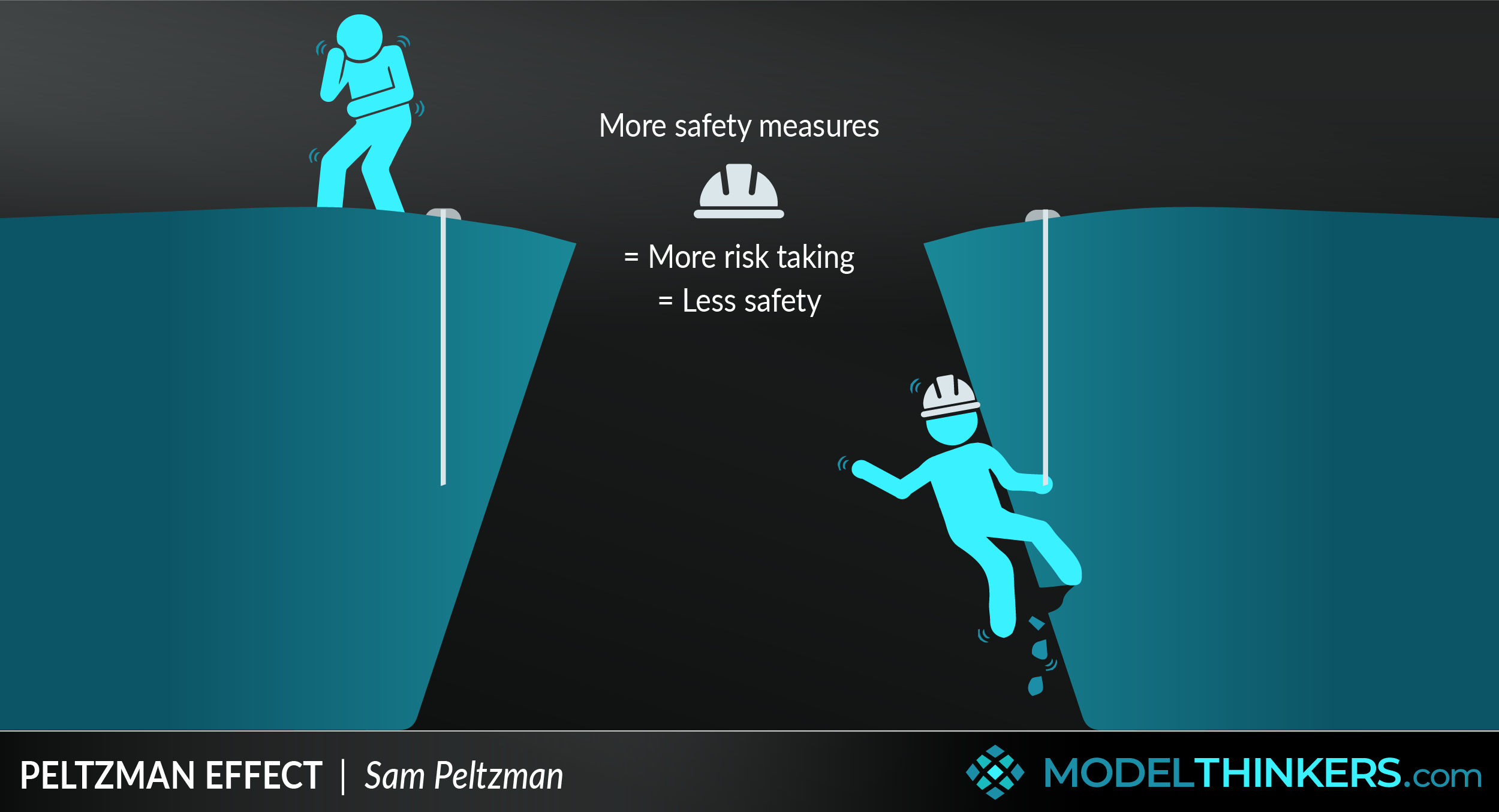
The Peltzman Effect, also known as risk compensation, suggests that humans have a target level of risk they are comfortable with. When an external change makes an activity feel safer, we tend to adjust our behavior to return to our personal risk "set point." This often involves taking more chances than we would have otherwise.
The theory is named after economist Sam Peltzman, whose 1975 study on automobile safety regulations sparked a long-running debate.
The Wikipedia article on Risk Compensation provides a concise introduction to the concept and its history.
Start by reading the introductory definition. Then, read the section on the Peltzman effect, noting Peltzman's original controversial claim and the subsequent finding that the effect, while real, is often partial.
The core idea is that the net safety benefit of a new measure is not simply its direct technical improvement, but that improvement minus the increase in risky behavior it induces.
A Formal Look at Risk-Taking
Given your background in statistics, you may appreciate a more structured model of this trade-off. We can think of a decision-maker (a driver, a lingerie buyer, a person in a relationship) balancing the utility of a "risky" action against its potential negative consequences.
The Effective Altruism Forum post "Notes on risk compensation" presents a model where an agent chooses a level of "capability" or activity, , which provides utility but also increases risk. The probability of a good outcome ("survival"), , depends on both and the amount of safety work, . An increase in (e.g., a better braking system) makes it "cheaper" to pursue higher levels of (e.g., drive faster) for a given level of risk.
Notes on risk compensation — EA Forum
This article models the economic intuition behind risk compensation. We will focus on the conceptual framework rather than the mathematical details.
Read the Introduction to get the basic definition and classic examples. Skim the section An AI lab's preferences. The key idea is that expected utility is the product of the probability of a good outcome and the utility gained from the action. Now, read the Result section carefully. This is the core of the argument. Pay attention to the variable k, which represents the value of life without the risky activity. The model shows that if k > 0 (life is worth living without the risky action), increasing safety S can actually make the agent take so much more risk C that the overall probability of a bad outcome increases. Finally, read the sections on the importance of unbounded utility and the key Takeaways. This explains why the effect isn't always total in the real world: the potential rewards of risk-taking are often bounded.
The most counterintuitive but crucial insight is that when an activity is initially perceived as very dangerous, many people avoid it entirely. Making it moderately safer might convince them to engage in it, thus moving from zero risk exposure to some risk exposure. This can lead to a net increase in total accidents, even if the accident rate per unit of activity has decreased.
Application 1: The "Guaranteed Comfortable" Bra
Let's apply this to lingerie design and marketing. Imagine your brand develops a new underwire technology or strap material and decides to market it with the powerful promise: "Guaranteed all-day comfort, no slipping or digging."
- The Safety Measure: The marketing guarantee and the underlying technology. This is equivalent to installing anti-lock brakes (ABS) in a car.
- Perceived Risk Reduction: The client's perceived risk of purchasing a bra that turns out to be uncomfortable, ill-fitting, or requires constant adjustment is significantly lowered. The "guarantee" acts as a psychological safety net.
- Risk Compensation Behavior: Feeling protected by the guarantee, the client may adjust her typical purchasing behavior.
- Less Diligence in Fitting: She might spend less time in the fitting room, ignoring subtle red flags. A band that feels a little too snug or cups that show slight gapping might be dismissed with the thought, "The technology will handle it; it's guaranteed to be comfortable." She is, in effect, driving faster and following the car ahead more closely because she trusts the ABS to save her.
- Boundary Pushing: She might purchase the bra for a specific, demanding purpose, like a wedding or a long flight, without giving it a proper "test drive" during a normal day. She compensates for the perceived safety by taking a greater risk with the context in which she wears it.
- The Outcome: The client buys a bra that is, in fact, a poor fit. The "no-slip" straps might not slip, but the ill-fitting band rides up, causing back pain. The "guaranteed comfort" underwire, strained against the wrong part of her sternum, begins to chafe intensely after a few hours. The net result is that the client is less comfortable than if she had purchased a standard bra with her usual level of diligence. The safety measure has induced behavior that completely nullifies, or even reverses, its benefit.
This is a direct parallel to the classic examples of risk compensation.
The Wikipedia article provides concrete examples that mirror the lingerie scenario.
Read the sections on Anti-lock brakes, Bicycle helmets, and Ski helmets. In each case, a safety technology leads users to behave more recklessly, offsetting the intended gains.
Application 2: The Safety of Relationship Rules
Now, let's turn to the vee relationship. A husband and wife decide to open their marriage, and the wife begins a relationship with a lover. To manage the complexities and mitigate the inherent emotional risks (jealousy, insecurity, neglect), they create a comprehensive relationship agreement.
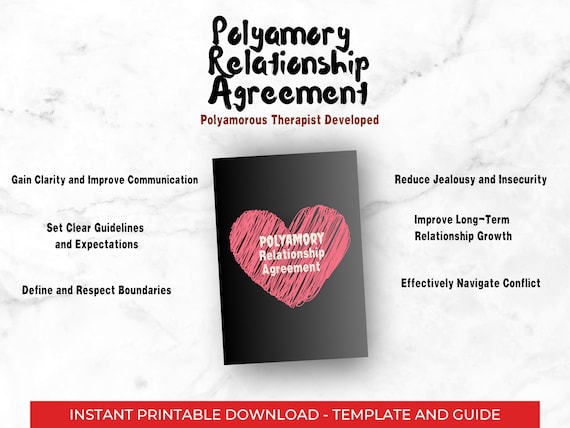
- The Safety Measure: The detailed relationship agreement. This document might include strict rules on scheduling, communication protocols (e.g., mandatory weekly check-ins), explicit boundaries on activities, and perhaps even "veto" power for the primary partners.
- Perceived Risk Reduction: The agreement creates a powerful illusion of control and predictability. The partners feel shielded from the most feared outcomes of polyamory. They believe they have a robust system that makes their non-monogamous exploration "safe."
- Risk Compensation Behavior: Feeling secure within the framework of their rules, one or more partners may engage in emotionally riskier behavior.
- Emotional Recklessness: The wife, feeling that the "rules" protect her marriage, might pursue a level of emotional intimacy or a pace of relationship escalation with her lover that she would have deemed too risky otherwise. She might think, "I can explore these intense feelings because our agreement has safety nets."
- Complacency and Neglect: The husband, feeling secure in the scheduled "date nights" and his theoretical "veto power," might not do the difficult, moment-to-moment emotional work of addressing his own insecurities. He relies on the system for safety instead of building genuine, resilient security through communication and self-reflection. He is "driving with less attention" because he trusts the car's safety features.
- The Outcome: This is a classic example of the
k > 0case from the formal model. The initial state (monogamy) is safe and acceptable. The risky activity (polyamory) is only undertaken because the "safety measure" (the agreement) makes it seem tenable. This very act introduces a new level of risk. A crisis inevitably occurs that the rules did not anticipate. Because the partners have been relying on the external rulebook instead of developing their internal skills of resilience and communication, the crisis is far more damaging than it would have been if they had proceeded more cautiously from the start. The safety agreement, by encouraging riskier behavior, has amplified the potential for catastrophic failure. This is analogous to how condom use or PrEP, while effective, can lead to a decrease in other safe-sex practices, potentially increasing the overall rate of other STIs.
Conclusion
The Peltzman Effect provides a crucial lens for evaluating any intervention designed to increase safety, whether it's a technical feature or a social contract. It reminds us that human behavior is not static and that our perception of risk is a powerful driver of our actions.
Key Takeaways:
- Peltzman Effect (Risk Compensation): When a system is made safer, people tend to behave more riskily, partially or sometimes fully offsetting the safety benefits.
- Mechanism: People have a target level of risk they are comfortable with. Perceived safety encourages them to take more chances to get more "utility" (speed, comfort, pleasure, emotional intimacy) while staying near their risk target.
- Application to Lingerie: A "guaranteed comfort" bra can lead clients to be less diligent during fitting, potentially resulting in a worse fit and more discomfort than if they had relied on their own judgment.
- Application to Polyamory: A detailed relationship agreement can create a false sense of security, encouraging partners to take greater emotional risks and neglect the ongoing work of communication, thereby increasing the potential for serious conflict.
In our next lesson, we will examine the Premack Principle. We will move away from risk and delve into motivation, exploring how a more preferred activity can be used as a powerful reward to encourage the completion of a less desired task.